


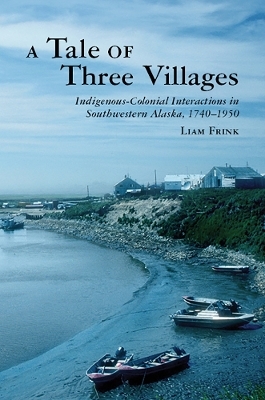
A Tale of Three Villages
Indigenous-Colonial Interactions in Southwestern Alaska, 1740–1950
Seiten
2025
University of Arizona Press (Verlag)
978-0-8165-5541-3 (ISBN)
University of Arizona Press (Verlag)
978-0-8165-5541-3 (ISBN)
People are often able to identify change agents. They can estimate possible economic and social transitions, and they are often in an economic or social position to make calculated- sometimes risky- choices. Exploring this dynamic, A Tale of Three Villages is an investigation of culture change among the Yup'ik Eskimo people of the southwestern Alaskan coast from just prior to the time of Russian and Euro-North American contact to the mid-twentieth century.
Liam Frink focuses on three indigenous-colonial events along the southwestern Alaskan coast: the late precolonial end of warfare and raiding, the commodification of subsistence that followed, and, finally, the engagement with institutional religion. Frink's innovative interdisciplinary methodology respectfully and creatively investigates the spatial and material past, using archaeological, ethnoecological, and archival sources.
The author's narrative journey tracks the histories of three villages ancestrally linked to Chevak, a contemporary Alaskan Native community: Qavinaq, a prehistoric village at the precipice of colonial interactions and devastated by regional warfare Kashunak, where people lived during the infancy and growth of the commercial market and colonial religion and Old Chevak, a briefly occupied 'stepping-stone' village inhabited just prior to modern Chevak. The archaeological spatial data from the sites are blended with ethnohistoric documents, local oral histories, eyewitness accounts of people who lived at two of the villages, and Frink's nearly two decades of participant-observation in the region.
Frink provides a model for work that examines interfaces among indigenous women and men, old and young, demonstrating that it is as important as understanding their interactions with colonizers. He demonstrates that in order to understand colonial history, we must actively incorporate indigenous people as actors, not merely as reactors.
Liam Frink focuses on three indigenous-colonial events along the southwestern Alaskan coast: the late precolonial end of warfare and raiding, the commodification of subsistence that followed, and, finally, the engagement with institutional religion. Frink's innovative interdisciplinary methodology respectfully and creatively investigates the spatial and material past, using archaeological, ethnoecological, and archival sources.
The author's narrative journey tracks the histories of three villages ancestrally linked to Chevak, a contemporary Alaskan Native community: Qavinaq, a prehistoric village at the precipice of colonial interactions and devastated by regional warfare Kashunak, where people lived during the infancy and growth of the commercial market and colonial religion and Old Chevak, a briefly occupied 'stepping-stone' village inhabited just prior to modern Chevak. The archaeological spatial data from the sites are blended with ethnohistoric documents, local oral histories, eyewitness accounts of people who lived at two of the villages, and Frink's nearly two decades of participant-observation in the region.
Frink provides a model for work that examines interfaces among indigenous women and men, old and young, demonstrating that it is as important as understanding their interactions with colonizers. He demonstrates that in order to understand colonial history, we must actively incorporate indigenous people as actors, not merely as reactors.
Liam Frink is a professor of anthropology at the University of Nevada, Las Vegas, where he researches Arctic indigenous-colonial history, ethnoecology, identity, and subsistence technology and production. He is the co-editor of Decolonizing Indigenous Histories: Exploring Prehistoric/Colonial Transitions in Archaeology.
| Erscheinungsdatum | 02.07.2025 |
|---|---|
| Reihe/Serie | Archaeology of Indigenous-Colonial Interactions in the Americas |
| Zusatzinfo | 21 halftones, 5 maps, 8 tables |
| Verlagsort | Tucson |
| Sprache | englisch |
| Maße | 152 x 229 mm |
| Gewicht | 454 g |
| Themenwelt | Geisteswissenschaften ► Archäologie |
| Sozialwissenschaften ► Ethnologie | |
| Sozialwissenschaften ► Soziologie | |
| ISBN-10 | 0-8165-5541-9 / 0816555419 |
| ISBN-13 | 978-0-8165-5541-3 / 9780816555413 |
| Zustand | Neuware |
| Informationen gemäß Produktsicherheitsverordnung (GPSR) | |
| Haben Sie eine Frage zum Produkt? |
Mehr entdecken
aus dem Bereich


aus dem Bereich
maternal health science and the reproduction of harm
Buch | Softcover (2024)
University of California Press (Verlag)
CHF 52,35
long-lasting legacies of colonialism and nationalism in Israel, …
Buch | Softcover (2025)
Vernon Press (Verlag)
CHF 109,95


