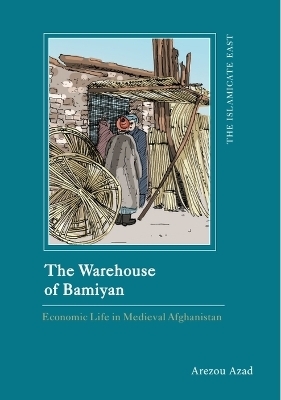
The Warehouse of Bamiyan
Edinburgh University Press (Verlag)
978-1-3995-4670-6 (ISBN)
- Noch nicht erschienen (ca. Januar 2026)
- Versandkostenfrei
- Auch auf Rechnung
- Artikel merken
Bamiyan, in present-day Afghanistan, is famous for its giant Buddhas, but what was life like for its rural inhabitants 500 years after the Muslim conquest? The Warehouse of Bamiyan uncovers the untold history of the region’s warehouse, revealing the lives of farmers, landholders, the taxes they paid, and their role in the economy. Based on newly discovered documents studied since the late 2010s, Arezou Azad details the reconstruction of the archive and the scholarly methods used behind the scenes to read medieval documents ‘against the grain.’ The book offers a fresh perspective on the medieval eastern Islamicate lands through the lens of medieval Bamiyan, highlighting the significance of agricultural societies and shedding light on the diverse roles of rural communities often overlooked in royal narratives.
Arezou Azad is Senior Research Fellow and Director of the Invisible East programme at the Department of Continuing Education at the University of Oxford. She is also Professor and Chair of the Arts and Heritage of Afghanistan at the Institut national des langues et civilisations orientales (Inalco) in Paris. She has authored four other peer-reviewed books: The Rise and Fall of the Barmakids (Edinburgh University Press, 2026), The Warehouse of Bamiyan: Economic Life in Medieval Afghanistan (Edinburgh University Press, 2025), Faḍāʾil-i Balkh or “The Merits of Balkh”, an annotated translation of a 13th-century history of Balkh (Edinburgh University Press, 2021) and Sacred Landscape in Medieval Afghanistan (Oxford University Press, 2013). Pejman Firoozbakhsh is a Research Associate at the University of Hamburg and a former member of the Invisible East programme at the University of Oxford. He is a linguist interested in the formation and development of early New Persian, West Iranian dialects, Persian codicology and textual criticism. Pejman Firoozbakhsh’s recent publications include “Manuscript of a Persian Qaṣīda from about the Year 400/1007”, in Bi yād-i Īraj Afshār, edited by Jawād Basharī (vol. 2. Tehran: Duktur Maḥmūd Afshār, 1402/2024, 661–72) (In Persian) and ‘The Story of Rustam and Suhrāb,’ by Abu al-Qāsim Firdawsī, edited by Jalal Khaleqi Motlaq (Tehran: Sokhan 2014; rev. 2020). He has also contributed to a book by Arezou Azad The Warehouse of Bamiyan: Economic Life in Medieval Afghanistan (Edinburgh University Press, 2025).
List of Illustrations
Note on the Invisible East Collection
Maps
Preface
Technical Notes
Dramatis Personae
Introduction: The Invisibility of People of the Medieval Islamicate East
1. Method, Aims and Sources
2. Assumption and Paradigms About Rural Administration and Land Management
3. The Warehouse
4. Landholding Patterns in Bamiyan
5. The Documentary and Archival Context
Conclusion: Uncovering Life Beyond the Palace Walls
Appendix: The Documents
Acknowledgements
Timeline of Ghurid Rulers, ca. 392-612/1000-1215
Timeline of Khwārazmshāhī Rulers During Ghurid Suzerainty, up to 628/1231
Glossary of Terms Used in the Bamiyan Papers
Bibliography
Subject Index
| Erscheint lt. Verlag | 31.1.2026 |
|---|---|
| Reihe/Serie | The Islamicate East: New Approaches to Texts and History |
| Co-Autor | Pejman Firoozbakhsh |
| Zusatzinfo | 82 illustrations (51 colour images including 1 colour map, 16 b/w images including 1 b/w map, 6 b/w tables and 9 b/w figures) |
| Verlagsort | Edinburgh |
| Sprache | englisch |
| Maße | 170 x 244 mm |
| Themenwelt | Geschichte ► Allgemeine Geschichte ► Mittelalter |
| Geisteswissenschaften ► Geschichte ► Regional- / Ländergeschichte | |
| Sozialwissenschaften ► Soziologie | |
| ISBN-10 | 1-3995-4670-8 / 1399546708 |
| ISBN-13 | 978-1-3995-4670-6 / 9781399546706 |
| Zustand | Neuware |
| Informationen gemäß Produktsicherheitsverordnung (GPSR) | |
| Haben Sie eine Frage zum Produkt? |
aus dem Bereich