


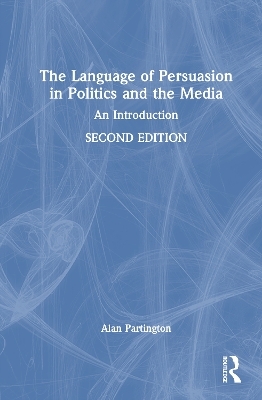
The Language of Persuasion in Politics and the Media
Routledge (Verlag)
978-1-032-66274-9 (ISBN)
This bestselling introductory textbook examines the relationship between politicians, the press and the public through the language they employ. Now fully revised with new material on delegitimisation, ‘fake news’, disinformation, (self-)censorship, ‘conspiracy theories’ and ‘Zombie’ narratives, key topics include:
Evaluation, the ‘engine’ of persuasion
‘Spin’, ‘spin control’ and ‘image’ politics
Models of persuasion, including authority, contrast, problem-solution, association, 'garden path'
Pseudo-logical and ‘post-truth’ arguments
Humour, irony and satire
Metaphors: use, misuse and dangers
Election rhetoric
Extracts from speeches, soundbites, newspapers and blogs, social media, interviews, press conferences, election slogans and satires are used to provide the reader with the tools to discover the beliefs, character and hidden strategies of the would-be persuader, as well as the counter-strategies of their targets. This book demonstrates how the study of language use can help us appreciate, exploit and protect ourselves from the art of persuasion.
With a wide variety of practical examples, on both recent issues and historically significant ones, every topic is complemented with guiding tasks, queries and exercises, with keys and commentaries at the end of each unit. This highly original textbook is ideal for all introductory courses on language and politics, media language, rhetoric and persuasion, discourse studies and related areas.
Alan Partington has been Professor of English Linguistics at the Universities of Camerino and Bologna, Italy, at the School of Political Science and the Department for Interpreters and Translators. He is the author of The Linguistics of Political Argument and The Linguistics of Laughter, both published by Routledge, and was the founding editor-in-chief of the International Journal of Corpora and Discourse.
List of figures and tablesPrefaceAcknowledgements
Unit 1: Politics, the media and us: The language of persuasion
Unit 2: But then along came social media …
Unit 3: Evaluation: What’s good and what’s bad
Unit 4: Evaluation by language choice: Selection and omission
Unit 5: Sounding good: Rhetorical effects in action: ‘Liberté! Egalité! Fraternité!’ (But not for all …)
Unit 6: Strategies of persuasion
Unit 7: High-risk tactics. Fooling and insulting your audience. The Garden Path technique
Unit 8: ‘Joined-up’ thinking: Propositional and evaluative cohesion
Unit 9: Dirty tricks: Really? Caveat emptor!
Unit 10: Dirty tricks? Perhaps: Dis/information wars, collusion with tyrants and conspiracy (theories)
Unit 11: The importance of importance marking in persuasion
Unit 12: Metaphors and company: The subtle persuaders
Unit 13: Questions and responses. Softball questions, hardball questions and how to handle them
Unit 14: Humour, irony and satire in politics
Unit 15: The language of referendum campaigns
Unit 16: The year of the six elections
Conclusion
Glossary
References
Index
| Erscheinungsdatum | 22.05.2025 |
|---|---|
| Zusatzinfo | 18 Tables, black and white; 5 Line drawings, black and white; 3 Halftones, black and white; 8 Illustrations, black and white |
| Verlagsort | London |
| Sprache | englisch |
| Maße | 156 x 234 mm |
| Gewicht | 870 g |
| Themenwelt | Geisteswissenschaften ► Sprach- / Literaturwissenschaft ► Sprachwissenschaft |
| Sozialwissenschaften ► Politik / Verwaltung | |
| ISBN-10 | 1-032-66274-3 / 1032662743 |
| ISBN-13 | 978-1-032-66274-9 / 9781032662749 |
| Zustand | Neuware |
| Informationen gemäß Produktsicherheitsverordnung (GPSR) | |
| Haben Sie eine Frage zum Produkt? |
aus dem Bereich


