


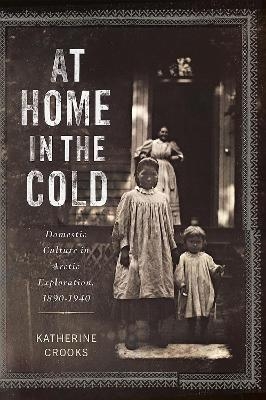
At Home in the Cold
Domestic Culture in Arctic Exploration, 1890–1940
Seiten
2025
McGill-Queen's University Press (Verlag)
978-0-2280-2561-0 (ISBN)
McGill-Queen's University Press (Verlag)
978-0-2280-2561-0 (ISBN)
At Home in the Cold brings to light the stories of five white and northern Indigenous women who travelled between the eastern Arctic and America between 1890 and 1940 in connection with exploratory expeditions. Their journeys and recollections challenged prevailing ideas about home, the North, and the rightful place of women.
In the late nineteenth and early twentieth centuries, the idea of home came into focus as a place of warmth and comfort, associated with interior spaces and feminine touches. In the same period, writing about the Arctic as a frigid and inhospitable landscape proliferated. American readers were fascinated by stories of Arctic exploration and supposedly heroic feats of survival by rugged white men. Moving across these opposing pictures were a handful of white and northern Indigenous women who travelled between the eastern Arctic and America from 1890 to 1940 in connection with exploratory expeditions. Their journeys and recollections challenged prevailing ideas about home, the North, and the rightful place of women.
At Home in the Cold brings to light the histories of five women involved in Arctic exploration. The stories of three white women explorers – Mina Hubbard, Josephine Peary, and her daughter, Marie Peary – reveal the importance of middle-class domestic ideology to understanding the history of Arctic exploration, as they sought to transform the Arctic into a more familiar environment. Their journeys are considered alongside the stories of two northern women – Eqariusaq, from Greenland, and Elizabeth Ford, born in Labrador – who travelled to the United States in connection with Arctic expeditions. They, too, made comparisons of eastern Arctic and American environments that were rooted in their experiences of the Arctic as a natural home.
Representations of the Arctic as a difficult place to live continue to dominate outsider perceptions of the North as an inferior region, with significant implications for northern residents today. At Home in the Cold considers the colonial implications of home and domestic ideology in the Arctic context.
In the late nineteenth and early twentieth centuries, the idea of home came into focus as a place of warmth and comfort, associated with interior spaces and feminine touches. In the same period, writing about the Arctic as a frigid and inhospitable landscape proliferated. American readers were fascinated by stories of Arctic exploration and supposedly heroic feats of survival by rugged white men. Moving across these opposing pictures were a handful of white and northern Indigenous women who travelled between the eastern Arctic and America from 1890 to 1940 in connection with exploratory expeditions. Their journeys and recollections challenged prevailing ideas about home, the North, and the rightful place of women.
At Home in the Cold brings to light the histories of five women involved in Arctic exploration. The stories of three white women explorers – Mina Hubbard, Josephine Peary, and her daughter, Marie Peary – reveal the importance of middle-class domestic ideology to understanding the history of Arctic exploration, as they sought to transform the Arctic into a more familiar environment. Their journeys are considered alongside the stories of two northern women – Eqariusaq, from Greenland, and Elizabeth Ford, born in Labrador – who travelled to the United States in connection with Arctic expeditions. They, too, made comparisons of eastern Arctic and American environments that were rooted in their experiences of the Arctic as a natural home.
Representations of the Arctic as a difficult place to live continue to dominate outsider perceptions of the North as an inferior region, with significant implications for northern residents today. At Home in the Cold considers the colonial implications of home and domestic ideology in the Arctic context.
Katherine Crooks is a postdoctoral research fellow in northern history at Mount Saint Vincent University.
Figures vii
Acknowledgments xiii
1 Introduction At Home with the Arctic, 1890–1940 3
2 “Never Far From Home” Mina Hubbard’s Labrador Journey and Domestic Geographies of Exploration 29
3 “The Only Eskimo on the American Platform” Elizabeth Ford’s American Homemaking through Arctic Performance 66
4 Greenland’s White Mother Josephine Diebitsch Peary and American Domesticity’s Racial Order 115
5 Home at the “Outermost Limit of the World” The Arctic Girlhoods of Eqariusaq and Marie Peary 172
Conclusion 228
Notes 235
Bibliography 281
Index 311
| Erscheinungsdatum | 20.11.2025 |
|---|---|
| Zusatzinfo | 51 photos, 2 maps |
| Verlagsort | Montreal |
| Sprache | englisch |
| Maße | 152 x 229 mm |
| Themenwelt | Geisteswissenschaften ► Geschichte ► Regional- / Ländergeschichte |
| Geschichte ► Teilgebiete der Geschichte ► Kulturgeschichte | |
| Sozialwissenschaften ► Soziologie ► Gender Studies | |
| ISBN-10 | 0-2280-2561-3 / 0228025613 |
| ISBN-13 | 978-0-2280-2561-0 / 9780228025610 |
| Zustand | Neuware |
| Informationen gemäß Produktsicherheitsverordnung (GPSR) | |
| Haben Sie eine Frage zum Produkt? |
Mehr entdecken
aus dem Bereich



aus dem Bereich
Die Revolution des Gemeinen Mannes
Buch | Softcover (2024)
C.H.Beck (Verlag)
CHF 16,80
Eine Geschichte des Geschmacks
Buch | Hardcover (2025)
C.H.Beck (Verlag)
CHF 49,95
vom Mittelalter bis zur Gegenwart
Buch | Softcover (2024)
C.H.Beck (Verlag)
CHF 16,80


