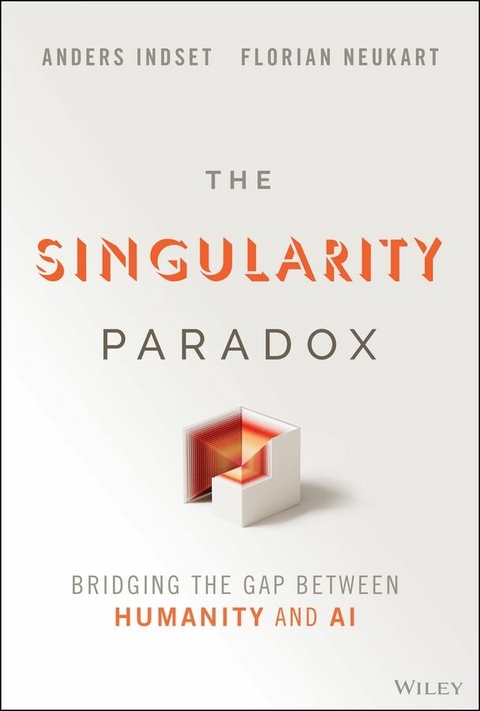
The Singularity Paradox (eBook)
481 Seiten
Wiley (Verlag)
978-1-394-30965-8 (ISBN)
Understand humanity's opportunity to create Artificial Conscious Entities in response to the singularity
The Singularity Paradox: Bridging the Gap Between Humanity and AI is a comprehensive exploration of how the fusion of biology, neuroscience, and artificial intelligence can lead to the creation of Artificial Human Intelligence (AHI) as a conscious response to the unconscious development of superintelligence. You will learn about how:
- Singularity highlights the tension between the boundless possibilities of technological advancement and the potential loss of human autonomy, control, and relevance.
- AHI may become essential in navigating this singularity and preventing the severe consequences that could arise.
- The convergence of humanity and technology, shedding light on the ethical, social, and scientific implications of this transformation is taken on with a fresh perspective.
Written by Anders Indset and Florian Neukart, The Singularity Paradox is a must-read read for anyone interested in the future of technology, artificial intelligence, neuroscience, and philosophy, as well as humanity's not-so-distant future, where science fiction may become reality.
ANDERS INDSET is a Norwegian-born philosopher and deep-tech investor. Recognized by Thinkers50 as one of the leading voices shaping technology and leadership, he is the author of four Spiegel bestsellers, with his works translated into over ten languages. Anders is the founder and Chairman of Njordis Group, a driving force behind initiatives like the Quantum Economy, and a sought-after international speaker on exponential technologies and the future of humanity.
DR. FLORIAN NEUKART is an Austrian physicist, computer scientist, and business executive specializing in quantum computing (QC) and artificial intelligence (AI). He serves on the Board of Trustees for the International Foundation of AI and QC and co-authored Germany's National Roadmap for Quantum Computing. Currently, he is Chief Product Officer at Terra Quantum AG, following over a decade leading global innovation and research labs at Volkswagen Group. He holds advanced degrees in computer science, physics, and IT, including a Ph.D. in AI and QC. A professor at Leiden University, Florian has authored books and published over 100 articles on topics including space propulsion, materials science, and AI.
Understand humanity's opportunity to create Artificial Conscious Entities in response to the singularity The Singularity Paradox: Bridging the Gap Between Humanity and AI is a comprehensive exploration of how the fusion of biology, neuroscience, and artificial intelligence can lead to the creation of Artificial Human Intelligence (AHI) as a conscious response to the unconscious development of superintelligence. You will learn about how: Singularity highlights the tension between the boundless possibilities of technological advancement and the potential loss of human autonomy, control, and relevance. AHI may become essential in navigating this singularity and preventing the severe consequences that could arise. The convergence of humanity and technology, shedding light on the ethical, social, and scientific implications of this transformation is taken on with a fresh perspective. Written by Anders Indset and Florian Neukart, The Singularity Paradox is a must-read read for anyone interested in the future of technology, artificial intelligence, neuroscience, and philosophy, as well as humanity's not-so-distant future, where science fiction may become reality.
Introduction
To this day, we humans live with two irrefutable truths: Everything is in constant change, and we all will die. The first one, panta rhei—“everything flows,” as the Greek philosopher Heraclitus described it—explains that we cannot step into the same river twice, “for it is not the same river, and we are not the same man”; it is a realization with which we humans can cope. The second statement, on the other hand, that we all will die, is a little trickier. It triggers fear because it is a step into the unknown. Is life, then, over, or does the soul experience a transition into another being? Existential angst arises from pondering the nature of human existence, the meaning of life, and the inevitability of death.
The human being, or Mensch (in German), as we will refer to it in our book, possesses what seems to be a unique ability to be consciously aware of its mortality. This awareness can lead to existential angst as we grapple with the fact that our lives are finite and that we will eventually cease to exist. Our fear of death can drive us to seek meaning and purpose in our lives, and existential angst arises when the Mensch struggles to find a sense of meaning or purpose, leading to feelings of emptiness and despair. It is also the representation of the ultimate unknown that causes fear, because no one can honestly know what happens after we die. We may feel overwhelmed by the uncertainty surrounding death and the afterlife. Death is an inevitable part of life, and the fact that it is beyond our control can lead to feelings of helplessness and anxiety. Existential angst can stem from this lack of control as people grapple with the idea that their existence is ultimately subject to forces beyond their influence.
What is death? There are no absolute answers. Religion and research offer many building blocks, usually with a comforting message: the path to transition can be painful, but dying itself is peaceful, even for the companions. Just as each life differs, so too does the dying process. Biologically, each dying process can be defined, but only in terms of the death of individual cells or organs. Even during embryonic development, programmed cell death occurs repeatedly when excess cells that are no longer needed during development kill themselves. Later, T lymphocytes—white blood cells—eliminate cells that are harmful to the organism. Even whole organs, such as limbs or the spleen, can die while the person continues to live. Surprisingly, little research has been done on what causes an organism to die. Cardiovascular failure, often cited as a reason, is usually the result of other circumstances. Is it the soul itself, whose life energy slowly halts according to a plan, as many spiritual wisdom teachings claim? Transplant medicine is currently raising the question of whether human death can be defined as brain death. Only total brain death has been established as a necessary condition for organ harvesting.
What about life after death, which religions often promote? No one knows the truth; therefore, there are many interpretations of what life after death might look like. Christian religions provide surprisingly little accurate information. Rebirth is ruled out, but from an all‐death theology to a personal judgment that decides the soul's subsequent whereabouts in heaven or hell, everything seems possible and nothing concrete. Most Christian theologians today assume that the whole person (with body and soul) dies at the moment of death but immediately awakens to a new life in the afterlife. Accordingly, the individual resurrection would not occur on the Last Day but immediately after each person's death. For some philosophers, separating the soul from matter is not possible.
Perhaps most difficult to understand is the view of many believers that after death, there should be a trial, a retrospection, or a negotiation in which the future whereabouts of the soul are determined. Imagine that a person has finally overcome the agony of death and is either judged immediately, leaving no further opportunity to improve on the mistakes of one's life, or the personality is preserved in an intermediate state indefinitely until the Day of Judgment. This view, though fortunately no longer so strongly taught today, was for a long time considered binding on believers, probably also to keep them from loving each other in life. Religion is always a mirror of its time.
The ancient wisdom texts should also not go unmentioned. The Bardo Thodol, or the Tibetan Book of the Dead, describes precisely and meticulously the heavenly worlds into which the soul will enter, places supposedly seen by Tibetan monks who could make such a journey while in a superconscious state through deep meditation. In many spiritual and metaphysical contexts, the superconscious state is described as a level of consciousness beyond humans' everyday waking consciousness, transcending the individual mind's limitations. It is often associated with states of enlightenment, spiritual insight, or deep intuitive understanding. It's seen as a state where one can access universal truths or wisdom, often linked with the concept of collective consciousness. Perhaps the ancient Egyptian texts describing similar afterworlds, including the so‐called tunnel, were written by people with near‐death experiences. We can learn a lot from religions and ancient texts, especially about the value of life.
In this book, we will follow a different path and take immortality into our own hands. Even without a scientific understanding and agreed‐upon definition of consciousness, let alone a superconscious state, science is helping us more and more to understand the universe and unravel the mysteries of life, and we might soon reach a point where we can decide for ourselves if and when we want to go. In this book, we will explore the journey toward technological singularity and how perhaps consciously building singularity and creating what we will refer to as artificial human intelligence (AHI) might be humanity's (only) path to follow. We will look at the arising paradoxes we are confronted with when building AHIs—identical to the Mensch—yet keeping the concept of “The Mensch” unsolved.
The concept of singularity, also known as technological singularity, refers to the hypothetical future in which technological progress will become so rapid that it will fundamentally change the nature of human civilization and the world as we know it. Some people think that the singularity could be triggered by the development of artificial intelligence (AI) that surpasses human intelligence, leading to a scenario in which machines become capable of independently creating new technologies and advancing exponentially.
There is ongoing debate about whether the singularity is likely to occur and, if so, when it might happen. Some experts think the singularity is not near and may never happen, while others think it is imminent and could occur within the next few decades. There are several reasons why the singularity may not be near. One reason is that it is difficult to predict the future course of technological development and its progress rate. It is possible that technological progress may not proceed as rapidly as some people expect or that unforeseen obstacles may arise that slow down or prevent the development of the technologies thought necessary for the singularity to occur.
Another reason is that significant technical challenges need to be overcome before AI can reach the level of intelligence required to trigger the singularity. For example, AI systems still struggle with tasks that are simple for humans, such as natural language processing and understanding context. While progress is being made in these areas, it is unclear how long it will take for AI to reach the level of intelligence required to trigger the singularity.
Ethical and social considerations also need to be taken into account when considering the potential impact of the singularity. Some people are concerned about its potential negative consequences, such as the displacement of human workers by intelligent machines or the potential for AI to be used for malicious purposes.
Creating machines with conscious experiences has been one of the most difficult challenges in AI. Since the emergence of AI as a research field, researchers have been exploring ways to create machines that mimic humanlike consciousness. However, the challenge is further compounded by the numerous philosophical definitions of consciousness. These definitions range from the most superficial interpretations, such as the awareness of one's surroundings, to more complex interpretations, such as the presence of self‐awareness or subjective experiences.
One of the most common starting points for understanding consciousness is examining qualia or the subjective experiences associated with sensory perceptions, such as the redness of a rose or the sweetness of a piece of chocolate. However, it is still not completely clear how the brain creates conscious content. This has led researchers to focus on understanding the neural mechanisms underlying conscious experience. To develop machines that can exhibit conscious experiences, defining a starting point for understanding consciousness is necessary. This is because we must first understand how consciousness works before creating machines that can have conscious experiences. Only then can we create hardware and software capable of reproducing the conditions required for creating conscious experiences. This involves designing algorithms that...
| Erscheint lt. Verlag | 22.4.2025 |
|---|---|
| Sprache | englisch |
| Themenwelt | Geisteswissenschaften ► Philosophie |
| Sozialwissenschaften ► Politik / Verwaltung | |
| Schlagworte | Artificial Conscious Entities • Artificial Intelligence • Cyborg • Future humanity • Human Machine • mind theory • Neuroscience • Quantum Computing • self aware machines • Technology Ethics • technology future • technology philosophy |
| ISBN-10 | 1-394-30965-1 / 1394309651 |
| ISBN-13 | 978-1-394-30965-8 / 9781394309658 |
| Informationen gemäß Produktsicherheitsverordnung (GPSR) | |
| Haben Sie eine Frage zum Produkt? |
 EPUB (Adobe DRM)
Kopierschutz: Adobe-DRM
Adobe-DRM ist ein Kopierschutz, der das eBook vor Mißbrauch schützen soll. Dabei wird das eBook bereits beim Download auf Ihre persönliche Adobe-ID autorisiert. Lesen können Sie das eBook dann nur auf den Geräten, welche ebenfalls auf Ihre Adobe-ID registriert sind.
Details zum Adobe-DRM
Dateiformat: EPUB (Electronic Publication)
EPUB ist ein offener Standard für eBooks und eignet sich besonders zur Darstellung von Belletristik und Sachbüchern. Der Fließtext wird dynamisch an die Display- und Schriftgröße angepasst. Auch für mobile Lesegeräte ist EPUB daher gut geeignet.
Systemvoraussetzungen:
PC/Mac: Mit einem PC oder Mac können Sie dieses eBook lesen. Sie benötigen eine
eReader: Dieses eBook kann mit (fast) allen eBook-Readern gelesen werden. Mit dem amazon-Kindle ist es aber nicht kompatibel.
Smartphone/Tablet: Egal ob Apple oder Android, dieses eBook können Sie lesen. Sie benötigen eine
Geräteliste und zusätzliche Hinweise
Buying eBooks from abroad
For tax law reasons we can sell eBooks just within Germany and Switzerland. Regrettably we cannot fulfill eBook-orders from other countries.
aus dem Bereich