


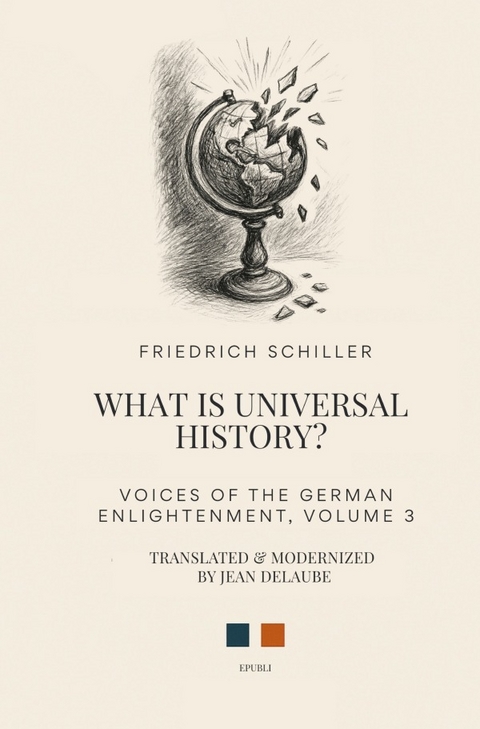
Voices of the German Enlightenment / What Is Universal History?
Seiten
2025
epubli (Verlag)
978-3-8190-8235-1 (ISBN)
epubli (Verlag)
978-3-8190-8235-1 (ISBN)
Schiller's masterwork-published shortly after the French Revolution began-returns in English for the first time: a stirring, visionary, and surprisingly modern reflection on why history matters.
"The only true immortality is the one in which the deed endures, even after the name is forgotten."First delivered as his inaugural lecture in Jena and published just months after the outbreak of the French Revolution, Friedrich Schiller's "What Is, and to What End Do We Study, Universal History?" is one of the boldest and most visionary calls to intellectual action in European thought. Appearing in November 1789, it responds to a moment of global upheaval with a philosophical manifesto for freedom, Bildung, and the moral progress of humanity.With soaring prose and prophetic clarity, Schiller draws a sharp line between the "bread-scholar" who studies only for utility, and the "philosophical mind" that seeks unity, inner development, and universal truth. In an age increasingly defined by fragmentation and ideology, Schiller's words strike with renewed urgency, offering a framework for self-education, civic responsibility, and global humanism.This is the first modern English edition of Schiller's world-historical vision-meticulously translated and annotated by Jean Delaube, and embedded in the revolutionary moment of 1789. It opens a window onto the intellectual atmosphere of late Enlightenment Germany, where philosophy, politics, and history were engaged in a dramatic rethinking of the human condition.A lost classic of world philosophy-restored for the twenty-first century.This volume 3 continues the Voices of the German Enlightenment series begun with Wieland's "The Secret of the Order of Cosmopolitans". Also available in the series: "Ideas for a Philosophy of the History of Mankind" from 1788 by Herder.
"The only true immortality is the one in which the deed endures, even after the name is forgotten."First delivered as his inaugural lecture in Jena and published just months after the outbreak of the French Revolution, Friedrich Schiller's "What Is, and to What End Do We Study, Universal History?" is one of the boldest and most visionary calls to intellectual action in European thought. Appearing in November 1789, it responds to a moment of global upheaval with a philosophical manifesto for freedom, Bildung, and the moral progress of humanity.With soaring prose and prophetic clarity, Schiller draws a sharp line between the "bread-scholar" who studies only for utility, and the "philosophical mind" that seeks unity, inner development, and universal truth. In an age increasingly defined by fragmentation and ideology, Schiller's words strike with renewed urgency, offering a framework for self-education, civic responsibility, and global humanism.This is the first modern English edition of Schiller's world-historical vision-meticulously translated and annotated by Jean Delaube, and embedded in the revolutionary moment of 1789. It opens a window onto the intellectual atmosphere of late Enlightenment Germany, where philosophy, politics, and history were engaged in a dramatic rethinking of the human condition.A lost classic of world philosophy-restored for the twenty-first century.This volume 3 continues the Voices of the German Enlightenment series begun with Wieland's "The Secret of the Order of Cosmopolitans". Also available in the series: "Ideas for a Philosophy of the History of Mankind" from 1788 by Herder.
Friedrich Schiller (1759-1805) was one of the most brilliant luminaries of German literature and thought. This extraordinary dramatist, poet, philosopher and historian transformed the landscape of European culture with his unparalleled creative genius. As a philosopher, his groundbreaking essays on aesthetics and ethics established him as one of the most penetrating minds of the Enlightenment. His legendary friendship with Goethe created the most formidable intellectual partnership in literary history, propelling German culture to unprecedented heights.
| Erscheinungsdatum | 01.05.2025 |
|---|---|
| Reihe/Serie | Voices of the German Enlightenment ; 3 |
| Übersetzer | Jean Delaube |
| Sprache | englisch |
| Maße | 135 x 205 mm |
| Gewicht | 91 g |
| Themenwelt | Schulbuch / Wörterbuch |
| Sozialwissenschaften ► Pädagogik ► Allgemeines / Lexika | |
| Schlagworte | Ideas for a Philosophy of the History of Mankind • Schiller • The Secret of the Order of Cosmopolitans • Universal History • Voices of the German Enlightenment • What is and to what end do we study Universal History • World History |
| ISBN-10 | 3-8190-8235-2 / 3819082352 |
| ISBN-13 | 978-3-8190-8235-1 / 9783819082351 |
| Zustand | Neuware |
| Informationen gemäß Produktsicherheitsverordnung (GPSR) | |
| Haben Sie eine Frage zum Produkt? |
Mehr entdecken
aus dem Bereich



aus dem Bereich
ihr individueller Weg: von der Themensuche zum Doktortitel
Buch | Softcover (2025)
UTB (Verlag)
CHF 26,45
Einführung in die Theorie transformatorischer Bildungsprozesse
Buch | Softcover (2023)
Kohlhammer (Verlag)
CHF 47,60


