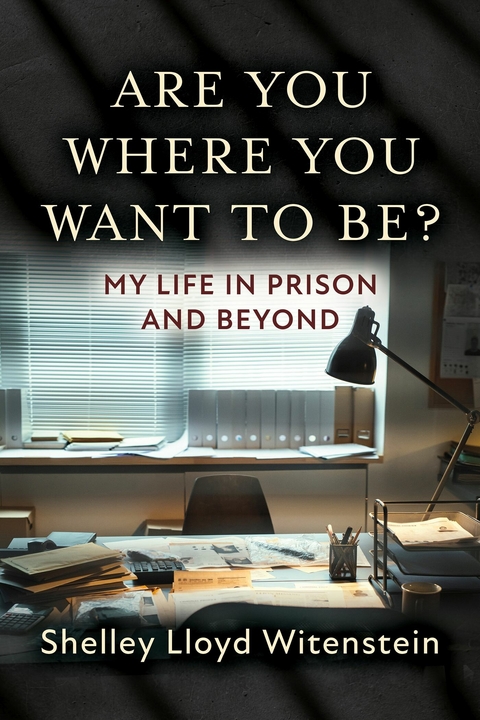
Are you where you want to be?...My life in prison and beyond. (eBook)
200 Seiten
Bookbaby (Verlag)
979-8-3509-9891-7 (ISBN)
Born in Brooklyn, raised mostly in Queens and Long Island. Parents owned and operated an Appetizing store (like a deli, without tables and chairs). College at Hofstra University and masters degree from Post College of Long Island University. Married, with 3 children. Started in the Federal Bureau of Prisons in January 1974. Currently retired with my wonderful wife and our Shih Tzu, Wesley.
The book is moved along via back and forth dialogue between the author/protagonist and his lifelong friend, Jake. Their discussions detail actual events in the lives of prisoners and parolees. Successful life pattern changes are revealed. Inmates and parolees are not the only ones who change. The author's maturation process is evident in the telling of the emerging life stories.
Chapter 4:
The bigger pictures.
Jake: If the human stories are so similar, maybe devising ways to help them overcome their issues should not be complicated to develop.
Me: There is more to it Jake. First of all, despite similarities, every human is different from his neighbor.
Secondly, and most interestingly, despite many offenders with similar social histories, we sometimes learn that these offenders have siblings, people in similar familial and social circumstances, and in many instances, the siblings have no criminal records. It would appear then that our life blueprints are affected by factors in addition to our family circumstances. Those factors include the unique biological makeup each of us is born with and the very specific chance circumstances of our lives. These life factors also contribute to create who we are and who we will become.
Jake: Okay, I can buy that, it makes sense to me.
Now this story about Antonio is interesting, but overall, did you like what you were doing and most specifically, where you were doing it?
Me: Jake, I really enjoyed most of my career, although there were times I wished I was elsewhere. Although my time working in institutions was not that lengthy, I learned a lot and maybe I would have learned these things in other settings. I was able to apply things I learned about people while working in corrections to other aspects of my life.
Before I fill your head with life stories of inmates, let me give you some examples of stuff I learned about humans, things that appear in many of the stories I will tell you. My interactions with the prisoners, parolees and probationers, revealed many traits that seem to be common to human beings. One theory I already discussed; that each of us will only accept important, often life changing information, if it is presented in a way that our egos have deemed acceptable. My favorite work experiences were during those times that I was able to determine the acceptable approach to provide potential life affecting information and then delivering it.
In my search for pertinent information about individuals I would notice traits that seem to be common to all of us. The vast majority of us humans want to stay alive. Then there is hope. It became most apparent when I worked in the maximum security federal penitentiary at Marion, Illinois, that hope was a dominant force within most lives. Many of the prisoners had slim possibilities for ever returning to the free world. Yet they had hope, not always realistic hope, but hope that they would someday be free. Perhaps through escape or that the sentencing Judge would die and another Judge would free them, or that the prison would burn down and they would run off. I figured if these guys maintained hope, then it must be universal.
Another thread of human similarity that is very evident in prison, as well as in the free world, is a strong desire to have some control over our lives. Later I’ll tell you a story about an inmate named Jimmy who craved a little power to manage a life situation.
A self-defeating trait that seems to bind us is a fear of change. Making changes to our lives is difficult, but, in my opinion, for most of us, making changes to our behavior is possible and not always as difficult as we humans like to assert. For some people, knowing about their issue, having heard it out loud, is enough to start the process of change. During a career that included working with prisoners and parolees, many of whom had drug, alcohol or other persistent patterns that negatively affected their lives, I’ve been told by many of them on too many occasions to recall, that breaking these habits was too difficult. But, then again, I have met people who have conquered their life defeating habits. I learned that when we become more uncomfortable with our current behavior patterns than with the looming process of change, we often take the initiative to change.
As a youngster I saw the will and process to change in my father. My brother and I read a newspaper article reporting that smoking cigarettes was a health hazard, probably linked to cancer. Our father smoked two to three packs of non-filtered cigarettes each day. We showed him the article and told him we did not want him to die and we wanted him to stop smoking. He did so, immediately. Other than enjoying a cigar once or twice a year for a decade or so after quitting cigarettes, he remained smokeless for the rest of his life, about fifty-five additional years.
My father demonstrated a positive or “can do” attitude and this seems to be a necessary trait for those who successfully navigate this world. My son overcame a claim of “I can’t do it” when he was quite young. He was a walking, talking little person at fifteen months. He experienced great difficulty when attempting to climb into the bed my wife and I shared, to be with us. After all, the bed had legs, then a box spring and, over all, the mattress. He would try to climb onto the bed, lifting one leg up and pulling on the bedspread with both hands, but he found it a very difficult climb. He would exclaim “I can’t do it” to encourage my wife or me to lift him up. It seemed to us he could do it, but he preferred to be helped. We decided to test our theory by bringing a pizza home and, trying something we did not ordinarily do; eat it in bed. We brought the pizza to the bedroom and Matthew zoomed up to join us. We suggested that he not insist “I can’t do it” anymore about climbing into the bed. He stopped.
Jake: Maybe there is some hope for me. I want to lose weight, but I don’t really want to eat less and do a bunch of exercises on a regular basis. It’s easier to stay a little over weight. Maybe if I try a little harder, what do you think?
Me: Jake my friend, I will truly miss you if you die before your time because you didn’t want to work hard enough to save yourself.
Let me proceed.
Jake: Wait one minute. Are you trying to get me to change?
Me: I can’t make you change Jake, that’s your choice.
Jake: Well, okay then.
Me: Another common characteristic seems to be a struggle within each of us to develop or mature, so that we successfully interact in our environments. This struggle to develop seems to be hampered by our maintenance of something I refer to as “loopholes.” Loopholes are evidenced by our words revealing we could do better if it wasn’t for…him, her, it, them, etc.
I believe to mature we must accept responsibility for our lives and to do this, we must understand who we are. For me, being on the track team at college helped me to learn about myself and how to cope with me. As a college freshman I was the fastest on the freshman team at the 100-yard dash, and at the 220-yard dash, or so I thought. Usually I’d be winning the 220 until the last 10 yards or so and then I would see that other freshman in my peripheral vision and he would be moving up and up and I did not respond in kind. Mostly he would nip me at the end. Well I thought about this a lot. I refused to decide I wasn’t faster, and I didn’t want to use an excuse or loop hole to excuse my failures to do my best. I needed to determine what was not allowing me to do my best. It seemed that I was concentrating more on others in the race than I was concentrating on racing my best. I decided that to be the fastest I could be, I needed to block out the competition and concentrate on doing my best.
I never became a world beater, but I learned to overcome my own fears of success on the track. I concentrated on the lines I ran between and did my best to ignore the other runners. I think this thought process is what I needed to do my best and it was a maturation process. It resulted in my winning races during my college career and improving my running times. Learning that the true competition is within each of us to do our best, revealed to me that I would have to overcome or block out my fears of failure or perhaps of success. Also, I needed to maximize my efforts and overcome a call to laziness (the last may also be a common trait) in order to have a chance at a satisfying, productive life.
A fear of success was something evident in releasing inmates, especially for those who quickly returned through some fault of their own.
The last thing I want to mention about common issues, one that propels an offender toward reincarceration, is a lack of fear of confinement, combined with a thought that prison has the feeling of being home for many of the repeaters. This became apparent to me when I met and spoke with a parolee during time I spent as an intern in the criminal justice system. He had been out for several months and was working and living with family. He volunteered that he often thought about being back inside the prison he had released from and would day dream about playing left field again, on the prison softball team.
Jake: Those were the highlight moments of his life? That’s terrible.
Me: Maybe they were. I hoped someone would enlighten him about the better things in life and encourage him to aspire to those pleasant moments that add up to a satisfactory existence.
Jake: Wait a minute, what about disliking someone different from you? Isn’t that a common bond among people.
Me: I don’t think so Jake. I believe it’s a learned...
| Erscheint lt. Verlag | 18.4.2025 |
|---|---|
| Sprache | englisch |
| Themenwelt | Sozialwissenschaften ► Politik / Verwaltung |
| ISBN-13 | 979-8-3509-9891-7 / 9798350998917 |
| Informationen gemäß Produktsicherheitsverordnung (GPSR) | |
| Haben Sie eine Frage zum Produkt? |
 EPUB (Ohne DRM)
Größe: 2,2 MB
Digital Rights Management: ohne DRM
Dieses eBook enthält kein DRM oder Kopierschutz. Eine Weitergabe an Dritte ist jedoch rechtlich nicht zulässig, weil Sie beim Kauf nur die Rechte an der persönlichen Nutzung erwerben.
Dateiformat: EPUB (Electronic Publication)
EPUB ist ein offener Standard für eBooks und eignet sich besonders zur Darstellung von Belletristik und Sachbüchern. Der Fließtext wird dynamisch an die Display- und Schriftgröße angepasst. Auch für mobile Lesegeräte ist EPUB daher gut geeignet.
Systemvoraussetzungen:
PC/Mac: Mit einem PC oder Mac können Sie dieses eBook lesen. Sie benötigen dafür die kostenlose Software Adobe Digital Editions.
eReader: Dieses eBook kann mit (fast) allen eBook-Readern gelesen werden. Mit dem amazon-Kindle ist es aber nicht kompatibel.
Smartphone/Tablet: Egal ob Apple oder Android, dieses eBook können Sie lesen. Sie benötigen dafür eine kostenlose App.
Geräteliste und zusätzliche Hinweise
Buying eBooks from abroad
For tax law reasons we can sell eBooks just within Germany and Switzerland. Regrettably we cannot fulfill eBook-orders from other countries.
aus dem Bereich