


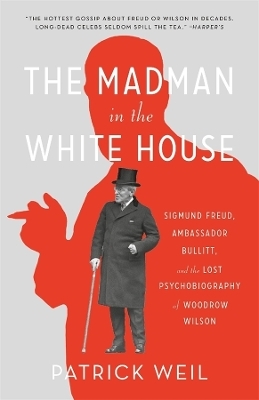
The Madman in the White House
Sigmund Freud, Ambassador Bullitt, and the Lost Psychobiography of Woodrow Wilson
Seiten
2025
Harvard University Press (Verlag)
978-0-674-30159-7 (ISBN)
Harvard University Press (Verlag)
978-0-674-30159-7 (ISBN)
In 1932 Sigmund Freud and diplomat William Bullitt completed a well-informed psychobiography of Woodrow Wilson, inspired by his irrational handling of the Treaty of Versailles. Released decades later in redacted form, the book was panned by critics and immediately forgotten. Patrick Weil resurrects the original version and reassesses its insights.
Shortlist, Cundill History Prize
“The extraordinary untold story of how a disillusioned American diplomat named William C. Bullitt came to Freud’s couch in 1926, and how Freud and his patient collaborated on a psychobiography of President Woodrow Wilson.” —Wall Street Journal
“A vivid shaggy-dog story about a curio that illuminates the possibilities (and perils) of studying the psychological soundness of presidents—a discipline as relevant as ever.” —The Atlantic
“Excellent…Nearly a century since Wilson’s death, Weil’s monograph is the first to offer a comprehensive historical account of Bullitt’s career-long engagement with Wilson.” —American Literary History
When the fate of millions rests on the decisions of a mentally compromised leader, what can one person do? Alarmed by President Woodrow Wilson’s irrational handling of the 1919 Treaty of Versailles, a US diplomat named William C. Bullitt asked this very question. With the help of his friend Sigmund Freud—and the cooperation of interviewees in Wilson’s inner circle—Bullitt set out to write a psychological biography of a troubled president. In The Madman in the White House, Patrick Weil resurrects this forgotten portrait.
The manuscript was completed in 1932, but the book was not published until 1966, in a heavily redacted edition. By that time, the mystique of psychoanalysis had waned and Wilson’s legacy was unassailable. Critics panned the book, and Freud’s descendants denied his involvement. But in 2014, Weil discovered the original manuscript, which leaves no doubt as to Freud’s role—or the significance of Bullitt and Freud’s analysis. Reassessing the notorious psychobiography, Weil finds a powerful warning about the influence a single unbalanced personality can have on the course of history.
Shortlist, Cundill History Prize
“The extraordinary untold story of how a disillusioned American diplomat named William C. Bullitt came to Freud’s couch in 1926, and how Freud and his patient collaborated on a psychobiography of President Woodrow Wilson.” —Wall Street Journal
“A vivid shaggy-dog story about a curio that illuminates the possibilities (and perils) of studying the psychological soundness of presidents—a discipline as relevant as ever.” —The Atlantic
“Excellent…Nearly a century since Wilson’s death, Weil’s monograph is the first to offer a comprehensive historical account of Bullitt’s career-long engagement with Wilson.” —American Literary History
When the fate of millions rests on the decisions of a mentally compromised leader, what can one person do? Alarmed by President Woodrow Wilson’s irrational handling of the 1919 Treaty of Versailles, a US diplomat named William C. Bullitt asked this very question. With the help of his friend Sigmund Freud—and the cooperation of interviewees in Wilson’s inner circle—Bullitt set out to write a psychological biography of a troubled president. In The Madman in the White House, Patrick Weil resurrects this forgotten portrait.
The manuscript was completed in 1932, but the book was not published until 1966, in a heavily redacted edition. By that time, the mystique of psychoanalysis had waned and Wilson’s legacy was unassailable. Critics panned the book, and Freud’s descendants denied his involvement. But in 2014, Weil discovered the original manuscript, which leaves no doubt as to Freud’s role—or the significance of Bullitt and Freud’s analysis. Reassessing the notorious psychobiography, Weil finds a powerful warning about the influence a single unbalanced personality can have on the course of history.
Patrick Weil is Oscar M. Ruebhausen Distinguished Fellow at Yale Law School and a research professor at the National Center for Scientific Research in France. The founder and president of Libraries Without Borders, he is the author of The Sovereign Citizen and How to Be French.
| Erscheinungsdatum | 17.10.2025 |
|---|---|
| Verlagsort | Cambridge, Mass |
| Sprache | englisch |
| Maße | 156 x 235 mm |
| Themenwelt | Geschichte ► Allgemeine Geschichte ► Neuzeit (bis 1918) |
| Geisteswissenschaften ► Geschichte ► Regional- / Ländergeschichte | |
| Sozialwissenschaften ► Politik / Verwaltung ► Staat / Verwaltung | |
| ISBN-10 | 0-674-30159-5 / 0674301595 |
| ISBN-13 | 978-0-674-30159-7 / 9780674301597 |
| Zustand | Neuware |
| Informationen gemäß Produktsicherheitsverordnung (GPSR) | |
| Haben Sie eine Frage zum Produkt? |
Mehr entdecken
aus dem Bereich

aus dem Bereich
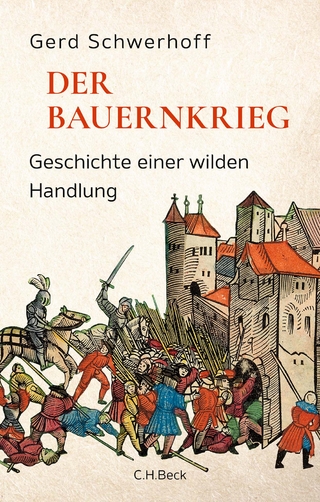
Geschichte einer wilden Handlung
Buch | Hardcover (2024)
C.H.Beck (Verlag)
CHF 47,60


