


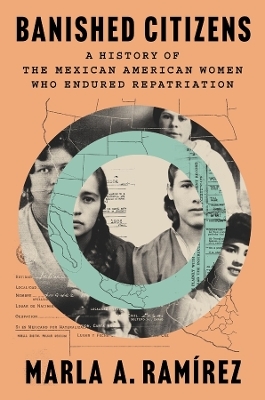
Banished Citizens
A History of the Mexican American Women Who Endured Repatriation
Seiten
2025
Harvard University Press (Verlag)
978-0-674-29594-0 (ISBN)
Harvard University Press (Verlag)
978-0-674-29594-0 (ISBN)
From 1921 to 1944, the United States removed approximately one million ethnic Mexicans—mostly women and children who were US citizens—across the southern border. Marla A. Ramírez explores the lasting effects of “repatriation” on banished women and their descendants, who acted with resilience in their efforts to reclaim citizenship and return home.
A moving portrait of a grim period in American immigration history, when approximately one million ethnic Mexicans—mostly women and children who were US citizens—were forced to relocate across the southern border.
From 1921 to 1944, approximately one million ethnic Mexicans living in the United States were removed across the border to Mexico. What officials called “repatriation” was in fact banishment: 60 percent of those expelled were US citizens, mainly working-class women and children whose husbands and fathers were Mexican immigrants. Drawing on oral histories, transnational archival sources, and private collections, Marla A. Ramírez illuminates the lasting effects of coerced mass removal on three generations of ethnic Mexicans.
Ramírez argues that banishment served interests on both sides of the border. In the United States, the government accused ethnic Mexicans of dependence on social services in order to justify removal, thereby scapegoating them for post–World War I and Depression-era economic woes. In Mexico, meanwhile, officials welcomed returnees for their potential to bolster the labor force. In the process, all Mexicans in the United States—citizens and undocumented immigrants alike—were cast as financially burdensome and culturally foreign. Shedding particular light on the experiences of banished women, Ramírez depicts the courage and resilience of their efforts to reclaim US citizenship and return home. Nevertheless, banishment often interrupted their ability to pass on US citizenship to their children, robbed their families of generational wealth, and drastically slowed upward mobility. Today, their descendants continue to confront and resist the impact of these injustices—and are breaking the silence to ensure that this history is not forgotten.
A wrenching account of expulsion and its afterlives, Banished Citizens illuminates the continuing social, legal, and economic consequences of a removal campaign still barely acknowledged in either Mexico or the United States.
A moving portrait of a grim period in American immigration history, when approximately one million ethnic Mexicans—mostly women and children who were US citizens—were forced to relocate across the southern border.
From 1921 to 1944, approximately one million ethnic Mexicans living in the United States were removed across the border to Mexico. What officials called “repatriation” was in fact banishment: 60 percent of those expelled were US citizens, mainly working-class women and children whose husbands and fathers were Mexican immigrants. Drawing on oral histories, transnational archival sources, and private collections, Marla A. Ramírez illuminates the lasting effects of coerced mass removal on three generations of ethnic Mexicans.
Ramírez argues that banishment served interests on both sides of the border. In the United States, the government accused ethnic Mexicans of dependence on social services in order to justify removal, thereby scapegoating them for post–World War I and Depression-era economic woes. In Mexico, meanwhile, officials welcomed returnees for their potential to bolster the labor force. In the process, all Mexicans in the United States—citizens and undocumented immigrants alike—were cast as financially burdensome and culturally foreign. Shedding particular light on the experiences of banished women, Ramírez depicts the courage and resilience of their efforts to reclaim US citizenship and return home. Nevertheless, banishment often interrupted their ability to pass on US citizenship to their children, robbed their families of generational wealth, and drastically slowed upward mobility. Today, their descendants continue to confront and resist the impact of these injustices—and are breaking the silence to ensure that this history is not forgotten.
A wrenching account of expulsion and its afterlives, Banished Citizens illuminates the continuing social, legal, and economic consequences of a removal campaign still barely acknowledged in either Mexico or the United States.
Marla A. Ramírez is Assistant Professor of History and Chicane/x and Latine/x Studies at the University of Wisconsin–Madison.
| Erscheinungsdatum | 17.10.2025 |
|---|---|
| Zusatzinfo | 2 Maps |
| Verlagsort | Cambridge, Mass |
| Sprache | englisch |
| Maße | 140 x 210 mm |
| Gewicht | 589 g |
| Themenwelt | Geisteswissenschaften ► Geschichte ► Regional- / Ländergeschichte |
| Geschichte ► Teilgebiete der Geschichte ► Kulturgeschichte | |
| Sozialwissenschaften ► Ethnologie | |
| Sozialwissenschaften ► Soziologie | |
| ISBN-10 | 0-674-29594-3 / 0674295943 |
| ISBN-13 | 978-0-674-29594-0 / 9780674295940 |
| Zustand | Neuware |
| Informationen gemäß Produktsicherheitsverordnung (GPSR) | |
| Haben Sie eine Frage zum Produkt? |
Mehr entdecken
aus dem Bereich



aus dem Bereich
Die Revolution des Gemeinen Mannes
Buch | Softcover (2024)
C.H.Beck (Verlag)
CHF 16,80
Eine Geschichte des Geschmacks
Buch | Hardcover (2025)
C.H.Beck (Verlag)
CHF 49,95
vom Mittelalter bis zur Gegenwart
Buch | Softcover (2024)
C.H.Beck (Verlag)
CHF 16,80


