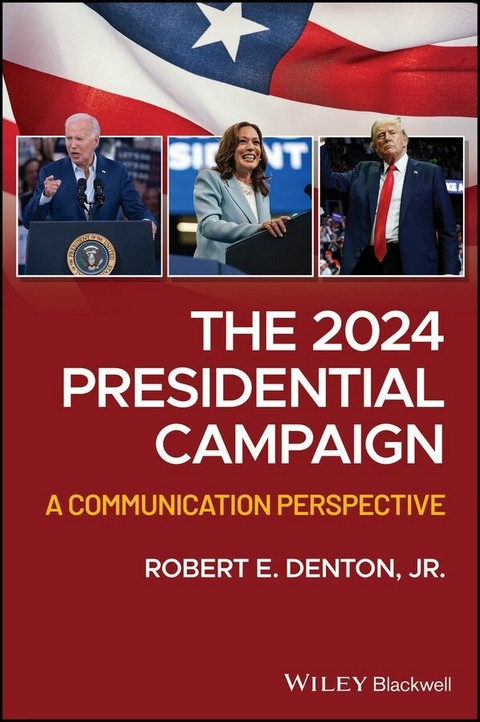
The 2024 Presidential Campaign (eBook)
523 Seiten
Wiley-Blackwell (Verlag)
978-1-394-25037-0 (ISBN)
A comprehensive communication analysis of the 2024 presidential campaign
Presidential campaigns are more than elections, they are cultural touchstones that shape national identity and political discourse. The 2024 presidential campaign was a defining moment in American history, marked by political polarization and cultural turns. In The 2024 Presidential Campaign: A Communication Perspective Robert E. Denton, Jr. and a team of esteemed scholars offer an incisive look at the strategies, narratives, and media that influenced this landmark election.
Examining all key areas of the 2024 election through the lens of communication, this timely volume delves into critical facets of campaign messaging, including political advertising and established news media. Discussions of recent developments such as AI-generated content and the expansion of alternative media provide a deeper understanding of how rapid technological advancement impacts both presidential campaigns and American democracy. Each chapter provides unique insights, connecting communication theory to real-world electoral phenomena.
- Presents in-depth analyses of televised debates, social media strategies, and advertising
- Explores the use of humor in computer-generated images and political cartoons
- Includes chapters on candidate branding and political party conventions
- Addresses the impact of campaign finance on electoral outcomes
- Offers the latest insights into digital and mediated campaign practices
- Provides a unique perspective on cultural and generational shifts in U.S. politics
The 2024 Presidential Campaign: A Communication Perspective is essential reading for scholars and students in Political Science, Journalism, and Communication, particularly those studying presidential campaigns, media and politics, and the presidency. Ideal for upper-level undergraduate and graduate courses, it is also a valuable resource for professionals in political campaign management.
Robert E. Denton, Jr. is the W. Thomas Rice Chair Emeritus and Professor Emeritus of Communication at Virginia Tech University, where he previously served as the Founding Director of the School of Communication and of the Rice Center for Leader Development. Denton has authored or edited 33 books, many in multiple editions, focusing on political communication and leadership.
A comprehensive communication analysis of the 2024 presidential campaign Presidential campaigns are more than elections, they are cultural touchstones that shape national identity and political discourse. The 2024 presidential campaign was a defining moment in American history, marked by political polarization and cultural turns. In The 2024 Presidential Campaign: A Communication Perspective Robert E. Denton, Jr. and a team of esteemed scholars offer an incisive look at the strategies, narratives, and media that influenced this landmark election. Examining all key areas of the 2024 election through the lens of communication, this timely volume delves into critical facets of campaign messaging, including political advertising and established news media. Discussions of recent developments such as AI-generated content and the expansion of alternative media provide a deeper understanding of how rapid technological advancement impacts both presidential campaigns and American democracy. Each chapter provides unique insights, connecting communication theory to real-world electoral phenomena. Presents in-depth analyses of televised debates, social media strategies, and advertising Explores the use of humor in computer-generated images and political cartoons Includes chapters on candidate branding and political party conventions Addresses the impact of campaign finance on electoral outcomes Offers the latest insights into digital and mediated campaign practices Provides a unique perspective on cultural and generational shifts in U.S. politics The 2024 Presidential Campaign: A Communication Perspective is essential reading for scholars and students in Political Science, Journalism, and Communication, particularly those studying presidential campaigns, media and politics, and the presidency. Ideal for upper-level undergraduate and graduate courses, it is also a valuable resource for professionals in political campaign management.
Preface
Every four years a gong goes off and a new Presidential campaign surges into the national consciousness; new candidates, new issues, a new season of surprises. But underlying the syncopations of change is a steady, recurrent rhythm from election to election, a pulse of politics that brings up the same basic themes in order, over and over again.
James David Barber (1980)1
It was 44 years ago in the fall of the 1980 presidential campaign between Jimmy Carter and Ronald Reagan as a new doctoral graduate student in a presidential campaigns course that I was introduced to the work of noted political science scholar James David Barber. I was struck by the above quote and the notion that every presidential campaign is different, yet the same. Since 1992, I have edited a volume on the presidential election. In all the previous volumes, I have noted that every presidential election is historic from policy, issues, communication, and cultural perspectives. In so many ways the 2024 presidential election was not only historic but also unprecedented.
- It started with an incumbent president and former president running against each other.
- One candidate dropped out nearly three months before the general election. Not since 1968 has an eligible incumbent dropped out of a race.
- Over 60% of Americans from the beginning of primaries through their conclusion did not want either Biden or Trump on the ballot.
- One candidate had 34 indictments and is a convicted felon. If he would lose the election could well do jail time.
- One candidate would be the oldest if won at 82 and was already the oldest president and Trump became the oldest elected president at 78.
- One candidate survived two assassination attempts.
- First woman of color on a ticket, hence the potential of first woman president.
- First time the largest eligible voting block were millennials representing a generational shift.
- The 2024 election was the most expensive in American history with $16 billion spent across all federal races. The Harris campaign and PACs raised $1.6 billion and the Trump campaign and PACs $1.1 billion. The total is nearly a billion more between the candidates than in 2020.
- There was a 26% decline in primetime coverage of the presidential election across 18 cable and broadcast networks compared to 2020.
- Trump received the most electoral votes of 312 for a Republican candidate since 1988.
- Trump becomes the first former president in over 120 years to get elected for a second nonconsecutive term.
- The age difference of 38 years between Donald Trump and J.D. Vance is the largest age gap of any president and vice president in American history.
Clearly, former President Donald Trump pulled off one of the greatest comebacks in American history beginning with winning a third consecutive nomination of the Republican Party. For many Democrats, it was a blessing and a gift. Most leaders of the Democrat Party thought that Trump had too much historical garbage and continual missteps. President Biden had nearly 50 years of political public service and a record.
Ironically, the vast majority of American citizens did not desire a rematch between Biden and Trump. And most polls showed that as high as 70% of voters thought the country was headed in the wrong direction. The post‐COVID world, staggering inflation, and the loss of confidence in political leaders and public institutions provided the backdrop for the presidential contest.
For Biden, his job approval remained in the mid to low 40%. Among Democrats, there were concerns about Biden’s age more than his performance in office. Early fundraising was behind that of 2020.
Despite all the legal problems for Trump, his support among followers strengthened and grew during the primary and post‐primary period. In a field of 12 challengers, Trump dominated the primaries. He grew support within the GOP ranks and dominated the news cycles—with positive but mostly negative coverage.
Early polls continued to show a close race nationally. However, as all politics have become more national rather than local, it appeared very early that it would come down to six or eight states that would determine the outcome.
And then there was “the debate.” From the beginning, Biden appeared frail, confused, struggling, and diminished. Democrat operatives said the President had “a bad night.” Trump began to rise in national polls. On July 13, 2024, was the first assassination attempt on Trump. The iconic photo of the bloody ear, with Secret Service members shielding him while pumping his fist in the air, dominated the news. Trump was viewed as defiant, heroic, and “chosen.” The event animated the MAGA movement. Soon after was a rather successful Republican convention with favorable media coverage. Biden continued to trail behind Trump in RealClearPolitics poll averages.
There was national talk of Biden withdrawing from the race; and there was pressure from party leaders and public statements of reflection from President Barack Obama and House Speaker Nancy Pelosi. On July 22, 2024, Biden announced his withdrawal from the race with a statement on X’s social media website.
Harris quickly consolidated support among Democrats and walked back earlier liberal policy positions. The messages of “hope,” “we are not going back,” and “joy” resonated with Democrats, Independents, and “Never Trumpers.” Harris began to lead in national polls. The Trump campaign struggled in trying to define her and Harris enjoyed a “media honeymoon.” There was great anticipation for the pending debate between Harris and Trump. For Trump, he wanted to link her to Biden and administration policies and records. Harris wanted to bait and rattle Trump. She was largely successful in doing so. Trump even went to the post‐debate “spin room” to proclaim that the moderators were unfair, “it was three against one,” and won the debate.
In the dash to Election Day, there were many pivotal moments discussed throughout the chapters of this volume. The polls stayed within the margin of error. The initial focus was on seven battleground states of Pennsylvania, Michigan, Wisconsin, Georgia, North Carolina, Arizona, and Nevada.
According to Gallup’s analysis, there were several factors that favored Trump. The economy was the primary concern for 52% of voters. Of those voters, they preferred Trump over Harris by 9%. In addition, in the third quarter of the year, 48% identified as lean Republican compared to 45% identified as lean Democrat. This was a significant reversal. Just 26% of Americans were satisfied with the direction of the nation. Perhaps most significantly, 46% of Americans thought the Republican Party was better able to address the problems confronting America compared to 41% for Democrats. Interestingly, in terms of candidate qualities, Harris led Trump as being perceived as more likable, with strong moral character, honesty, and trustworthiness. However, Trump was perceived as being a strong leader and able to get things done2. It certainly appears that Trump’s perceived leadership skills and the poor state of the nation were more important than personal qualities.
Trump’s victory was indeed political but also cultural. Trump himself refers to his “movement” of followers. His popularism clearly stimulated a political realignment in terms of ideology and constituent groups. The Democrat and Republican parties must adapt to new electoral maps, voter coalitions, and issues.
Dan Nimmo, one of the fathers of political communication as a field of study and mentor many years ago, argued that the essence of politics is “talk” or human interaction. The interaction may be formal or informal, verbal or non‐verbal, public or private, but always persuasive, forcing us as individuals to interpret, to evaluate, and to act.
Throughout my academic career, I have argued that presidential campaigns are our national conversations. They are highly complex and sophisticated communication events: communication of issues, images, social reality, and personas. They are essentially exercises in the creation, recreation, and transmission of “significant symbols” through human communication. As we attempt to make sense of our environment, “political bits” of communication comprise our voting choices, worldviews, and legislative desires.
Robert E. Denton, Jr., and Gary C. Woodward identify four characteristics of political communication.3 Political communication tends to have a short‐term orientation. Especially in political campaigns, there is a beginning and an ending on Election Day. There also tends to be a “season” of discourse surrounding issues with resulting legislation upon election. Above all, it is communication based on objectives. The communication is directive and persuasive to alter some belief, attitude, or value, leading to a behavior (voting, candidate support, issue motivation, etc.). And finally, today as never before, political communication is largely mediated. We come to know candidates, issues, positions, and arguments through the media largely defined to include digital. Finally, all communication is audience‐centered but especially political communication that is strategic, crafted, and targeted to specific audiences. In general, Denton and Woodward conceive of political communication as “a practical, process‐centered,...
| Erscheint lt. Verlag | 11.4.2025 |
|---|---|
| Sprache | englisch |
| Themenwelt | Sozialwissenschaften ► Kommunikation / Medien |
| Sozialwissenschaften ► Politik / Verwaltung | |
| Sozialwissenschaften ► Soziologie | |
| Schlagworte | 2024 election campaign finance • 2024 election communication analysis • 2024 election debates • 2024 election media coverage • 2024 election political advertising • 2024 election social media • 2024 political communication • 2024 presidential campaign |
| ISBN-10 | 1-394-25037-1 / 1394250371 |
| ISBN-13 | 978-1-394-25037-0 / 9781394250370 |
| Informationen gemäß Produktsicherheitsverordnung (GPSR) | |
| Haben Sie eine Frage zum Produkt? |
 EPUB (Adobe DRM)
Kopierschutz: Adobe-DRM
Adobe-DRM ist ein Kopierschutz, der das eBook vor Mißbrauch schützen soll. Dabei wird das eBook bereits beim Download auf Ihre persönliche Adobe-ID autorisiert. Lesen können Sie das eBook dann nur auf den Geräten, welche ebenfalls auf Ihre Adobe-ID registriert sind.
Details zum Adobe-DRM
Dateiformat: EPUB (Electronic Publication)
EPUB ist ein offener Standard für eBooks und eignet sich besonders zur Darstellung von Belletristik und Sachbüchern. Der Fließtext wird dynamisch an die Display- und Schriftgröße angepasst. Auch für mobile Lesegeräte ist EPUB daher gut geeignet.
Systemvoraussetzungen:
PC/Mac: Mit einem PC oder Mac können Sie dieses eBook lesen. Sie benötigen eine
eReader: Dieses eBook kann mit (fast) allen eBook-Readern gelesen werden. Mit dem amazon-Kindle ist es aber nicht kompatibel.
Smartphone/Tablet: Egal ob Apple oder Android, dieses eBook können Sie lesen. Sie benötigen eine
Geräteliste und zusätzliche Hinweise
Buying eBooks from abroad
For tax law reasons we can sell eBooks just within Germany and Switzerland. Regrettably we cannot fulfill eBook-orders from other countries.
aus dem Bereich