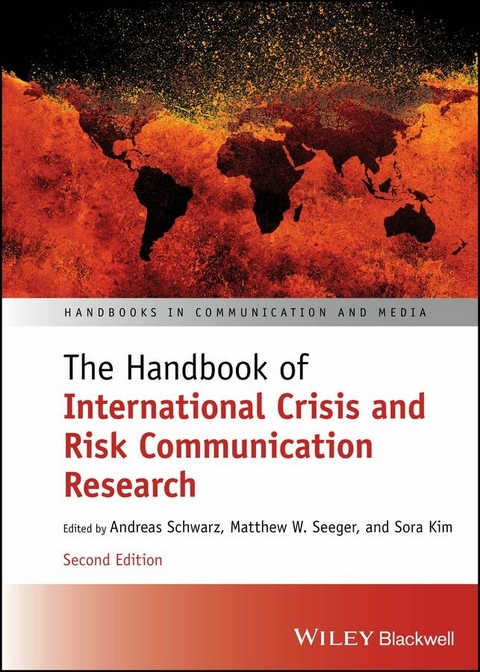
The Handbook of International Crisis and Risk Communication Research (eBook)
1591 Seiten
Wiley-Blackwell (Verlag)
978-1-394-18083-7 (ISBN)
Global Insights on Navigating Today's Complex Crises
Now in its second edition, The Handbook of International Crisis and Risk Communication Research offers a timely and comprehensive exploration of the methods, challenges, and innovations in managing present-day global crises and risks. Bringing together expert insights from across the fields of communication, public relations, and social sciences, this interdisciplinary volume examines crisis and risk communication through an international lens. Each chapter presents unique cultural, theoretical, and methodological perspectives for managing risk, mitigating crises, and fostering resilience.
Amid growing transnational issues such as public health emergencies, climate-induced disasters, and political upheavals, the Handbook emphasizes the role of communication in crisis awareness, recovery, and renewal. Contributions by leading scholars and practitioners investigate vital issues such as the impact of misinformation, digital technologies, and media dynamics in shaping public perception and policy response. This revised and expanded edition also reflects recent global threats, including climate change, the COVID-19 pandemic, the war in Ukraine, and other cross-border crises.
Equipping readers with the knowledge and frameworks necessary to navigate an increasingly complex and interconnected world, The Handbook of International Crisis and Risk Communication Research is perfect for advanced graduate courses and PhD programs in crisis and risk communication, as well as crisis managers, public relations consultants, communication officers, and scholars in risk management and communication.
Global Insights on Navigating Today s Complex Crises Now in its second edition, The Handbook of International Crisis and Risk Communication Research offers a timely and comprehensive exploration of the methods, challenges, and innovations in managing present-day global crises and risks. Bringing together expert insights from across the fields of communication, public relations, and social sciences, this interdisciplinary volume examines crisis and risk communication through an international lens. Each chapter presents unique cultural, theoretical, and methodological perspectives for managing risk, mitigating crises, and fostering resilience. Amid growing transnational issues such as public health emergencies, climate-induced disasters, and political upheavals, the Handbook emphasizes the role of communication in crisis awareness, recovery, and renewal. Contributions by leading scholars and practitioners investigate vital issues such as the impact of misinformation, digital technologies, and media dynamics in shaping public perception and policy response. This revised and expanded edition also reflects recent global threats, including climate change, the COVID-19 pandemic, the war in Ukraine, and other cross-border crises. Equipping readers with the knowledge and frameworks necessary to navigate an increasingly complex and interconnected world, The Handbook of International Crisis and Risk Communication Research is perfect for advanced graduate courses and PhD programs in crisis and risk communication, as well as crisis managers, public relations consultants, communication officers, and scholars in risk management and communication.
List of Contributors
Tariku Abas
Loyola Marymount University, Marymount Institute‐TSEHAI Publishers, Los Angeles, CA, USA
Wole Adamolekun
Department of Mass Communication, Elizade University, Ilara‐Mokin, Nigeria
Ilhem Allagui
Journalism and Strategic Communication Program, Northwestern University, Doha, Qatar
Jesús Arroyave
Departamento de Comunicación Social, Universidad del Norte, Barranquilla, Colombia
Alina Bârgăoanu
National University of Political Studies and Public Administration (SNSPA), European Digital Media Observatory (EDMO), Bucharest, Romania
Cynthia Baur
Department of Behavioral and Community Health, Horowitz Center for Health Literacy, School of Public Health, University of Maryland, College Park, MD, USA
Zenebe Beyene
University of Mississippi, Media & Communication, Oxford, MS, USA
Monica Bîră
National University of Political Studies and Public Administration (SNSPA), Bucharest, Romania
Frederic Bouder
Faculty of Science and Technology, Department of Safety, Economic and Planning, University of Stavanger, Stavange, Norway
Corina Buzoianu
National Univeristy of Political Studies and Public Administration (SNSPA), Bucharest, Romania
An‐Sofie Claeys
Department of Translation, Interpreting and Communication, Ghent University, Gent, Belgium
Ester Cohen‐Rinski
School of Communication, Bar Ilan University, Ramat Gan, Israel
Ruth DeFoster
Hubbard School of Journalism and Mass Communication, University of Minnesota, Minneapolis, MN, USA
Ganga S. Dhanesh
Department of Communication, University of Maryland, College Park, MD, USA
Audra Diers‐Lawson
Institute for Communication, Kristiania University of Applied Sciences, Oslo, Norway
Iuliia Dolmatova
Gaylord College of Journalism and Mass Communication, University of Oklahoma, Norman, OK, USA
Ben Duncan
Self‐employed crisis and risk communication consultant, Consultant to WHO Health Emergencies Programme, Brussels, Belgium
Ana María Erazo‐Coronado
Dirección Especialización Endodoncia, Universidad Metropolitana, Barranquilla, Colombia
Pauline Gidget Estella
Department of Media Studies, Institute of Media and Communication Science, Technische Universität Ilmenau, Ilmenau, Germany
Finn Frandsen
Department of Management, Aarhus School of Business and Social Sciences, Aarhus University, Denmark
Ryan P. Fuller
Department of Management & Organizations, College of Business, California State University‐Sacramento, Sacramento, CA, USA
Christopher Galloway
Massey Business School, Massey University, Auckland, New Zealand
Rozália Del Gáudio Soares
Inspiria 3 Consulting, São Paulo, SP, Brazil
Amiso M. George
Department of Strategic Communication, Bob Schieffer College of Communication, Texas Christian University, Fort Worth, TX, USA
Eytan Gilboa
School of Communication, Bar Ilan University, Ramat Gan, Israel
Rob Grace
University of Cincinnati, School of Information Technology, Cincinnati, OH, USA
Michel M. Haigh
School of Journalism and Mass Communication, Texas State University, San Marcos, TX, USA
Robert L. Heath
Valenti School of Communication, University of Houston, Houston, TX, USA
Øyvind Ihlen
Department of Media and Communication, Faculty of Humanities, University of Oslo, Oslo, Norway
Yingru Ji
College of Media and International Culture, Zhejiang University, Hangzhou, China
Yan Jin
Grady College of Journalism and Mass Communication, University of Georgia, Athens, GA, USA
Amsterdam School of Communication Research (ASCoR), University of Amsterdam, Amsterdam, The Netherlands
Winni Johansen
Department of Management, Aarhus School of Business and Social Sciences, Aarhus University, Denmark
Bengt Johansson
Department of Journalism, Media, and Communication, University of Gothenburg, Gothenburg, Sweden
Soo‐Yeon Kim
College of Media, Arts, and Science, Sogang University in Seoul, Seoul, Korea
Sora Kim
School of Journalism and Communication, Chinese University of Hong Kong, Shatin, Hong Kong
Marjorie Kyomuhendo
Department of Journalism and Communication, Makerere University, Kampala, Uganda
Kenneth A. Lachlan
University of Connecticut, Storrs, CT, USA
Elin Strand Larsen
Department of Computer Science and Communication, Faculty of Computer Science, Engineering and Economics, Østfold University College, Halden, Norway
Jason Shi‐yang Lim
Lee Kong Chian School of Business, Singapore Management University, Singapore, Singapore
Brooke Fisher Liu
Department of Communication, University of Maryland, College Park, MD, USA
Martin Löffelholz
Institut für Medien und Kommunikationswissenschaft, Technische Universität Ilmenau, Ilmenau, Germany
Marta N. Lukacovic
Department of Communication and Mass Media, Angelo State University, San Angelo, TX, USA
Clila Magen
School of Communication, Bar Ilan University, Ramat Gan, Israel
Toni G.L.A. van der Meer
Grady College of Journalism and Mass Communication, University of Georgia, Athens, GA, USA
Amsterdam School of Communication Research (ASCoR), University of Amsterdam, Amsterdam, The Netherlands
Aisha Sembatya Nakiwala
Department of Journalism and Communication, Makerere University, Kampala, Uganda
Angella Napakol
School of Journalism, Media and Communication, Uganda Christian University, Mukono, Uganda
Jerena Ng
Lee Kong Chian School of Business, Singapore Management University, Singapore, Singapore
Michael J. Palenchar
Tombras School of ADPR, University of Tennessee, Knoxville, TN, USA
Augustine Pang
Lee Kong Chian School of Business, Singapore Management University, Singapore, Singapore
Damián Fernández Pedemonte
Universidad Austral, Graduate School of Communication, Buenos Aires, Argentina
Andrew S. Pyle
Department of Communication, Clemson University, Clemson, SC, USA
Constanze Rossmann
Department of Media and Communication, University of Munich, Munich, Germany
Liane Rothenberger
School of Journalism, Catholic University of Eichstätt‐Ingolstadt, Eichstätt, Germany
Aino Ruggiero
Humanitarian Logistics and Supply Chain Research Institute, Department of Marketing, Hanken School of Economics, Helsinki, Finland
Mihoko Sakurai
Graduate School of International Management, International University of Japan, Niigata, Japan
Sergei A. Samoilenko
Department of Communication, George Mason University, Washington, Fairfax, VA, USAAynur Sarısakaloğlu
Department of Media Studies, Institute of Media and Communication Science, Technische Universität Ilmenau, Ilmenau, Germany
Kathrin Schleicher
Institute of Media and Communication Science, Technische Universität Ilmenau, Ilmenau, Germany
Andreas Schwarz
Institute of Media and Communication Science, Technische Universität Ilmenau, Ilmenau, Germany
Matthew W. Seeger
Center for Emerging and Infectious Diseases, Wayne State University, Detroit, MI, USA
Deanna D. Sellnow
Department of Communication, Clemson University, Clemson, SC, USA
Timothy L. Sellnow
Department of Communication, Clemson University, Clemson, SC, USA
Greg SimonsDepartment of Journalism, Media & Communication, Daffodil International University in Dhaka, Bangladesh
Paulo Henrique Soares
Brazilian Mining Institute, Belo Horizonte, MG, Brazil
Rodrigo Soares
University of Vermont, Department of Agriculture, Landscape & Environment, Burlington, VT, USA
Patric R. Spence
University of Central Florida, Orlando, FL, USA
Krishnamurthy Sriramesh
Advertising, Public Relations, and Design, University of Colorado, Boulder, CO, USA
Minttu Tikka
Faculty of Social Sciences, University of Helsinki, Helsinki, Finland
W. Timothy CoombsCentre for Crisis and Risk Communications, Calgary, Canada
Katerina Tsetsura
Gaylord College of Journalism and Mass Communication, University of Oklahoma, Norman, OK, USA
Robert R. Ulmer
Greenspun College of Urban Affairs, University of Nevada Las Vegas, Las Vegas, NV, USA
Shari R. Veil
College of Journalism and Mass Communications, University of Nebraska‐Lincoln, Lincoln, NE, USA
Melanie Verhovnik‐Heinze
Faculty of Business, Ansbach University of Applied Science, Ansbach, Germany
Orla Vigsø
Department of Journalism, Media, and Communication, University of Gothenburg, Gothenburg, Sweden
Daniel Vogler
Research Center for the Public Sphere and Society (fög), University of Zurich, Zurich, Switzerland
Chang Wan
College of Media and International Culture, Zhejiang University, Hangzhou, China
Carla White
Tombras School of ADPR,...
| Erscheint lt. Verlag | 10.4.2025 |
|---|---|
| Reihe/Serie | Handbooks in Communication and Media |
| Sprache | englisch |
| Themenwelt | Sozialwissenschaften ► Kommunikation / Medien |
| Sozialwissenschaften ► Politik / Verwaltung | |
| Sozialwissenschaften ► Soziologie | |
| Schlagworte | Climate Change Communication • Crisis communication • crisis communication research • crisis management communication • interdisciplinary crisis research • media and crisis response • Organizational Crisis • public health communication • Risk communication |
| ISBN-10 | 1-394-18083-7 / 1394180837 |
| ISBN-13 | 978-1-394-18083-7 / 9781394180837 |
| Informationen gemäß Produktsicherheitsverordnung (GPSR) | |
| Haben Sie eine Frage zum Produkt? |
 EPUB (Adobe DRM)
Kopierschutz: Adobe-DRM
Adobe-DRM ist ein Kopierschutz, der das eBook vor Mißbrauch schützen soll. Dabei wird das eBook bereits beim Download auf Ihre persönliche Adobe-ID autorisiert. Lesen können Sie das eBook dann nur auf den Geräten, welche ebenfalls auf Ihre Adobe-ID registriert sind.
Details zum Adobe-DRM
Dateiformat: EPUB (Electronic Publication)
EPUB ist ein offener Standard für eBooks und eignet sich besonders zur Darstellung von Belletristik und Sachbüchern. Der Fließtext wird dynamisch an die Display- und Schriftgröße angepasst. Auch für mobile Lesegeräte ist EPUB daher gut geeignet.
Systemvoraussetzungen:
PC/Mac: Mit einem PC oder Mac können Sie dieses eBook lesen. Sie benötigen eine
eReader: Dieses eBook kann mit (fast) allen eBook-Readern gelesen werden. Mit dem amazon-Kindle ist es aber nicht kompatibel.
Smartphone/Tablet: Egal ob Apple oder Android, dieses eBook können Sie lesen. Sie benötigen eine
Geräteliste und zusätzliche Hinweise
Buying eBooks from abroad
For tax law reasons we can sell eBooks just within Germany and Switzerland. Regrettably we cannot fulfill eBook-orders from other countries.
aus dem Bereich