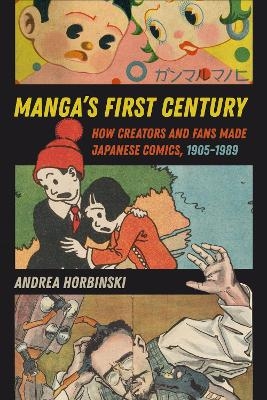
Manga's First Century
University of California Press (Verlag)
978-0-520-40398-7 (ISBN)
- Noch nicht erschienen
- Versandkostenfrei
- Auch auf Rechnung
- Artikel merken
Manga is the world’s most popular style of comics. How did manga and anime—“moving manga”—become ubiquitous? Manga’s First Century delves into the history and finds surprising answers.
In fact, manga has always been a global phenomenon. Countering essentialist myths of manga’s emergence from the deepest wells of Japanese art, author Andrea Horbinski shows it was born in the early 1900s, a hybrid form that crossed single-panel satirical cartoons popular in Europe and America with the Edo period’s artistic legacy. As a medium, manga initially focused on political commentary, expanding to include social satire, children’s comics, and proletarian art in the 1920s and 1930s. Manga’s evolution into a medium embracing complex, long-form storytelling was likewise driven by creators and fans pushing publishers to accept new, radical expansions in manga’s artistic and narrative practices. In the 1970s, innovative creators and fans empowered a new breed of fan-generated comics (dōjinshi) and established robust audiences of adult, female, and queer manga readers, while nurturing generations of amateur and professional creators who continue to enrich and renew manga today.
Andrea Horbinski earned her PhD in modern Japanese history and new media from the University of California, Berkeley. She serves on the editorial board of the Journal of Anime and Manga Studies and as the submissions editor for Mechademia: Second Arc.
Contents
List of Illustrations
Acknowledgments
Note on Names, Styles, and Terms
Introduction
Part One: Origins, 1905–1928
Overview: Manga Against Tradition
1. The Origins of Japanese Comics
2. Arresting the Fleeting Moment: Manga Turns Modern
Conclusion: 1928
Part Two: Manga During Wartime, 1928–1945
Overview: Manga During Wartime
3. Norakuro and Friends
4. The Manga Men
Conclusion: Eating Vegetables, Rereading Manga
Part Three: Manga in the Postwar Era, 1945–1963
Overview: Nowhere to Go but Up
5. The Manga Pulps and the God of Manga
6. Manga for Whom? Kashihonya, Gekiga, and the "Ban Bad Books Movement"
Conclusion: Postwar Platforms
Part Four: TV Manga and the Age of Revolution, 1963–1975
Overview: Shambling Toward the Postmodern
7. Seeking Alternatives: Garo, COM, and Manga Fan Culture
8. The Emergence of Seinen Manga and the Shōjo Revolution
Conclusion: Tankōbon: The Meaning of a Format
Part Five: Manga Turns Postmodern, 1975–1989
Overview: Applauding the DJ
9. Something Postmodern Going On
10. Lost in Wonderland
Conclusion: Still Preoccupied with 1989
Conclusion: A Distinctive History
Note on Sources
Glossary
Notes
Bibliography
Index
| Erscheinungsdatum | 17.10.2025 |
|---|---|
| Zusatzinfo | 20 b-w illustrations, 11 color illustrations |
| Verlagsort | Berkerley |
| Sprache | englisch |
| Maße | 152 x 229 mm |
| Themenwelt | Literatur ► Comic / Humor / Manga ► Comic |
| Literatur ► Comic / Humor / Manga ► Manga | |
| Geisteswissenschaften ► Geschichte ► Regional- / Ländergeschichte | |
| Sozialwissenschaften ► Pädagogik | |
| ISBN-10 | 0-520-40398-3 / 0520403983 |
| ISBN-13 | 978-0-520-40398-7 / 9780520403987 |
| Zustand | Neuware |
| Informationen gemäß Produktsicherheitsverordnung (GPSR) | |
| Haben Sie eine Frage zum Produkt? |
aus dem Bereich