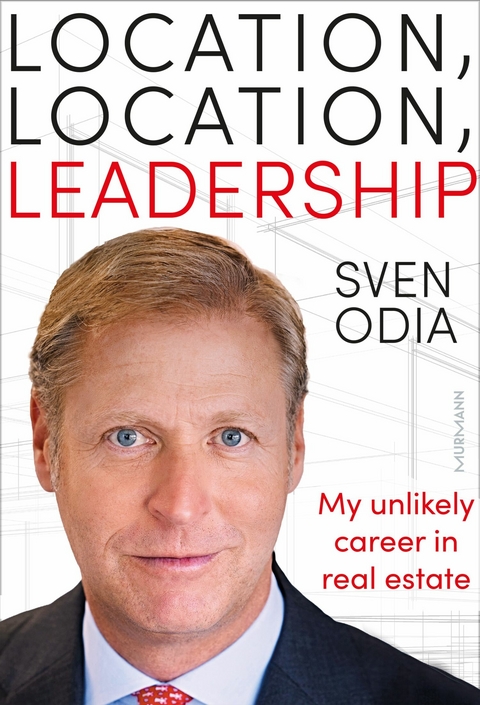
Location, location, leadership. My unlikely career in real estate (eBook)
220 Seiten
Murmann Publishers GmbH (Verlag)
978-3-86774-860-5 (ISBN)
At the age of just 21, Sven Odia decided to strike out on his own as an entrepreneur. Before even completing his training as a real estate agent with Engel & Völkers, he went to Mallorca to set up as a licensed partner of the company. Three years later, having made a success of the business in Mallorca, Odia founded Engel & Völkers International with Christian Völkers, which under his leadership grew to become one of the strongest players in the real estate industry worldwide. A particularly notable achievement was expansion into the United States, where Engel & Völkers became the first non-American company to establish a lasting presence in an extremely competitive market. Odia brings an unparalleled wealth of experience in the real estate industry and expansion into over 30 countries, having spent over 25 years at Engel & Völkers, most recently as Global CEO and President. Today, Sven Odia is Chairman of the Advisory Board of Spain Sotheby's International Realty and a member of the Advisory Board of the e-learning company PINKTUM.
At the age of just 21, Sven Odia set out for Mallorca before even completing his training as a real estate agent, to become an entrepreneur within the company as a licensed partner of Engel & Völkers. After a successful start in Mallorca, Odia founded Engel & Völkers International three years later with Christian Völkers, which under his leadership has grown to become one of the strongest players in the real estate industry worldwide. This includes, in particular, the expansion into the US, where the company is the first non-American player to establish itself sustainably in an extremely competitive market. Odia brings an unparalleled wealth of experience in the real estate industry and expansion in over 30 countries with him and, following his departure from Engel & Völkers, is now a shareholder in Sotheby's Spain and a member of the advisory board of the e-learning company PINKTUM, among other things.
CHAPTER 1
NO SET PATH
HOW I LAID THE FOUNDATION FOR MY CAREER BY BEING SELF-EMPLOYED
The reasons why someone is enthusiastic about a profession can be very banal. For some, it’s wanting to emulate their parents. For others, it’s a friend who tells you about a vacant internship that you then apply for. For me, it was Grund Genug, the magazine published by Engel & Völkers.
I still remember exactly how I got hold of a copy of this magazine in my penultimate year at school. On Fridays, my father often came home with a large number of architecture and interior design magazines as weekend reading. I was so fascinated by the exclusive flats, houses and estates that were presented in the home stories in Grund Genug magazine that I made a decision: I would send off an application for one of the open apprenticeships to become a property and housing management assistant. I had no idea whatsoever about the property sector or the company behind the glossy pictures. Nor did I know anyone who worked there. Nevertheless, I only sent this single application to Engel & Völkers. If that didn’t work out, I would study law, as I had planned to do after my A-levels.
My application to Engel & Völkers
When I heard later that school leavers often have to write dozens or even more than a hundred applications to get a traineeship, I can only marvel at how it worked out for me. Was it skill or luck? It’s hard to say. Probably a mixture of both, with a larger share of luck. As I said, I didn’t even really know what I was applying for. I even asked my sixth-form German teacher for help with proofreading my documents. But it worked. The answer came a few weeks later. Engel & Völkers invited me to an interview.
When I arrived, I felt a bit like I had landed on another planet. All the other applicants seemed to come from the west of Hamburg, from the Elbe suburbs. They seemed older and more mature, with an air of self-confidence. It was as if they had grown up in the houses I knew only from the E&V magazine. Most of them talked about their time abroad as exchange students, some told me about their military service. I, on the other hand, came from the northern neighbourhood, from the village of Ellerbek in the district of Pinneberg to the north of the city, which the others probably hadn’t even heard of. Though I felt out of place, I was invited to the second round. Apparently, I had made a positive impression on the people in charge, doing quite well in teamwork and in presenting our concept.
I was so happy about the new invitation that I didn’t read the rest of the letter carefully enough. I was more concerned with entering the date and time neatly in the calendar on my parents’ kitchen wall. Where would the next meeting take place? At the premises on Elbchaussee, of course, just like the first time. Unfortunately, that wasn’t the case.
When a well-dressed young woman opened the door for me on the day of the interview, she just looked at me with wide eyes. Then she very politely informed me that today’s appointment would take place in another branch, in the office on Mittelweg by the Alster. I grabbed my bag and sprinted back to the car. While I cursed wildly and was annoyed at my stupidity, which I was firmly convinced would cost me my apprenticeship, I drove briskly along the Elbchaussee towards the city centre. At the same time, I wondered how I could best explain my lateness. A traffic jam? A fallen tree on the road? A typo in the letter I had received?
When I arrived at my destination, I naturally attracted everyone’s attention when I entered the office. And some people may have thought that was it for this guy with his application. If he can’t even turn up on time for this appointment, what are his chances on the job? But having drawn attention to myself in this – not necessarily advisable – way, I apologised and explained that I hadn’t read the invitation carefully enough. Honesty is the best policy, I thought to myself, and wanted to try to make up for my mishap.
There were two interviews that day, one with the managing director and another with the training manager, each accompanied by a second-year trainee. Neither of these young men looked like trainees to me. In their meticulously tailored suits, they looked like they had stepped out of a Ralph Lauren catalogue and could have been working in a managerial role. At the beginning of the first interview, I was also told that more than 400 applications had been received that year – and that Engel & Völkers were hiring only six trainees. Despite the pressure, my nervousness suddenly flew away. I had a good feeling on the journey home.
When I took my contract out of the envelope a few weeks later, I read every detail carefully this time. The pay was 650 deutschmarks in first year, 850 in the second and 1050 in the third. I signed both copies and sent one back to Engel & Völkers. Now I just had to finish my A-levels.
Even back then, estate agents had a poor reputation, ranking somewhere between used car dealers and prostitutes. Some of my parents’ friends were therefore very surprised by my decision. Others were downright shocked. They asked why I wasn’t training to be a banker. However, their concerns could not dissuade me from my plans. I was convinced that Engel & Völkers would be the perfect fit for me. A sales company with a special product, that was what I wanted. A few weeks later, I graduated from high school, and just under three months later, on 1 August 1997, I started my apprenticeship.
Here we go: My training at Engel & Völkers
The Managing Director and the Head of Training welcomed us to the new headquarters on Stadthausbrücke in the city centre. It smelled of paint, some of the moving boxes standing around had not yet been unpacked and you could tell that everyone was still finding their way around the floors and corridors. There were six of us, three boys and three girls, and to my surprise I knew one of them from a previous school. (Of course, I didn’t realise it at the time that Timo would later play a decisive role in our entry into the US.) We then went back to Elbchaussee, where we went through the E&V Academy for a fortnight. I was particularly impressed by the sales training. The trainer had enormous energy and was very convincing. He spent hours talking about a three-phase model, pencil selling and colour theory in relation to buying motives. He kept challenging us with his knowledge of sales psychology. At times it felt as if he could read our minds. I soaked up every word like a sponge. Years later, I still categorised my search customers according to his method and marked their search criteria in the colours red, blue or green in the IT system. Red, for example, stood for the prestige-oriented buyer – I could still list our trainer’s criteria for recognising this type today. Years later, we still worshipped him like a sales god.
After the academy, I went to the “property shop” in Blankenese. Nils, our office manager, had been working in the sector for a long time and had joined us from a competitor a few years ago. The property shop concept had only been introduced a few months earlier and some property consultants were still struggling with it. Whereas before they could hide behind thick walls in a nice, almost anonymous office, they were now clearly visible to customers behind a shop window in a popular shopping street. The team was responsible for sales in the Elbe suburbs and was organised hierarchically: those at the top took care of the higher-priced properties, while those at the bottom looked after the cheaper properties. The women – they were all women – did not make it easy for the office manager. One very energetic lady upstairs kept repeating over and over again that she felt like a fish in a tank and that people she knew could watch her work as she walked past. Nils listened to everything patiently, with almost stoic calm, and kept trying to reassure her.
My place in the small letting team was right at the front by the shop window. The team consisted of a second-year trainee and a property consultant for lettings. I was hoping to put my knowledge from the academy to good use, but to my disappointment I wasn’t let loose on the customers straight away. Much of next few weeks was spent drawing up rental contracts, on a typewriter of course. We trainees were given classes for this in the evenings, including a final exam and certificate. I was now a ten-finger typist who no longer had to constantly check where the individual letters were on the keyboard.
I was also entrusted with the exposés for rental properties. After the first time, I understood why the consultants gratefully delegated this work to me. It was a tedious, laborious task. Firstly, I had to write the text modules on the computer, then print them out and cut them out with scissors so that I could stick them onto sturdy A3-sized paper. The accompanying photos were developed in a photo shop. You had to take the film there, pick up the pictures a few days later, select the best ones and then stick them on. Then it was off to the photocopier and the biggest challenge: the template and the pre-printed exposé paper – labelled “To Let”, of course – had to be placed in the correct compartments of the photocopier. Unfortunately, the desired result was often not achieved at the first attempt.
After starting in...
| Erscheint lt. Verlag | 29.4.2025 |
|---|---|
| Verlagsort | Hamburg |
| Sprache | englisch |
| Themenwelt | Sachbuch/Ratgeber ► Geschichte / Politik ► Politik / Gesellschaft |
| Sozialwissenschaften ► Politik / Verwaltung | |
| Schlagworte | Biography • Board of Directors • Broker • business • Business book • Career • CEO • Engel & • Engel & Völkers • Leader • Leadership • Management • Real Estate • Real Estate industry • Success • Sven Odia • Völkers |
| ISBN-10 | 3-86774-860-8 / 3867748608 |
| ISBN-13 | 978-3-86774-860-5 / 9783867748605 |
| Informationen gemäß Produktsicherheitsverordnung (GPSR) | |
| Haben Sie eine Frage zum Produkt? |
 EPUB (Wasserzeichen)
DRM: Digitales Wasserzeichen
Dieses eBook enthält ein digitales Wasserzeichen und ist damit für Sie personalisiert. Bei einer missbräuchlichen Weitergabe des eBooks an Dritte ist eine Rückverfolgung an die Quelle möglich.
Dateiformat: EPUB (Electronic Publication)
EPUB ist ein offener Standard für eBooks und eignet sich besonders zur Darstellung von Belletristik und Sachbüchern. Der Fließtext wird dynamisch an die Display- und Schriftgröße angepasst. Auch für mobile Lesegeräte ist EPUB daher gut geeignet.
Systemvoraussetzungen:
PC/Mac: Mit einem PC oder Mac können Sie dieses eBook lesen. Sie benötigen dafür die kostenlose Software Adobe Digital Editions.
eReader: Dieses eBook kann mit (fast) allen eBook-Readern gelesen werden. Mit dem amazon-Kindle ist es aber nicht kompatibel.
Smartphone/Tablet: Egal ob Apple oder Android, dieses eBook können Sie lesen. Sie benötigen dafür eine kostenlose App.
Geräteliste und zusätzliche Hinweise
Buying eBooks from abroad
For tax law reasons we can sell eBooks just within Germany and Switzerland. Regrettably we cannot fulfill eBook-orders from other countries.
aus dem Bereich