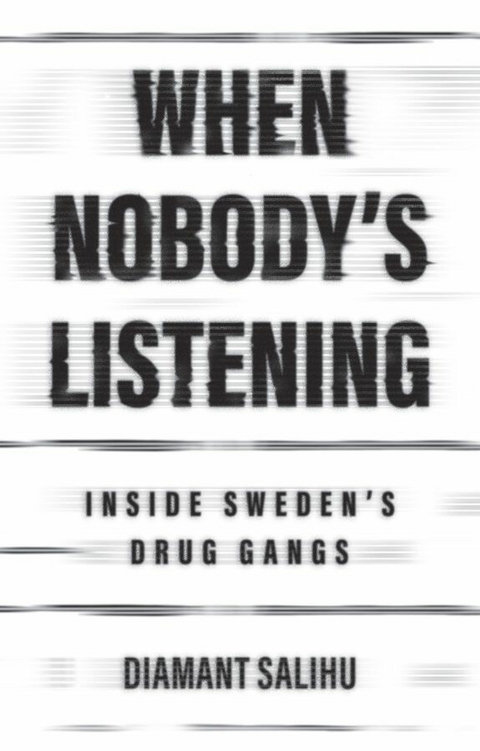
When Nobody's Listening (eBook)
379 Seiten
Polity Press (Verlag)
978-1-5095-6464-4 (ISBN)
To save lives, the police must respond quickly, but must also be careful not to reveal that they're listening in. As unexpected arrests of criminals grow increasingly frequent, criminal networks come into view, with nodes dotted all across Europe, all prepared to do whatever it takes to gain control of the drug trade. One name in particular will come to haunt the investigators: the Kurdish Fox, a notorious gang leader with ambitions to become the Pablo Escobar of Scandinavia.
Diamant Salihu's gripping story lifts the veil on a shadowy underworld swathed in secrecy but responsible for some of today's most violent crimes.
Diamant Salihu is one of Sweden's most influential investigative journalists. He has won numerous awards for his work, including Stora Journalistpriset for the 'Voice of the Year' category (the biggest prize for journalism in Sweden), Guldspaden (best investigative journalism), Natur & Kulturs Non-Fiction prize (the biggest nonfiction prize in Sweden) and Bernspriset (the Swedish PEN prize).
In a quiet little town in northern France, an improbable sequence of events takes place which will go on to transform completely the struggle against organised crime in Europe. It all starts when the French cybercrime police hacks into an encrypted service called Encrochat: suddenly anonymity crumbles and murder contracts and drug deals become visible on the screen. Police are able to follow communications between drug couriers, gang leaders, and teenage hitmen in real time. To save lives, the police must respond quickly, but must also be careful not to reveal that they re listening in. As unexpected arrests of criminals grow increasingly frequent, criminal networks come into view, with nodes dotted all across Europe, all prepared to do whatever it takes to gain control of the drug trade. One name in particular will come to haunt the investigators: the Kurdish Fox, a notorious gang leader with ambitions to become the Pablo Escobar of Scandinavia. Diamant Salihu s gripping story lifts the veil on a shadowy underworld swathed in secrecy but responsible for some of today s most violent crimes.
PREFACE TO THE ENGLISH EDITION
At the time of writing, a year has passed since this book was originally published in Swedish, and I’ve long since lost count of all the children who have been systematically exploited to carry out bombings and shootings. When I went on parental leave, I kept in touch with gang members and family members of victims on my phone during visits to playgrounds. One of the people I was in contact with was a grandfather called Ömer. His son had been shot dead in his home in the south of Stockholm. According to sources in the criminal underworld, the victim’s son, Ömer’s grandson, had been accused of shooting at Rawa Majid’s relatives in Uppsala, and the murder was an act of retribution. When I met with Ömer later on, he was beside himself with grief. He told me how his family had worked hard to earn an honest living since leaving Turkey four decades ago.
‘My son had a good life here’, he said, with tired eyes. ‘What’s happening in Sweden right now is more than just a conflict between gangs. It’s terrorism.’
The charges against Ömer’s grandson and his suspected accomplices were eventually dropped.
Another parent I spoke to told me about how she had tried to convince the local social services to take her son into care, but that they had determined that he wasn’t sufficiently involved in criminal activity for such a measure to be taken. The police barely knew who he was. His mother, however, had seen how quickly things were heading in the wrong direction. He had suddenly begun to spend a great deal of time with some new friends, and he was very evasive in responding to her anxious calls and messages. One day, the police stormed their house. Her anxiety grew into a panic when she realized that her son was being arrested on suspicion of murder.
After participating in a panel discussion on recent developments in Swedish society in a crowded church, I was approached by a grandmother who told me how she’d been babysitting her daughter’s baby when some youths fired a hail of bullets at her front door.
During an onstage interview at the Gothenburg Book Fair in the autumn of 2023, I stressed the point that the criminals I speak to don’t usually blame society or their parents. Rather, they tend to insist that they actively chose their lifestyle. I told the audience about a girl I’d met, who went to university and had gone on to serve on various boards, while her brother had been convicted of murder and handed a life sentence.
‘We had the same opportunities. But when we reached a certain crossroads in life, and I went right, he went left’, the sister had told me.
I noticed a woman at the back of the crowd, who had clearly been moved by this. During the book-signing after the interview, that woman was in the line, accompanied by a young woman, her daughter. They both burst into tears when we met. The story I had just told onstage had resonated deeply within them. The woman’s daughter was pursuing a degree in public health sciences, but her brother was an alleged gang leader who was currently serving a long prison sentence. When they told me that her convicted brother’s young son had pointed and said that ‘That’s where daddy lives’, when they passed by the police station one day, I found myself overcome by emotion, too.
The mother had tried, as parents in her situation often do, to figure out what had gone wrong and what she might have done differently.
Later, lying on the bed in my hotel room, I called a therapist who specializes in helping criminals change their lives and deal with their trauma. My reason for calling was that I had recently come into contact with young women who had been victimized by male gang members and gang-raped. It immediately dawned on me that, being a journalist, I was unable to take on the role of their therapist. Instead, they needed somebody who had experience of giving long-term treatment to trauma and PTSD sufferers.
The therapist could hear how tired and exhausted I was over the phone, and before he answered my questions, he asked me one, instead: ‘What about you, Diamant? Who are you talking to about all this stuff?’
*
When I first began working on When Nobody’s Listening, Rawa Majid – the Kurdish Fox – was virtually unknown in Sweden. By the time I was finalizing the book, he was everywhere. His name and picture were in all the newspapers, alongside articles declaring him to be a notorious Swedish drug lord who sent children out to commit acts of violence in the name of the Foxtrot network. This was in the spring of 2023, when the first of two major waves of violence that year was in full swing. I had to update the book constantly, right up until I submitted the manuscript for publication, as new, highly publicized acts of drug- and honour-fuelled violence were being committed every day. The Foxtrot network was at war with the Dalen network, and the situation seemed to escalate with every bombing, every shooting and every victimized participant or innocent bystander.
Things would soon grow even worse, as even more lines were crossed. That autumn, the second wave of violence of 2023 began and, this time, the conflict was an internal one. Ismail Abdo – also known as the Strawberry – was on one side. His mother was shot dead with a single bullet in her home in Gränby, Uppsala. Her son hails from a family of entrepreneurs, but ended up pursuing a criminal career in the drug trafficking business. He allied himself with Rawa Majid, who also came from Uppsala. However, their loyalties had begun to unravel several months earlier. I’ve received various accounts of why this happened from sources who had previously been members of the network’s inner circle. Rawa Majid had become a megalomaniac, and was ordering an unreasonable number of killings in his highly publicized conflict with the Dalen network during the spring of 2023.
Some sources told me that the turning point for many had been when family members on both sides became targets in the conflict. Others accused Rawa Majid of having claimed too large a portion of the profits from drug trafficking, which was his network’s main source of income. By committing acts of violence and offering guaranteed drug deliveries, Foxtrot had managed to gain influence in many Swedish cities, from north to south, as well as to establish varying degrees of presence in both Norway and Finland. Anybody who was allied with Foxtrot was allowed to sell the drugs the network delivered in their name, enjoying their protection. Anybody who opposed them might end up being the next in line to be murdered. This threat was levelled at rival criminals and their family members alike.
Now, though, a war had erupted within the network. Its leaders had long resided in Turkey, where many of them felt sufficiently secure to settle in the luxurious Maslak neighbourhood in northern Istanbul. Rawa Majid was living there with his family, and had also bought a house just a stone’s throw from the sea in the coastal town of Bodrum. This property had cost him more than 20 million kronor, according to Foxtrot members.
Allegedly, he borrowed some of the money from his contact within the unofficial banking network known as Hawala, which operates internationally. This individual, who was actually an Arabic-speaking man, used the alias ‘Jenny’ in encrypted chats.
Mention of money changers like this individual became increasingly common during that dark autumn. During September 2023 alone, twelve people were killed, two of whom weren’t even indirectly involved in the conflict.
Foxtrot, like other gangs, had come to depend on Hawala bankers, who took a percentage for processing the gangs’ criminal proceeds from drug sales and fraud. In other words, the gangs’ practice of using money changers who operated bureaux de change offices had been discontinued after it was uncovered during the police operation that followed the hacking of the secret Encrochat communications network. Instead, individuals who used the informal Hawala banking system were helping the gangs transfer their funds to countries such as Turkey, the Netherlands, Iraq and the United Arab Emirates. The whole procedure was completely anonymous, and didn’t involve any digital transactions at all. Once they had been handed the cash, it was entirely up to the money changers and their partners to decide how to handle and launder the money.
The money changers were paid to accept the risk of the money being seized. However, there were so many millions being moved around every day that any such loss would be quickly recouped thanks to the fees the gangs were paying. Long before the internal strife began, Foxtrot had also begun to suffer the consequences of a series of successful police operations leading to major drug seizures. The gang had used credits offered by ‘Jenny’ and other money changers to buy a lot of the drugs that were seized. A well-organized criminal network would have managed to quickly repay these debts, but as the internal rivalries intensified and the justice system achieved more successes, the debt held by Rawa Majid alone is alleged to have grown to tens of millions of kronor.
The police were also growing more effective in combatting the gangs.
The Swedish Police Authority had expanded its operations, and called in extra staff to the regions where there had been a particular uptick in violent crime. Since many of...
| Erscheint lt. Verlag | 7.4.2025 |
|---|---|
| Übersetzer | Jan Salomonsson |
| Sprache | englisch |
| Themenwelt | Recht / Steuern ► Strafrecht |
| Sozialwissenschaften ► Soziologie | |
| Schlagworte | Bombing • crime in Europe • crime in Sweden • criminal justice system • criminal networks in Europe • Diamant Salihu • drug networks • drug rackets • Drugs • Drug Trade • EncroChat • encrypted chat • European gangs • France • Gang Activity • Gangs • gang violence in Sweden • Greece • gun crime • hit men • Kidnapping • Knife crime • Kurdish Fox • Mafia • male violence • Morocco • Murder • murder rate in Europe • murders in Stockholm • murders in Sweden • Narco • Netherlands • Police • Scandinavia • Somalia • South America • threats • True Crime • Turkey • what is to be done about drug-related violence? • which city has the highest murder rate in Europe? • why are people increasingly drawn towards violence? • why are young people drawn into crime? • why is Sweden the gun capital of Europe? • why is violence rising in Europe? |
| ISBN-10 | 1-5095-6464-0 / 1509564640 |
| ISBN-13 | 978-1-5095-6464-4 / 9781509564644 |
| Informationen gemäß Produktsicherheitsverordnung (GPSR) | |
| Haben Sie eine Frage zum Produkt? |
 EPUB (Adobe DRM)
Kopierschutz: Adobe-DRM
Adobe-DRM ist ein Kopierschutz, der das eBook vor Mißbrauch schützen soll. Dabei wird das eBook bereits beim Download auf Ihre persönliche Adobe-ID autorisiert. Lesen können Sie das eBook dann nur auf den Geräten, welche ebenfalls auf Ihre Adobe-ID registriert sind.
Details zum Adobe-DRM
Dateiformat: EPUB (Electronic Publication)
EPUB ist ein offener Standard für eBooks und eignet sich besonders zur Darstellung von Belletristik und Sachbüchern. Der Fließtext wird dynamisch an die Display- und Schriftgröße angepasst. Auch für mobile Lesegeräte ist EPUB daher gut geeignet.
Systemvoraussetzungen:
PC/Mac: Mit einem PC oder Mac können Sie dieses eBook lesen. Sie benötigen eine
eReader: Dieses eBook kann mit (fast) allen eBook-Readern gelesen werden. Mit dem amazon-Kindle ist es aber nicht kompatibel.
Smartphone/Tablet: Egal ob Apple oder Android, dieses eBook können Sie lesen. Sie benötigen eine
Geräteliste und zusätzliche Hinweise
Buying eBooks from abroad
For tax law reasons we can sell eBooks just within Germany and Switzerland. Regrettably we cannot fulfill eBook-orders from other countries.
aus dem Bereich