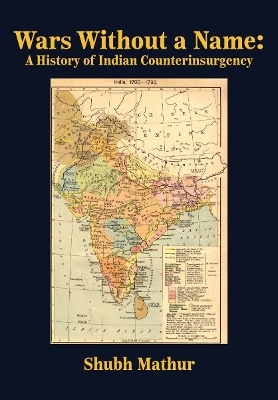
Wars Without a Name
Academica Press (Verlag)
978-1-68053-577-8 (ISBN)
Indian counterinsurgency has expanded steadily over the years, adding a new region in each decade since the 1950s. Beginning with Nagaland, these wars without a name have followed a remarkably consistent pattern throughout the Northeast, in Punjab, Kashmir, and the central Indian Tribal Belt up to the present day. Such shared features as blanket repression, intensive military mobilization, large scale violence against civilians, and the de jure and de facto impunity given to military and police forces provide an important corrective to facile descriptions of India as the "world's largest democracy." Received wisdom in Indian politics has long held that a strong, centralized government is needed to manage and control the wealth of diversity and pluralism that characterizes the subcontinent. In practice, the imbalance created by a powerful center and the absence of regional autonomy has produced a pattern of cumulative and escalating ethnic and regional conflict. This pattern is characteristic of the post-independence state in India, and indeed in all of South Asia. It might be seen as the outcome of the superimposition of a strong centralized power structure and extractive economy on a terrain of ethnic and religious difference. Read as a whole, these conflicts provide a portrait of the relationship between Indian state and society on the one hand and ethnic and religious minorities on the other.
Shubh Mathur is an independent scholar specializing in anthropology, history, and international affairs. She has published extensively on human rights, religious nationalism, state violence and sovereignty, including three books: The Everyday Life of Hindu Nationalism: An Ethnographic Account, The Human Toll of the Kashmir Conflict: Grief and Courage in a South Asian Borderland and (co-edited with Mirza Saaib Bég), and Life, Politics, and Resistance in Kashmir after 2019: A Multidisciplinary Understanding of the Conflict. Mathur's current interests include environmental ethics and animal rights. She believes that the notion of sovereignty as unchecked power links political violence with environmental devastation, and that the way we treat the natural world is a reflection of how we treat each other.
| Erscheinungsdatum | 02.04.2025 |
|---|---|
| Verlagsort | Bethesda |
| Sprache | englisch |
| Maße | 152 x 229 mm |
| Themenwelt | Geisteswissenschaften ► Geschichte ► Regional- / Ländergeschichte |
| Geschichte ► Teilgebiete der Geschichte ► Militärgeschichte | |
| Sozialwissenschaften ► Politik / Verwaltung ► Europäische / Internationale Politik | |
| ISBN-10 | 1-68053-577-3 / 1680535773 |
| ISBN-13 | 978-1-68053-577-8 / 9781680535778 |
| Zustand | Neuware |
| Informationen gemäß Produktsicherheitsverordnung (GPSR) | |
| Haben Sie eine Frage zum Produkt? |
aus dem Bereich