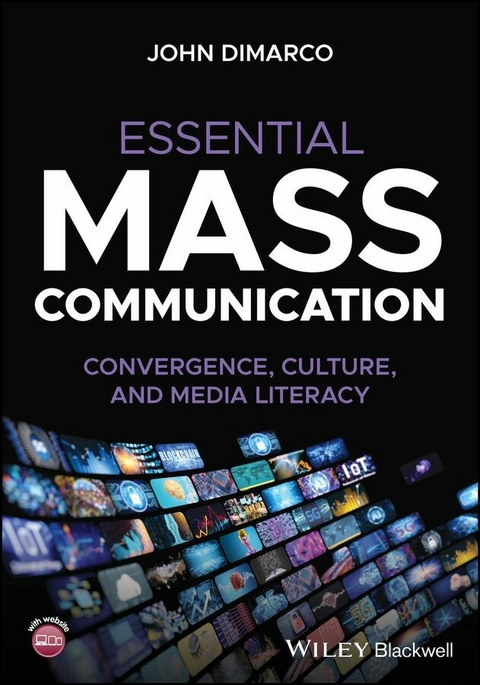
Essential Mass Communication (eBook)
1203 Seiten
Wiley-Blackwell (Verlag)
978-1-394-16297-0 (ISBN)
Helps students develop the ability to analyze culture and utilize media literacy techniques, provides the core skills necessary to succeed in a communications career
Essential Mass Communication helps students build a strong understanding of communication theory, mass communication technology, information studies, and mass communication practices. Offering an expanded view of the field, this comprehensive textbook combines easily accessible coverage of core skills and concepts with historically critical content on mass communication revolutions, cultural impacts, and converging media as they changed society. Throughout the text, author John DiMarco integrates professional practice components into each chapter, including professional pathways to applying mass communication to students' careers.
Essential Mass Communication addresses a variety of creative fields, such as storytelling, rhetoric, journalism, marketing and advertising, design, fine art, photography, and filmmaking. Student-friendly chapters explore a uniquely wide range of topics, from introductory content on communication process and product to more in-depth discussion of game history and theory, critical theory, strategic communication, and more.
Designed to help aspiring creative professionals learn and use the technology tools and channels available to deliver cultural and personal experiences in the form of media products, Essential Mass Communication:
- Introduces the concepts of mass communication and establishes foundations for understanding convergence and culture
- Provides the skills and knowledge required to apply critical media literacy analysis techniques in different fields
- Discusses the driving technologies, key people, convergence, and cultural instances of each mass communication media
- Covers the business and information disciplines of mass communication, including ethics and communication law
- Highlights the connection between communication technologies, culture, and careers in mass media
- Includes a wealth of real-world case studies, applied examples and assignments, key term definitions, end-of-chapter questions, in-text QR codes linking to internet sources, and valuable appendices for career development
With a strong focus on creative, active learning, Essential Mass Communication: Convergence, Culture, and Media Literacy is the perfect textbook for undergraduate and graduate courses in Mass Communication, Information Studies, and Communication technologies, as well as relevant courses in Media Studies, International Communications, and Marketing, Advertising, and Public Relations programs.
JOHN DIMARCO, Ph.D, is Professor of Mass Communication and Digital Media Design at St. John's University, NY, USA. He is a patented inventor and a nonfiction writer who has published numerous peer-reviewed articles and book chapters. He is the author of five textbooks, including Communications Writing and Design and Digital Design for Print and Web. Dr. DiMarco has taught, written, trained, and consulted in creativity, design thinking, new product development, digital media, instructional design, persuasive communication, and career building for the past 25 years.
Helps students develop the ability to analyze culture and utilize media literacy techniques, provides the core skills necessary to succeed in a communications career Essential Mass Communication helps students build a strong understanding of communication theory, mass communication technology, information studies, and mass communication practices. Offering an expanded view of the field, this comprehensive textbook combines easily accessible coverage of core skills and concepts with historically critical content on mass communication revolutions, cultural impacts, and converging media as they changed society. Throughout the text, author John DiMarco integrates professional practice components into each chapter, including professional pathways to applying mass communication to students' careers. Essential Mass Communication addresses a variety of creative fields, such as storytelling, rhetoric, journalism, marketing and advertising, design, fine art, photography, and filmmaking. Student-friendly chapters explore a uniquely wide range of topics, from introductory content on communication process and product to more in-depth discussion of game history and theory, critical theory, strategic communication, and more. Designed to help aspiring creative professionals learn and use the technology tools and channels available to deliver cultural and personal experiences in the form of media products, Essential Mass Communication: Introduces the concepts of mass communication and establishes foundations for understanding convergence and culture Provides the skills and knowledge required to apply critical media literacy analysis techniques in different fields Discusses the driving technologies, key people, convergence, and cultural instances of each mass communication media Covers the business and information disciplines of mass communication, including ethics and communication law Highlights the connection between communication technologies, culture, and careers in mass media Includes a wealth of real-world case studies, applied examples and assignments, key term definitions, end-of-chapter questions, in-text QR codes linking to internet sources, and valuable appendices for career development With a strong focus on creative, active learning, Essential Mass Communication: Convergence, Culture, and Media Literacy is the perfect textbook for undergraduate and graduate courses in Mass Communication, Information Studies, and Communication technologies, as well as relevant courses in Media Studies, International Communications, and Marketing, Advertising, and Public Relations programs.
Preface
The Creative Professional and Mass Communication
Individuals and professionals across business domains make creative communication utilizing creative skills in research, writing, design, production, and performance using technologies specialized for their fields. Have you ever used creativity to make something new that communicates an idea, message, sound, or still image or moving image? Regardless of the field or industry one works in, creativity is used to communicate with others, make new things, and solve problems. Thus, creative media skills become personal tools for all of us, and most importantly they become career tools for dedicated “creative professionals” across industries. Creative media skills can be self‐taught, transferred through personal learning, internship experiences, or acquired in a college, art school, or technical school – you already know this, as you have a wide set of your own – making you creative. Once you focus professional work on creativity, you become a creative professional.
The creative professional is intimately involved in mass communication. The prose and production quality, as well as the business directives needed in mass media, require a creative team of professionals who possess core skills in the following creative fields: storytelling, rhetoric, journalism, persuasion (marketing, advertising, public relations), design, fine art, photography, and film making, and understand the technology tools and channels available to deliver cultural and personal experiences in the form of media products. These core skills are the ones that you will build as you grow in a communications career. Let us walk through them briefly next, as we expand on these areas in greater depth in the following chapters exploring mass communication, media literacy, and creativity, and how they can connect to you.
Story Telling
Story telling is a living process that allows us to imagine according to information. Scholar Dr. Amy Spaulding bullets storytelling as an “organic art” and an “antidote to impersonality.” A living process according to Spaulding, story and information are intertwined entities, but have distinct differences. Whereas information is about distinguishing facts based on data gathered through observation and calculation sources, the story is about making the meaning of facts and data.1 The meaning made is planned to provide a direction toward one or more combined core media goals to inform, persuade, entertain, or educate.
Storytelling in written form is always a starting point for media products. It was at the beginning of mass communication, with orators and scribes delivering tales to crowds. In modern mass media products, visualization and writing out of ideas before production and delivery is a required practice in professional storytelling. Whether it be speeches, monologues, comedy routines, scripts, storyboards, content maps, or proposals, writing and presentation design is critical to pitching the quality and audience value of a proposed project. Presentation design is used to explain story ideas before media productions are financially approved. Storytelling across mass media is the invisible element that nurtures drama, comedy, suspense, action, and instruction to elicit emotional and logical connections for the audience that relate to their experiences reflected in settings, characters, and plots.
All media professionals tell stories in some form, making storytelling a critical mass communication skill. The ability to transcend experiences into entertaining and audience‐relevant content for delivery to an audience is the job of a storyteller. Professionally, in industries like Internet video, film, television, and publishing, writers, directors, designers, actors, and producers telling stories will meticulously research and document source materials, write storylines, and then produce a final communication product in a media format based on the communication channel delivering the message.
Rhetoric
Rhetoric is the art and science of oral presentation and argument of ideas. It surrounds spoken language and is the oldest and most influential social practice medium. It holds a place in the history of ideas as a tradition with three sets of concepts: preparing a speech, addressing the audience, and commonplace argument.2
Three sets of rhetorical concepts3
- Speech Preparation (Five stages)
- Inventio. Conceptualizing and collecting subject matter information to form main points and arguments.
- Dispositio. Structure planning of the speech to order the subject matter logically and pragmatically.
- Elecoutio. Linguistic delivery of the speech with emphasis on specific articulations.
- Memoria. Memorization of the speeches form, content, and delivery approach.
- Actio. Performance of the speech to an audience with the goal of persuasion.
- Audience delivery with the goal of persuasion (focused on action–).
- Ethos. Authority to speak on a subject creating subject matter credibility.
- Logos. Logical arguments that present reasons to alter opinion.
- Pathos. Emotional connection that relates to personal, social, and familial feelings and memories.
- Common place connection
- Topos, which means a place referring to familiar places that speakers share with audiences. This parallel connection to audiences with commonplace ideas becomes a topical argument that needs but a few concrete examples to persuade audience members with shared experiences.
Rhetoric is seen in modern‐day mass media in spoken words in media products including talk shows, newscasts, in article quotes, speeches, political debates, and interviews.
Journalism
Journalism is the art, science, and process of researching, observing, assembling, verifying, and publishing accurate facts based on credible sources of data and serves to provide citizens with reliable information needed to function in a free society.4
Journalists see themselves as having a literal sixth sense, called a “nose for news” to find instances of news. News is qualified by situations, activities, accounts, and outcomes that are relevantly rooted in phenomenon existing in society and culture. The term journalist used to be a label for someone who kept public records and presented them to the public; journalists now range across a slate of job titles and organizations, in both corporate and freelance positions, including photojournalists, publishers, photographers, field producers, trend writers, reviewers, and bloggers.5
Persuasion and Integrated Marketing Communications (IMC)
Persuasion is the use of messages and arguments aimed at logical and emotional reception with the goal of creating action in the message receiver. That action could be to make a purchase or believe in something, some idea, or somebody. The persuasion industries in mass communication include marketing, advertising, public relations, and sales promotion. These professional disciplines make up the core competencies in IMCs, succinctly called IMC in the business world. Companies practice IMC across different media channels with multiple media products. Professionals in the field may be practitioners of only one discipline, say public relations, or work across disciplines to produce multiple projects in IMC.
IMC brings together multiple approaches to persuasion to create a bubble of messages around media and product consumers so that they are inescapably engaged. It is important to realize that companies are using a mixture of methods to induce persuasion in the media. The media mix is a combination of touchpoint activities that yields different modes to reach audiences.
The focus of IMCs is to generate touchpoints, which are connections that brands make with audiences across different media products and media channels.6 Multiple interactions with consumers build trust and brand awareness, which can trigger a purchase, beyond a simple need. Touch points go across all media so an example for a consumer product purchased in a retail store…here’s what the touchpoints might look like: an advertisement showing the product and announcing launch dates in a magazine to inform consumers, a press release announcing the new product launch to inform the news media, a television commercial with a call‐to‐action persuading consumers to buy, a product purchase display and packaging represented at a public retail location or an online store. After the purchase, the touch points may continue with a product registration card that requires name, email, and dates of purchase, which will become a lead for a direct email marketing message set or digital ad, initiated by cookies that index data codes to a computer's IP address, which will follow someone around on the web as they search other websites. All in the name of announcing a flash sale or announcing the next new product offering.
Mass media persuasion disciplines advertising, public relations, marketing, and sales promotion gain media recognition and customer attention, which can be paid, self‐produced, or earned. Adding to the traditional media products delivered on commercial media channels of radio, television, and print...
| Erscheint lt. Verlag | 25.3.2025 |
|---|---|
| Sprache | englisch |
| Themenwelt | Sozialwissenschaften ► Kommunikation / Medien |
| Sozialwissenschaften ► Politik / Verwaltung | |
| Sozialwissenschaften ► Soziologie | |
| Schlagworte | mass communication convergence • mass communication creative career • mass communication creative fields • mass communication practice • mass communication technologies • mass communication textbook • media literacy creative fields • media literacy textbook |
| ISBN-10 | 1-394-16297-9 / 1394162979 |
| ISBN-13 | 978-1-394-16297-0 / 9781394162970 |
| Informationen gemäß Produktsicherheitsverordnung (GPSR) | |
| Haben Sie eine Frage zum Produkt? |
 EPUB (Adobe DRM)
Kopierschutz: Adobe-DRM
Adobe-DRM ist ein Kopierschutz, der das eBook vor Mißbrauch schützen soll. Dabei wird das eBook bereits beim Download auf Ihre persönliche Adobe-ID autorisiert. Lesen können Sie das eBook dann nur auf den Geräten, welche ebenfalls auf Ihre Adobe-ID registriert sind.
Details zum Adobe-DRM
Dateiformat: EPUB (Electronic Publication)
EPUB ist ein offener Standard für eBooks und eignet sich besonders zur Darstellung von Belletristik und Sachbüchern. Der Fließtext wird dynamisch an die Display- und Schriftgröße angepasst. Auch für mobile Lesegeräte ist EPUB daher gut geeignet.
Systemvoraussetzungen:
PC/Mac: Mit einem PC oder Mac können Sie dieses eBook lesen. Sie benötigen eine
eReader: Dieses eBook kann mit (fast) allen eBook-Readern gelesen werden. Mit dem amazon-Kindle ist es aber nicht kompatibel.
Smartphone/Tablet: Egal ob Apple oder Android, dieses eBook können Sie lesen. Sie benötigen eine
Geräteliste und zusätzliche Hinweise
Buying eBooks from abroad
For tax law reasons we can sell eBooks just within Germany and Switzerland. Regrettably we cannot fulfill eBook-orders from other countries.
aus dem Bereich