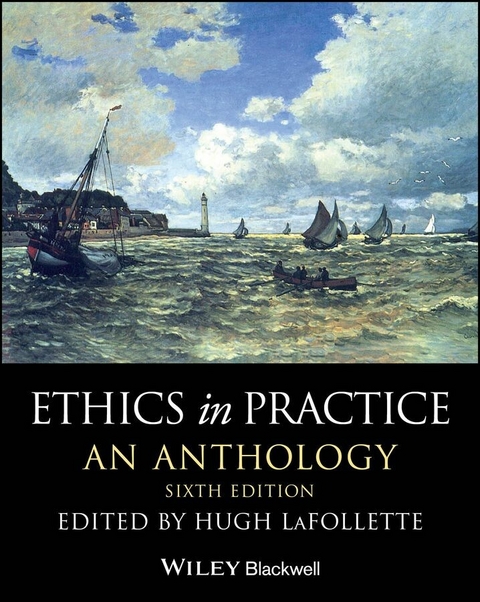
Ethics in Practice (eBook)
800 Seiten
Wiley (Verlag)
978-1-394-21069-5 (ISBN)
Praise for ETHICS in PRACTICE
'This new edition of Ethics in Practice offers a cornucopia of 72 expertly-edited texts - both canonical and contemporary - on a wonderfully wide selection of topics in moral theory and applied ethics. Students, teachers, and researchers will find in it a practically endless source of thought-provoking and conversation-sparking readings.'
-STUART GREEN, Distinguished Professor of Law, Rutgers University
'Those of us who write and teach in practical ethics owe a debt of gratitude to Hugh LaFollette for assembling this superb collection of important contributions to the core theoretical questions and pressing contemporary issues in moral philosophy.'
-CHRISTOPHER HEATH WELLMAN, Washington University in St. Louis
Ethics in Practice has guided students through the ethical dimensions of controversial debates for more than two decades, providing the knowledge required to confront difficult questions in various practical moral contexts. Now in its sixth edition, this field-defining textbook explores a wide range of global, local, and personal ethical issues while presenting the historical basis of key developments in ethical theory.
Editor Hugh LaFollette, highly regarded for his contributions in the field of practical ethics, critically integrates ethical theory with discussion of applied examples of economic injustice, discrimination, incarceration, genetic modification, gun control, torture, euthanasia, hate speech, and more. Throughout the book, student-friendly introductions clarify complex concepts and highlight the theoretical and practical aspects of each issue discussed.
This new edition is fully revised to reflect the latest empirical evidence and applications, including new and updated case studies, examples, data, and references. Entirely new essays address topics such as punishment, sentencing, assassination, the environment, epistemic vices, pragmatic ethics, biomedical technologies, and abortion in the post-Dobbs era.
HUGH LAFOLLETTE is Emeritus Professor of Philosophy and Emeritus Cole Chair at the University of South Florida, St. Petersburg. He is the author of several books, most recently In Defense of Gun Control. He is the editor of numerous works, including the International Encyclopedia of Ethics and The Blackwell Guide to Ethical Theory. He primarily works on diverse issues in practical and normative ethics.
Praise for ETHICS in PRACTICE This new edition of Ethics in Practice offers a cornucopia of 72 expertly-edited texts both canonical and contemporary on a wonderfully wide selection of topics in moral theory and applied ethics. Students, teachers, and researchers will find in it a practically endless source of thought-provoking and conversation-sparking readings. STUART GREEN, Distinguished Professor of Law, Rutgers University Those of us who write and teach in practical ethics owe a debt of gratitude to Hugh LaFollette for assembling this superb collection of important contributions to the core theoretical questions and pressing contemporary issues in moral philosophy. CHRISTOPHER HEATH WELLMAN, Washington University in St. Louis Ethics in Practice has guided students through the ethical dimensions of controversial debates for more than two decades, providing the knowledge required to confront difficult questions in various practical moral contexts. Now in its sixth edition, this field-defining textbook explores a wide range of global, local, and personal ethical issues while presenting the historical basis of key developments in ethical theory. Editor Hugh LaFollette, highly regarded for his contributions in the field of practical ethics, critically integrates ethical theory with discussion of applied examples of economic injustice, discrimination, incarceration, genetic modification, gun control, torture, euthanasia, hate speech, and more. Throughout the book, student-friendly introductions clarify complex concepts and highlight the theoretical and practical aspects of each issue discussed. This new edition is fully revised to reflect the latest empirical evidence and applications, including new and updated case studies, examples, data, and references. Entirely new essays address topics such as punishment, sentencing, assassination, the environment, epistemic vices, pragmatic ethics, biomedical technologies, and abortion in the post-Dobbs era.
Source Acknowledgments
The editor and publisher gratefully acknowledge the permission granted by rightsholders to reproduce their copyright material in the following chapters:
- 1 William H. Shaw, revised and abridged version of “The Consequentialist Perspective,” pp. 5–20 from James Dreier (ed.), Contemporary Debates in Moral Theory (Oxford: Blackwell, 2006). Reproduced with permission of John Wiley & Sons.
- 2 Reproduced with permission of David McNaughton and Piers Rawling.
- 3 Reproduced with permission of George W. Rainbolt.
- 5 Reproduced with permission of Quassim Cassam.
- 6 Reproduced with permission of Hugh LaFollette.
- 7a Reproduced with permission of Paul Woodruff.
- 8 J. David Velleman, revised version of “Against the Right to Die,” pp. 665–81 from Journal of Medicine and Philosophy 17:6 (1992). Reproduced with permission of Oxford University Press and J. David Velleman.
- 10 Reproduced with permission of John Hardwig.
- 11 Felicia Nimue Ackerman, “‘For Now Have I My Death’: The ‘Duty to Die’ Versus the Duty to Help the Ill Stay Alive,” Midwest Studies in Philosophy XXIV (2000). Reproduced with permission of John Wiley & Sons.
- 12 Judith Jarvis Thomson, “A Defense of Abortion,” pp. 47–62, 65–6 from Philosophy and Public Affairs 1:1. Reproduced with permission of John Wiley & Sons.
- 13 Mary Anne Warren, revised version of “On the Moral and Legal Status of Abortion,” pp. 43–61 from The Monist 57 (1973). Reproduced with permission of The Monist: An International Quarterly Journal of General Philosophical Inquiry, Peru, Illinois, USA 61354.
- 14 Reproduced with permission of Don Marquis.
- 15 Rosalind Hursthouse, revised version of “Virtue Theory and Abortion,” pp. 223–246 from Philosophy and Public Affairs 20. Reproduced with permission of John Wiley & Sons.
- 16 Leonard M. Fleck, “The Dobbs Decision: Can It Be Justified by Public Reason?” pp. 310–322 from Cambridge Quarterly of Healthcare Ethics 32:3 (2023). This is an open access article distributed under the terms of the Creative Commons CC BY license, which permits unrestricted use, distribution, and reproduction in any medium, provided the original work is properly cited.
- 17 Peter Singer, “All Animals are Equal,” from Philosophical Exchange 1 (1974). © 1974 by Peter Singer. Reproduced with permission of the author.
- 18 R. G. Frey, “Moral Standing, the Value of Lives, and Speciesism,” pp. 191–201 from Between the Species 4 (1988). Reproduced with permission of the author and online journal.
- 19 Tom Regan, “The Case for Animal Rights,” pp. 13–26 from Peter Singer (ed.), In Defense of Animals. Oxford: Basil Blackwell, 1985. Reproduced with permission of John Wiley & Sons.
- 21 Elizabeth S. Anderson, “Is Women’s Labor a Commodity?” pp. 71–92 from Philosophy and Public Affairs 19:1 (1990). Reproduced with permission of John Wiley & Sons.
- 22 Reproduced with permission of Maximilian Kiener and Thomas Douglas.
- 23 Reproduced with permission of Christopher Gyngell.
- 25 Reproduced with permission of Ronald Sandler.
- 26 David Schmidtz, revised version of “A Place for Cost–Benefit Analysis,” pp. 148–71 from Philosophical Issues 11 (Noûs supplement, 2001). Reproduced with permission of John Wiley & Sons.
- 27 Thomas E. Hill, Jr., “Ideals of Human Excellence and Preserving Natural Environments,” pp. 211–24 from Environmental Ethics 5 (1983). Reproduced with permission of the author and Environmental Ethics.
- 28 Stephen M. Gardiner, from A Perfect Moral Storm: The Ethical Tragedy of Climate Change. Oxford: Oxford University Press, 2011, revised version of “A Perfect Moral Storm: Climate Change, Intergenerational Ethics and the Problem of Moral Corruption,” Environmental Values 15:3 (2006) pp. 397–413. © 2006 The White Horse Press. Reproduced with permission.
- 29 Reproduced with permission of Elaine E. Englehardt and Michael S. Pritchard.
- 31 James Q. Wilson, “Against the Legalization of Drugs,” from Commentary (February 1990). Reproduced with permission.
- 32 Douglas Husak, “Why We Should Decriminalize Drug Use,” pp. 21–29 from Criminal Justice Ethics 22:1 (Winter/Spring 2003) © by John Jay College of Criminal Justice of The City University of New York. Reproduced with permission of Taylor & Francis Ltd, www.tandfonline.com on behalf of John Jay College of Criminal Justice of The City University of New York and of the author.
- 33 Todd C. Hughes and Lester H. Hunt, revised version of “The Liberal Basis of the Right to Bear Arms,” pp. 1–25 from Public Affairs Quarterly 14 (2000). Reproduced with permission of Public Affairs Quarterly.
- 34 Hugh LaFollette, “Gun Control.” This essay first appeared in Ethics 110:2 (2000), pp. 263–81. Reproduced with permission of The University of Chicago Press.
- 35 John Stuart Mill, abridged and edited from 2 of On Liberty. Indianapolis, IN: Hackett Publishing Co., 1978.
- 36 Susan J. Brison, revised version of “The Price We Pay?” pp. 236–50 from Christopher Heath Wellman and Andrew Cohen (ed.), Contemporary Debates in Applied Ethics. Malden, MA: Blackwell, 2004. Reproduced with permission of John Wiley & Sons.
- 37 Andrew Altman, “The Right to Get Turned On: Pornography, Autonomy, Equality,” pp. 223–35 from Christopher Heath Wellman and Andrew Cohen (ed.), Contemporary Debates in Applied Ethics. Malden, MA: Blackwell. 2004. Reproduced with permission of John Wiley & Sons.
- 39 Reproduced with permission of Andrew Altman.
- 41 Thomas E. Hill, Jr., “Servility and Self‐Respect,” pp. 87–104 from The Monist (1974). Reproduced with permission of The Monist: An International Quarterly Journal of General Philosophical Inquiry, Peru, Illinois, 61354.
- 42 Alex Madva, “Implicit Bias, Moods, and Moral Responsibility,” pp. 53–78 from Pacific Philosophical Quarterly 99 (2017). Reproduced with permission of John Wiley & Sons.
- 43 Reproduced with permission of Luke Charles Harris and Uma Narayan.
- 44 Jennifer Saul, updated and adapted version of “Stop Thinking So Much About ‘Sexual Harassment’,” Journal of Applied Philosophy 31:3 (2014), pp. 307–21. Reproduced with permission of John Wiley & Sons.
- 45 Larry May and Robert Strikwerda, revised version of “Men in Groups: Collective Responsibility for Rape,” pp. 134–51 from Hypatia 9:2 (1994). Reproduced with permission of Cambridge University Press and Robert Strikwerda.
- 51 Hugh LaFollette, “My Conscience May Be My Guide, But You May Not Need to Honor It,” Cambridge Quarterly for Healthcare Ethics 26:1 (January 2017), pp. 44–58. Reproduced with permission of Cambridge University Press.
- 52 H. L. A. Hart, “The Presidential Address: Prolegomenon to the Principles of Punishment,” pp. 1–26 from Proceedings of the Aristotelian Society 60 (1959–1960). Reproduced with permission of Oxford University Press.
- 54 Reproduced with permission of Douglas Husak.
- 55 Stuart P. Green, “Just Deserts in an Unjust Society,” pp. 352–376 from R. A. Duff and Stuart P. Green (ed.), Philosophical Foundations of Criminal Law. Oxford: Oxford University Press, 2011. Reproduced with permission of Oxford University Press.
- 56 John Kleinig, “To Protect and Serve: What is Wrong with the Policing of Minorities in the U.S.,” The Critique (“Black Lives Matter (Part II): Understanding The New Movement For Racial Justice,” May/June 2016).
- 57 John Rawls, pp. 11–22, 60–5, 150–6 from A Theory of Justice. Belknap Press of Harvard University Press, 1971. © 1971, 1999 by the President and Fellows of Harvard College. Reproduced with permission of Harvard University Press.
- 58 Robert Nozick, “The Entitlement Theory of Justice,” pp. 140–64, 167–74 from Anarchy, State, and Utopia. Basic Books, 1974. © 1974 by Basic Books, Inc. Reproduced with permission.
- 62 Chandran Kukathas, “Case for Open Immigration” from Andrew I. Cohen and Christopher Heath Wellman (ed.), Contemporary Debates in Applied Ethics, Second Edition. Malden, MA: Blackwell, 2004. Reproduced with permission of John Wiley & Sons.
- 63 Peter Singer, “Famine, Affluence, and Morality,” pp. 229–243 from Philosophy and Public Affairs. Reproduced with permission of John Wiley & Sons.
- 65 Thomas W. Pogge, revised version of “Eradicating Systemic Poverty: Brief for a Global Resources Dividend,” pp. 501–538 from D. Crocker and T. Linden (ed.), Ethics of Consumption. Rowman Littlefield Publishers, Inc., 1997. Reproduced with permission of Rowman & Littlefield Publishers, Inc.
- 67 Reproduced with permission of William J. Hawk.
- 68 Charles R. Beitz, revised version of “The Justifiability of Humanitarian Intervention,” from Bowdoin College...
| Erscheint lt. Verlag | 20.3.2025 |
|---|---|
| Sprache | englisch |
| Themenwelt | Geisteswissenschaften ► Philosophie ► Ethik |
| Sozialwissenschaften | |
| ISBN-10 | 1-394-21069-8 / 1394210698 |
| ISBN-13 | 978-1-394-21069-5 / 9781394210695 |
| Informationen gemäß Produktsicherheitsverordnung (GPSR) | |
| Haben Sie eine Frage zum Produkt? |
 EPUB (Adobe DRM)
Kopierschutz: Adobe-DRM
Adobe-DRM ist ein Kopierschutz, der das eBook vor Mißbrauch schützen soll. Dabei wird das eBook bereits beim Download auf Ihre persönliche Adobe-ID autorisiert. Lesen können Sie das eBook dann nur auf den Geräten, welche ebenfalls auf Ihre Adobe-ID registriert sind.
Details zum Adobe-DRM
Dateiformat: EPUB (Electronic Publication)
EPUB ist ein offener Standard für eBooks und eignet sich besonders zur Darstellung von Belletristik und Sachbüchern. Der Fließtext wird dynamisch an die Display- und Schriftgröße angepasst. Auch für mobile Lesegeräte ist EPUB daher gut geeignet.
Systemvoraussetzungen:
PC/Mac: Mit einem PC oder Mac können Sie dieses eBook lesen. Sie benötigen eine
eReader: Dieses eBook kann mit (fast) allen eBook-Readern gelesen werden. Mit dem amazon-Kindle ist es aber nicht kompatibel.
Smartphone/Tablet: Egal ob Apple oder Android, dieses eBook können Sie lesen. Sie benötigen eine
Geräteliste und zusätzliche Hinweise
Buying eBooks from abroad
For tax law reasons we can sell eBooks just within Germany and Switzerland. Regrettably we cannot fulfill eBook-orders from other countries.
aus dem Bereich