


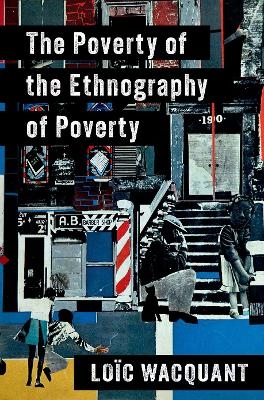
The poverty of the ethnography of poverty
Seiten
2025
|
1. Auflage
Oxford University Press Inc (Verlag)
978-0-19-780401-8 (ISBN)
Oxford University Press Inc (Verlag)
978-0-19-780401-8 (ISBN)
In The Poverty of the Ethnography of Poverty, Loïc Wacquant dissects how sociologists who carry out field studies of the poor write about race, class, and morality in the city's underbelly; the blinders and biases that affect their research and how to overcome them; and how to become aware of these biases and develop a better meshing of theory and research.
Recapitulating the three ages of urban ethnography born in Chicago a century ago, this book puts into historical and analytical perspective a controversy over the ethnography of the nexus of race, class, and morality in and around the black American ghetto in the age of triumphant neoliberalism, in order to draw from it positive lessons for the theory and practice of fieldwork. Thoughtless empiricism, acceptance of problematics prefabricated by ordinary and political common sense, confusion between folk and analytical categories, confinement to the immediate perimeter of interaction, bifurcating moralism: these are all traps that every ethnographer encounters sooner or later on her path and that only collective vigilance can hope to thwart.
This epistemological return is an opportunity to pinpoint the danger of ethnographism, the tendency to want to describe, interpret, and explain a phenomenon based solely on the elements discerned through fieldwork, and to call for the correlative practice of an enactive, structural, and historicized ethnography that sets out to embed the micro-actions observed in the interlocking series of nested social spaces that shape them and give them sense. Such an ethnography allows us to avoid falling into one or another of the five fallacies of participant observation: interactionism, inductivism, populism, presentism, and the hermeneutic drift. And to move beyond Clifford Geertz's "thick description" with the "thick construction" inspired by Pierre Bourdieu, whose mission is to construct scientifically the ordinary social construction of reality.
Recapitulating the three ages of urban ethnography born in Chicago a century ago, this book puts into historical and analytical perspective a controversy over the ethnography of the nexus of race, class, and morality in and around the black American ghetto in the age of triumphant neoliberalism, in order to draw from it positive lessons for the theory and practice of fieldwork. Thoughtless empiricism, acceptance of problematics prefabricated by ordinary and political common sense, confusion between folk and analytical categories, confinement to the immediate perimeter of interaction, bifurcating moralism: these are all traps that every ethnographer encounters sooner or later on her path and that only collective vigilance can hope to thwart.
This epistemological return is an opportunity to pinpoint the danger of ethnographism, the tendency to want to describe, interpret, and explain a phenomenon based solely on the elements discerned through fieldwork, and to call for the correlative practice of an enactive, structural, and historicized ethnography that sets out to embed the micro-actions observed in the interlocking series of nested social spaces that shape them and give them sense. Such an ethnography allows us to avoid falling into one or another of the five fallacies of participant observation: interactionism, inductivism, populism, presentism, and the hermeneutic drift. And to move beyond Clifford Geertz's "thick description" with the "thick construction" inspired by Pierre Bourdieu, whose mission is to construct scientifically the ordinary social construction of reality.
Loïc Wacquant is Professor of Sociology at the University of California, Berkeley, and Researcher at the Centre Européen de Sociologie et de Science Politique, Paris. His books have been translated into twenty languages and include Body and Soul: Notebooks of an Apprentice Boxer (expanded anniversary edition, 2022), The Invention of the "Underclass": A Study in the Politics of Knowledge (2022), Bourdieu in the City: Challenging Urban Theory (2023), and Racial Domination (2024).
Prologue: In Praise of "Thick Construction"
1. Dissecting the Ethnographic Unconscious
2. Poverty, Race, and Moralism in American Urban Ethnography
3. For a Political Epistemology of Fieldwork
Epilogue: Bachelard in the Ghetto
Acknowledgments
References
Index
| Erscheinungsdatum | 02.08.2025 |
|---|---|
| Verlagsort | New York |
| Sprache | englisch |
| Maße | 156 x 235 mm |
| Gewicht | 342 g |
| Themenwelt | Sozialwissenschaften ► Ethnologie |
| Sozialwissenschaften ► Soziologie ► Empirische Sozialforschung | |
| ISBN-10 | 0-19-780401-2 / 0197804012 |
| ISBN-13 | 978-0-19-780401-8 / 9780197804018 |
| Zustand | Neuware |
| Informationen gemäß Produktsicherheitsverordnung (GPSR) | |
| Haben Sie eine Frage zum Produkt? |
Mehr entdecken
aus dem Bereich

aus dem Bereich
Buch | Hardcover (2023)
De Gruyter Oldenbourg (Verlag)
CHF 48,90
Buch | Hardcover (2022)
Springer VS (Verlag)
CHF 209,95
Gestalt und Struktur biographischer Selbstbeschreibungen
Buch | Softcover (2024)
Campus (Verlag)
CHF 49,95


