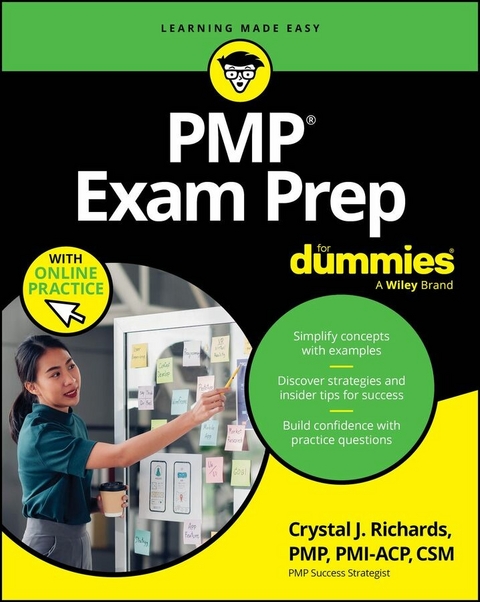
PMP Exam Prep For Dummies (eBook)
550 Seiten
For Dummies (Verlag)
978-1-394-30050-1 (ISBN)
Discover an exciting and lucrative new career in project management
Project management is one of the most flexible, engaging, and lucrative careers available today. And nothing gets you ready for it quite like the Project Management Professional (PMP) certification exam, which awards the gold-standard qualification in the field. PMP Exam Prep For Dummies walks you through every step you need to take to acquire your PMP credential. The book covers all aspects of the PMP certification exam, helping you learn to manage a project's people, processes, and business priorities with ease.
Applicable to virtually any industry-including health, construction, and information technology-the book offers:
- Critical info about the certification process, the application, the exam, and more
- Strategies for learning the most relevant parts of the Project Management Body of Knowledge (PMBOK)
- Complimentary access to an online practice question bank you can use to sharpen your skills and get ready for the test
Perfect for aspiring project management professionals, career changers, and anyone else interested in broadening their business skillset, PMP Exam Prep For Dummies is also a can't-miss resource for practicing project management professionals looking to brush up on the basics. Grab your copy today!
Crystal J. Richards, PMP, PMI-ACP, CSM, lead trainer and owner of MindsparQ®, has more than 20 years of experience in project management. Crystal has successfully trained more than 2,500 business professionals and has more than 65,000 students enrolled in her online courses on the Udemy and EdX platforms. Her expertise has enabled individuals to attain coveted credentials such as PMP®, CAPM®, and PMI-ACP®, while furthering their educational pursuits in project management.
Discover an exciting and lucrative new career in project management Project management is one of the most flexible, engaging, and lucrative careers available today. And nothing gets you ready for it quite like the Project Management Professional (PMP) certification exam, which awards the gold-standard qualification in the field. PMP Exam Prep For Dummies walks you through every step you need to take to acquire your PMP credential. The book covers all aspects of the PMP certification exam, helping you learn to manage a project's people, processes, and business priorities with ease. Applicable to virtually any industry including health, construction, and information technology the book offers: Critical info about the certification process, the application, the exam, and more Strategies for learning the most relevant parts of the Project Management Body of Knowledge (PMBOK) Complimentary access to an online practice question bank you can use to sharpen your skills and get ready for the test Perfect for aspiring project management professionals, career changers, and anyone else interested in broadening their business skillset, PMP Exam Prep For Dummies is also a can't-miss resource for practicing project management professionals looking to brush up on the basics. Grab your copy today!
Chapter 1
Welcome to Your PMP Certification Journey
IN THIS CHAPTER
Recognizing the role and purpose of the Project Management Institute
Discovering the PMI Talent Triangle
Exploring the project management framework
Congratulations on taking the first step in your PMP journey! This chapter is your welcome mat to the world of project management — what I like to call “Planet PMI.” Here, you’ll gain insight into the global standard of project management certification and find out what makes the PMP credential so highly regarded. You’ll take a closer look at the organization behind it all — the Project Management Institute (PMI) — and unpack the essential skills and competencies every project manager needs to excel, as outlined in the PMI Talent Triangle. To help you hit the ground running, I’ll also introduce some foundational terminology to familiarize you with the language of project management.
Let’s dive in!
PMP: Recognizing the Global Standard
When it comes to project management certification, the Project Management Professional (PMP) credential says, “Mamma, I made it!” in regard to project management excellence. For professionals with project management experience, the PMP certification is the ultimate badge of honor. It signifies a mastery of project management concepts, techniques, and best practices, distinguishing individuals as competent project management specialists.
The journey toward PMP certification is not an easy one, as it requires a substantial amount of project leadership experience. However, it’s precisely the challenges and dedication required that make achieving this certification such a remarkable feat. As a trainer, being part of the PMP certification process fills me with immense pride. Witnessing individuals invest countless hours honing their skills and demonstrating their expertise is a testament to their unwavering determination.
Here are a few reasons why the PMP designation matters:
- It is a globally recognized credential.
- It includes benefits such as industry recognition, professional development, increased job prospects, and higher earning potential.
- It requires that a project manager meet certain work and education requirements and then pass a rigorous, closed-book, 180-question exam.
- It reports 32-percent higher compensation than non-credentialed project managers.
This means that you have greater potential for job opportunities, networking, promotions, industries, and compensation as a result. Mamma, I made it!
As you prepare to take the PMP Exam, you may wonder why the requirements to sit for the exam are so stringent. This chapter aims to shed light on the rationale behind these requirements and their significance in maintaining the integrity and value of the PMP certification.
Introducing the Project Management Institute
You may wonder who makes this all happen with the PMP credential. That would be the Project Management Institute (PMI). PMI is the leading professional association for project management, with over 700,000 PMI members worldwide, offering eight certifications that recognize knowledge and competency, and more than 1,200,000 PMP certification holders worldwide. The PMP certification recognizes project managers who have proven they have the skills to manage projects successfully. The PMP certification was introduced by PMI in 1984, and ever since then, the PMP certification has become the gold standard for project management professionals worldwide.
So there.
PMI has established stringent requirements for candidates to uphold the credibility and value of the PMP certification. These requirements are designed to ensure that individuals who hold the PMP credential possess a standardized level of knowledge, experience, and competence. By maintaining consistent standards, the PMP certification becomes a reliable indicator of a project manager’s capabilities across industries and geographical boundaries.
Professional Skill Sets: Excelling with the PMI Talent Triangle
Another essential aspect of preparing for the PMP journey is understanding the PMI Talent Triangle. The PMI Talent Triangle is a framework introduced by PMI to highlight the key skills and competencies that project managers should possess for success in their roles. These skills are not just about the key competencies of skilled project managers; they also reflect the key domains of the PMP Exam: People, Process, and Business Environment.
The PMI Talent Triangle represents the ideal set of skills project professionals must develop and sharpen to be successful and work smarter in today’s evolving world of project management. Each side of the Triangle reflects the skills project professionals should possess to be successful in their projects. For an illustration of the PMI Talent Triangle, see Figure 1-1.
For further insight on each element of the PMI Talent Triangle, let’s take a look at each one and how they’re demonstrated in practice.
Power Skills
Power Skills, formerly Leadership, pertain to interpersonal skills, collaborative leadership, communication, an innovative mindset, for-purpose orientation, and empathy. Power Skills in practice include the following:
- Clearly communicating the goals and expectations of the project
- Clearly and effectively communicating between team members, stakeholders, and clients
- Delegating tasks effectively, providing feedback, and motivating team members to work towards the project’s goals.
FIGURE 1-1: The PMI Talent Triangle.
Ways of Working
Ways of Working, formerly Technical Project Management, focus on project managers learning different ways to manage their projects, whether they are predictive, Agile, design thinking, or other new practices still to be developed. Ways of Working in practice include the following:
- Knowing the right tools and techniques to use, given the project context and environment
- Structuring a project team with the right skills to execute to the project plan
Business Acumen
Business Acumen, formerly Strategic and Business Management, provides an understanding of the macro- and micro-influences across an organization or industry in order to make effective decisions while understanding how the project aligns with the big picture of broader organizational strategy and global trends. Business Acumen in practice involves the following:
- Understanding the business, the industry, and how projects align specifically with the organization’s strategic objectives
- Understanding the organization’s strategic objectives, market positioning, and financial goals
- Understanding the organization’s culture, structure, and processes to develop change management strategies that are effective and sustainable
For more information about the PMI Talent Triangle, visit the PMI webpage: https://www.pmi.org/certifications/certification-resources/maintain/talent-triangle
Exploring Process Groups, Knowledge Areas, and Project Management Processes
The current PMP Exam is structured around the Exam Content Outline (ECO), which references multiple resources beyond the PMBOK Guide. Therefore, the PMBOK Guide is not the sole source of exam content. (For detailed information, refer to the PMI Exam Content Outline webpage: https://www.pmi.org/certifications/project-management-pmp.)
However, for years, success on the PMP Exam hinged on being familiar with the three key areas: Process Groups, Knowledge Areas, and the project management processes. While this level of detail is no longer required, many instructors, like myself, still find the framework uber-helpful in providing structure to explain the enormity of the best practice details of project management.
That said, let’s walk through a brief overview of those topics.
Taking a granular look: 49 project management processes
The project life cycle is managed by following a series of steps called project management processes. There are 49 of these processes, and this study guide will walk you through the majority of them. Each process includes three key components:
- Input: What you need to get the process started
- Tools and techniques: The methods, tools, or systems used to move the process forward
- Output: The result or deliverable produced by the process
Do you need to memorize all the project management processes by name? Good news — you don’t! While the processes are mentioned in this exam prep guide for context, the current PMP Exam does not require you to commit all 49 project management processes to memory, unlike the old days. You’re off the hook! You’ll find out about each one as you continue. Keep reading!
Project management processes are used globally and are applicable across all industries.
Looking at Process Groups from start to finish
Process Groups provide a way to categorize the 49 project management processes to achieve specific objectives (such as processes to start the project, processes to execute the project, and so on). There are five Process Groups encompassing...
| Erscheint lt. Verlag | 17.3.2025 |
|---|---|
| Sprache | englisch |
| Themenwelt | Schulbuch / Wörterbuch |
| Sozialwissenschaften ► Pädagogik ► Erwachsenenbildung | |
| Schlagworte | how does project management work? • how do I become a project manager? • how much do project managers earn? • PMBOK • PMP certification • PMP certification exam • PMP Exam • pmp exam prep • project management careers • project management jobs • project management professional • project manager salary • what do project managers get paid? • what is a project manager? |
| ISBN-10 | 1-394-30050-6 / 1394300506 |
| ISBN-13 | 978-1-394-30050-1 / 9781394300501 |
| Informationen gemäß Produktsicherheitsverordnung (GPSR) | |
| Haben Sie eine Frage zum Produkt? |
 EPUB (Adobe DRM)
Kopierschutz: Adobe-DRM
Adobe-DRM ist ein Kopierschutz, der das eBook vor Mißbrauch schützen soll. Dabei wird das eBook bereits beim Download auf Ihre persönliche Adobe-ID autorisiert. Lesen können Sie das eBook dann nur auf den Geräten, welche ebenfalls auf Ihre Adobe-ID registriert sind.
Details zum Adobe-DRM
Dateiformat: EPUB (Electronic Publication)
EPUB ist ein offener Standard für eBooks und eignet sich besonders zur Darstellung von Belletristik und Sachbüchern. Der Fließtext wird dynamisch an die Display- und Schriftgröße angepasst. Auch für mobile Lesegeräte ist EPUB daher gut geeignet.
Systemvoraussetzungen:
PC/Mac: Mit einem PC oder Mac können Sie dieses eBook lesen. Sie benötigen eine
eReader: Dieses eBook kann mit (fast) allen eBook-Readern gelesen werden. Mit dem amazon-Kindle ist es aber nicht kompatibel.
Smartphone/Tablet: Egal ob Apple oder Android, dieses eBook können Sie lesen. Sie benötigen eine
Geräteliste und zusätzliche Hinweise
Buying eBooks from abroad
For tax law reasons we can sell eBooks just within Germany and Switzerland. Regrettably we cannot fulfill eBook-orders from other countries.
aus dem Bereich