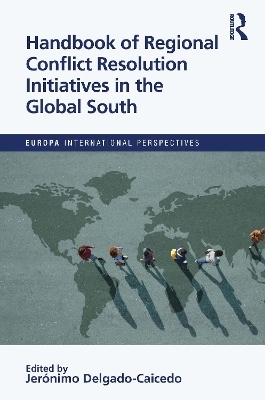
Handbook of Regional Conflict Resolution Initiatives in the Global South
Routledge (Verlag)
9781032261980 (ISBN)
During the first half of the twentieth century, the international system was largely dominated by the USA and the colonial powers of western Europe. After the two world wars, the political and economic dominance of these states guaranteed them and their allies an almost complete control of world politics. However, as it is the norm in the international system, power structures are not immutable. After the end of the Cold War, rapid changes to the existing international hierarchies took place, as new countries from the so-called ‘‘developing world’’ began to emerge as crucial actors capable of questioning and altering the power dynamics of the world. It is therefore unthinkable to ignore emerging countries such as Russia, the People’s Republic of China, India, Brazil or South Africa in the decision-making process in today’s world order.
In addition, there is a group of smaller, yet increasingly important countries that, while acknowledging their inability radically to change the rules of the international system, are still eager to shift power relations and enhance their influence in the world. Argentina, Colombia, Egypt, Indonesia, Iran, South Korea, Mexico, Nigeria, Pakistan, Saudi Arabia, Turkey and Vietnam are generally recognised as part of this grouping of emerging powers from the Global South.
While there is a consensus amongst academics that emerging powers from the Global South must have a stabilising role within their own regions, previous analyses have focused primarily on the impact that emerging powers have had in their own regions’ conflict resolution initiatives. This volume, instead, aims to go beyond these analyses and provide new insights regarding the effect that this stabilising role has on the continental and global positioning of emerging powers. In other words, this book explores the relation between a country’s involvement in conflict resolution initiatives and its positioning in the international system. The volume will contribute to this approach using the perspective of academics and practitioners from countries of the Global South, particularly from states that have strengthened - or sometimes weakened - their position in the international hierarchy of power through a leading role in regional conflict resolution initiatives.
List of Figures
The Editor and Contributors
Acknowledgments
1 Introduction: Going South
Jerónimo Delgado-Caicedo
Part I: Theories of Conflict Resolution and International Positioning in the Global South
2 Emerging Powers, a Radical Change in the Global Hierarchy of Power
Jerónimo Delgado-Caicedo and Juliana Andrea Guzmán-Cárdenas
3 Conflict Resolution and Positioning in the Global Power Hierarchy
Jerónimo Delgado-Caicedo, Juliana Andrea Guzmán-Cárdenas and Lucía Filippo-Aguillón
Part II: The Middle East and North Africa
4 Saudi Arabia and Security in the Middle East, New Challenges and Opportunities
Mohamed Badine El Yattioui and Yassine El Yattioui
5 The Regional (in)security of Iran: Reconstruction, stability and nuclear power
Marcela Álvarez-Pérez and Nathalia Torres-Crespo
6 Turkey: from Successful Mediator to Partisan Actor – Back to Successful Mediator?
Ekrem Eddy Güzeldere
7 Algeria, an Emerging Power in Regional Conflict Resolution Initiatives
Laurence-Aïda Ammour
Part III: South and East Asia
8 India-Pakistan, Intractable Conflict: A Challenge to the Emergence of Regions and Powers
Soraya Stella Caro-Vargas and Kelly Johana Arévalo-Franco
9 Constructive Engagement: Conflict Resolution with Chinese Characteristics
Fujian Li, Kwok Chung Wong and Jin Guanhui
Part IV: Eastern Europe
10 The Emergence of Azerbaijan as a Regional Power: Between Tensions and Neutrality
Soraya Stella Caro-Vargas and Kelly Chaib De Mares
11 Perceptions of the Role of Belarus in the Ukrainian Conflict and the Impact on the International System
Francisco Daniel Trejos-Mateus, Erli Margarita Marín-Aranguren and Kelly Johana Arévalo-Franco
Part V: Sub-Saharan Africa
12 The Shining Black Star of Africa: The Tale of Ghana in Conflict Resolution
Afua Boatemaa Yakohene and Juliana Abena Appiah
13 Implications of Ethiopia’s Engagement in Conflict Resolution Initiatives in the Horn of Africa on its Global Positioning
Kuruvilla Mathews and Adane Alemayehu Tadesse
14 Foreign Policy Imperatives of Nigeria’s Engagement in Conflict Resolution in Africa
Chibueze Nna-Emeka Okereke
15 Kenya’s Regional Leadership in Peace Diplomacy: A Case of Somalia Peace
Process
Paul Odhiambo Odongo
16 Constructive Diplomacy, Quiet Diplomacy, Diplomatic Pan-Africanism and South Africa’s Many Approaches to Conflict Mediation in Africa: An Assessment
Mopeli L. Moshoeshoe and Amy Niang
Part VI: Latin America
17 Brazil and Venezuela’s Migration Crisis: Dealing with a Regional Emergency in a Time of National Crisis
Maurício Santoro Rocha, Maiara Folly and Tássio Franchi
18 Emerging Middle Powers vs. Peripheral Leadership: Argentina and the Malvinas (Falkland) Islands under the Kirchner Administration (2010-15)
Juan Erardo Battaleme
19 Mexico’s Role as a Middle Power: From Diplomatic Activism to Commercial Foreign Policy
Luis Ochoa Bilbao, Myrna Rodríguez Añuez and Juan Pablo Prado Lallande
20 Chile and Regional Peace: A Rising Power Gamble?
María Teresa Aya-Smitmans
Index
| Erscheinungsdatum | 19.03.2025 |
|---|---|
| Reihe/Serie | Europa International Perspectives |
| Zusatzinfo | 5 Tables, black and white; 3 Line drawings, black and white; 3 Illustrations, black and white |
| Verlagsort | London |
| Sprache | englisch |
| Maße | 174 x 246 mm |
| Gewicht | 680 g |
| Themenwelt | Sozialwissenschaften ► Politik / Verwaltung ► Europäische / Internationale Politik |
| Sozialwissenschaften ► Soziologie ► Spezielle Soziologien | |
| ISBN-13 | 9781032261980 / 9781032261980 |
| Zustand | Neuware |
| Informationen gemäß Produktsicherheitsverordnung (GPSR) | |
| Haben Sie eine Frage zum Produkt? |
aus dem Bereich