


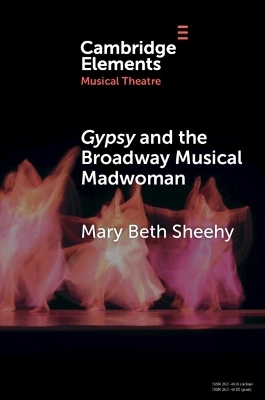
Gypsy and the Broadway Musical Madwoman
A Feminist Analysis
Seiten
2025
Cambridge University Press (Verlag)
978-1-009-55231-8 (ISBN)
Cambridge University Press (Verlag)
978-1-009-55231-8 (ISBN)
Gypsy, the groundbreaking 1959 Broadway musical, introduced musical theatre to one of the most formidable female characters ever to appear on stage: Madam (Momma) Rose. This Element's two-pronged approach uses the frameworks of feminist theory and musicological analysis to consider the importance, legacy, and reception of Rose's journey.
Gypsy, the groundbreaking 1959 Broadway musical by Jule Styne, Stephen Sondheim, and Arthur Laurents, introduced the world of musical theater to one of the most formidable female characters ever to strut onto the stage: Madam (Momma) Rose. She embodies the archetypal “stage mother” whose lifelong journey to achieve fame, enacted vicariously through her daughters and their vagabond life across America, drives her to a “madness” akin to that of the quintessential operatic madwoman. Her famous mad scene, “Rose's Turn,” demonstrates the many analytical possibilities intrinsic to this character definition. The creators of Gypsy's Rose thus showcased the “Broadway musical madwoman” type: a female character who, like her foremother the operatic madwoman, is rife with gendered complexity that creates a fascinating opportunity for feminist analytical study. This Element's two-pronged approach uses the frameworks of feminist theory and musicological analysis to consider the importance, legacy, and reception of Rose's journey.
Gypsy, the groundbreaking 1959 Broadway musical by Jule Styne, Stephen Sondheim, and Arthur Laurents, introduced the world of musical theater to one of the most formidable female characters ever to strut onto the stage: Madam (Momma) Rose. She embodies the archetypal “stage mother” whose lifelong journey to achieve fame, enacted vicariously through her daughters and their vagabond life across America, drives her to a “madness” akin to that of the quintessential operatic madwoman. Her famous mad scene, “Rose's Turn,” demonstrates the many analytical possibilities intrinsic to this character definition. The creators of Gypsy's Rose thus showcased the “Broadway musical madwoman” type: a female character who, like her foremother the operatic madwoman, is rife with gendered complexity that creates a fascinating opportunity for feminist analytical study. This Element's two-pronged approach uses the frameworks of feminist theory and musicological analysis to consider the importance, legacy, and reception of Rose's journey.
1. Overview of gypsy and the Broadway musical madwoman; 2. Gypsy's creative history: inventing rose; 3. Rose's musical numbers; 4. 'Rose's turn': analyzing gypsy's mad scene; Conclusion; References.
| Erscheinungsdatum | 13.05.2025 |
|---|---|
| Reihe/Serie | Elements in Musical Theatre |
| Zusatzinfo | Worked examples or Exercises |
| Verlagsort | Cambridge |
| Sprache | englisch |
| Themenwelt | Kunst / Musik / Theater ► Musik ► Klassik / Oper / Musical |
| Sozialwissenschaften ► Politik / Verwaltung ► Politische Theorie | |
| Sozialwissenschaften ► Soziologie | |
| ISBN-10 | 1-009-55231-7 / 1009552317 |
| ISBN-13 | 978-1-009-55231-8 / 9781009552318 |
| Zustand | Neuware |
| Informationen gemäß Produktsicherheitsverordnung (GPSR) | |
| Haben Sie eine Frage zum Produkt? |
Mehr entdecken
aus dem Bereich



aus dem Bereich
Essays und Gespräche
Buch | Hardcover (2025)
Wallstein Erfolgstitel (Verlag)
CHF 29,90


