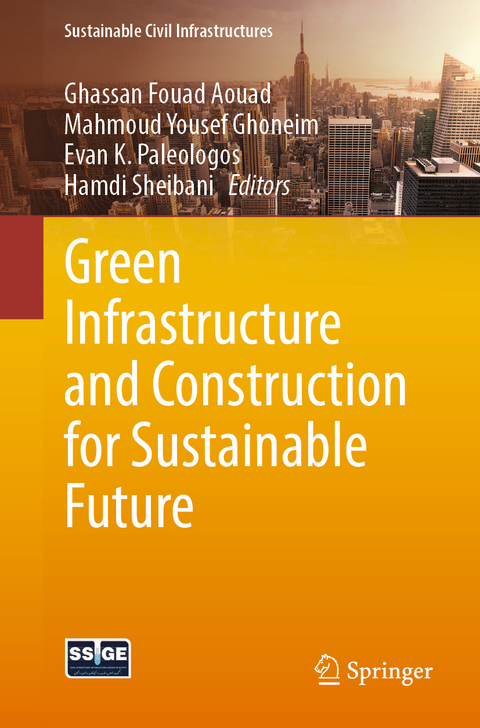
Green Infrastructure and Construction for Sustainable Future
Springer International Publishing (Verlag)
978-3-031-90962-7 (ISBN)
This book explores the strategies, frameworks, and innovations that promote sustainable urban transportation systems. It examines how cities can reduce their carbon footprint, improve air quality, and enhance the quality of life for residents by adopting sustainable transport solutions. The book focuses on integrating environmental, social, and economic aspects to create transportation systems that are efficient, accessible, and eco-friendly. Topics covered may include the implementation of green public transport, the role of technology in smart transportation, and the challenges of transitioning to sustainable urban mobility in different regions. Also, it explores the advancements and practices that support sustainability in the construction sector, particularly in the development and improvement of concrete. Furthermore, it covers the use of eco-friendly materials, innovative construction techniques, and strategies to minimize the environmental impact of construction activities. Special attention is given to the durability, efficiency, and sustainability of concrete, including the use of industrial byproducts, recycled materials, and novel binders. The discussion also includes the performance of new construction methods, such as 3D printing, and their potential to revolutionize sustainable building practices. This book focuses on the principles and practices of green building and the role of energy efficiency in achieving sustainable construction goals. It explores the use of renewable materials, energy-efficient designs, and smart technologies in creating buildings that minimize environmental impact while maximizing comfort and utility. The topic also addresses the decarbonization of the building sector, highlighting the importance of reducing energy consumption through advanced building automation systems and innovative construction techniques. The future of green building, including the potential of 3D printed structures and other technologies, is also examined.
Professor Ghassan Aouad brings a wealth of leadership and academic experience to his role as Chancellor of Abu Dhabi University (ADU), serving as President of Applied Science University in Bahrain for over eight years before joining ADU. He obtained his M.Sc. in construction (1987) and his Ph.D. in integrated planning systems for the construction industry (1991) from the Department of Civil and Building Engineering at Loughborough University in the UK. After completing his Ph.D., Professor Aouad joined the University of Salford as Research Fellow, progressing to become Pro Vice Chancellor for research and innovation and Dean of the College of Science and Technology. During his tenure at Salford, he supervised 24 Ph.D. students, examined 52 Ph.D. students, authored three research books, published 92 papers in top-rated journals, delivered over 50 keynote speeches, and presented his work in more than 42 countries.
Dr. Mahmoud Yousef Ghoneem is an Associate Professor with over 25 years of academic and professional experience in architecture, urban design, and landscape planning. Currently, he is working in the Department of Architecture and Building Science at King Saud University, KSA. He earned his Ph.D. in Architecture from Helwan University in 2011, specializing in environmental equilibrium in urban settings. He also holds a Postgraduate Diploma in Urban Management for Climate Change from IHS, Erasmus University (2014), a Postgraduate Diploma in Disaster Management from the National Institute of Rural Development, India (2016), and an MBA (2016). In 2017, he was a Visiting Professor at the School of Art and Design, Cardiff Metropolitan University, UK. Dr. Ghoneem has supervised over 15 master's and Ph.D. students, examined numerous theses, and contributed to curriculum development and accreditation processes. He has authored over 30 research papers in peer-reviewed journals and international conferences and has served as an editor for more than five conference proceedings with Springer, Elsevier, and Taylor & Francis. He has delivered over 20 keynote speeches, participated in more than 40 academic conferences and workshops, and contributed to quality assurance in architecture programs at leading universities. His expertise spans sustainable urbanism, disaster resilience, and environmental architecture, with extensive consulting experience on major projects across the Middle East.
Dr. Evan K. Paleologos
Part 1: Urban transportation for sustainable development.- 1. A Framework for Integrating Sustainability for the Success of UAE Sustainable Roads Infrastructure Projects.- 2. Opportunities of Implementing Sustainable Urban Transport in Al Madinah Al Munawara.- 3. Opinion mining of Indian customers towards two-wheeler electric vehicles using sentiment analysis.- 4. Sustainability through Blockchain: A Classification of International Adoption Patterns between Saudi Arabia and the United States.- 5. Sustainability Competencies for Project Managers within the Road Construction Sector.- Part 2: Sustainable Construction and concreate improvement.- 6. Resistance of Sustainable Concrete with Alkali-Activated Industrial Byproduct Binders to Acid Attack: A focused Review.- 7. The Performance of Helical Anchor as a Green Anchor in Cohesionless Soils.- 8. Applicability of Artificial Aggregate of Plastic Waste as Substitution Material in Concrete.- 9. Prediction of Construction Materials for Conventional and Alkali activated 3D Concrete Printing.- 10. Geospatial and temporal analysis of studies on construction projects' decarbonisation drivers.- Part 3: Green building construct ion and energy efficiency.- 11. Green building with 3D printed earth materials: current issues and future prospects of 3D printed green houses for the construction sector.- 12. A Step towards decarbonization of building Sector.- 13. Impact of Building Automation Control Systems on Energy Efficiency of Office Spaces.- Part 4: Project execution and construction technology.- 14. Project Team Member's Emotional Intelligence and Project Success in the Construction Industry: A Review of research and Future Research Agenda.- 15. Synergising Lean thinking and Circular Economy practices: A pathway to enhancing sustainability goals in the construction industry.- 16. Workload Analysis for Determining the Optimal Workforce Size and Setting the Work Target.
| Erscheinungsdatum | 17.05.2025 |
|---|---|
| Reihe/Serie | Sustainable Civil Infrastructures |
| Zusatzinfo | VIII, 165 p. 60 illus., 42 illus. in color. |
| Verlagsort | Cham |
| Sprache | englisch |
| Maße | 155 x 235 mm |
| Themenwelt | Sozialwissenschaften ► Pädagogik ► Allgemeines / Lexika |
| Schlagworte | 3D Concrete Printing • Blockchain • Concreate Improvement • energy efficiency • Green Building • Sustainable construction • Urban Transportation |
| ISBN-10 | 3-031-90962-3 / 3031909623 |
| ISBN-13 | 978-3-031-90962-7 / 9783031909627 |
| Zustand | Neuware |
| Informationen gemäß Produktsicherheitsverordnung (GPSR) | |
| Haben Sie eine Frage zum Produkt? |
aus dem Bereich