


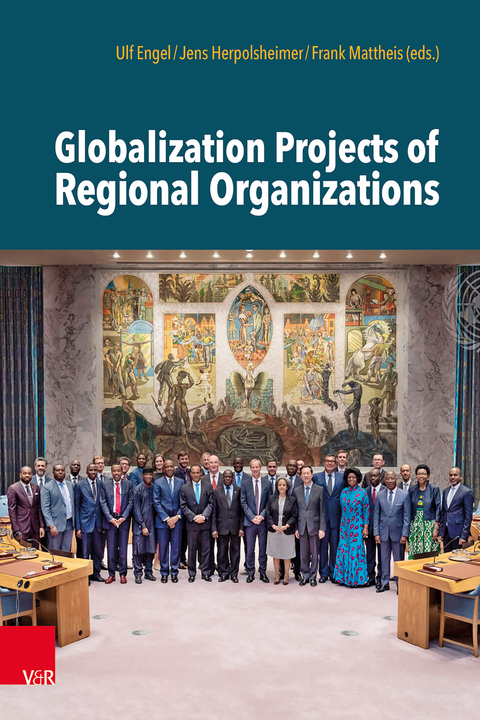
Globalization Projects of Regional Organizations
Seiten
2025
Vandenhoeck & Ruprecht (Verlag)
978-3-525-34035-6 (ISBN)
Vandenhoeck & Ruprecht (Verlag)
978-3-525-34035-6 (ISBN)
Das Handbuch untersucht die Globalisierungsprojekte von ausgewählten Regionalorganisationen seit 1945.
The handbook covers the period from 1945, when the United Nations was founded, to the present day, with a particular focus on the post–Cold War era. During this time, changing global conditions—or the perception of such changes—have led to different environments to which regional organizations and their specific globalization projects have responded. In order to establish a comprehensive periodization, six structuring conditions can be identified: (1) the need for many countries in the Global South to jointly cope with postcolonialism (2) and the establishment of Western liberalism. In addition, (3) some regional organizations are the direct result of proactive Southern globalization projects, (4) while others reflect the need to survive between the confrontational blocs of the Cold War. (5) After the end of the Cold War, regionalisms—particularly in the Global South—were revived or even restarted (the so-called wave of “new regionalisms”). Finally, over the past 20 years or so, regional organizations have increasingly been founded either to (passively) adapt to the emerging new world order, responding to “new global challenges,” or to (actively) shape it.
The handbook covers the period from 1945, when the United Nations was founded, to the present day, with a particular focus on the post–Cold War era. During this time, changing global conditions—or the perception of such changes—have led to different environments to which regional organizations and their specific globalization projects have responded. In order to establish a comprehensive periodization, six structuring conditions can be identified: (1) the need for many countries in the Global South to jointly cope with postcolonialism (2) and the establishment of Western liberalism. In addition, (3) some regional organizations are the direct result of proactive Southern globalization projects, (4) while others reflect the need to survive between the confrontational blocs of the Cold War. (5) After the end of the Cold War, regionalisms—particularly in the Global South—were revived or even restarted (the so-called wave of “new regionalisms”). Finally, over the past 20 years or so, regional organizations have increasingly been founded either to (passively) adapt to the emerging new world order, responding to “new global challenges,” or to (actively) shape it.
Dr. Ulf Engel ist Professor für Politik in Afrika am Institut für Afrikastudien der Universität Leipzig.
Dr. Jens Herpolsheimer ist Wissenschaftlicher Mitarbeiter am Institut für Afrikastudien der Universität Leipzig.
Dr. Frank Mattheis ist Wissenschaftlicher Mitarbeiter am United Nations University Institute on Comparative Regional Integration Studies (UNU-CRIS) in Brügge, Belgien.
| Erscheinungsdatum | 08.07.2025 |
|---|---|
| Reihe/Serie | Handbooks of Globalization Projects ; Band 002 |
| Mitarbeit |
Herausgeber (Serie): Matthias Middell, Steffi Marung, Ulf Engel |
| Zusatzinfo | mit 6 Abb. u. 5 Tab. |
| Verlagsort | Göttingen |
| Sprache | englisch |
| Maße | 175 x 245 mm |
| Gewicht | 1120 g |
| Themenwelt | Geschichte ► Allgemeine Geschichte ► 1918 bis 1945 |
| Sozialwissenschaften ► Soziologie | |
| Schlagworte | globale Ordnung • Globalgeschichte • Interregionalismus • Multilateralismus • Regionalorganisation |
| ISBN-10 | 3-525-34035-4 / 3525340354 |
| ISBN-13 | 978-3-525-34035-6 / 9783525340356 |
| Zustand | Neuware |
| Informationen gemäß Produktsicherheitsverordnung (GPSR) | |
| Haben Sie eine Frage zum Produkt? |
Mehr entdecken
aus dem Bereich



aus dem Bereich
Deutschland 1933 bis 1945
Buch | Hardcover (2025)
S. Fischer (Verlag)
CHF 47,60
ein Psychologe erlebt das Konzentrationslager
Buch | Hardcover (2024)
Kösel (Verlag)
CHF 30,80


