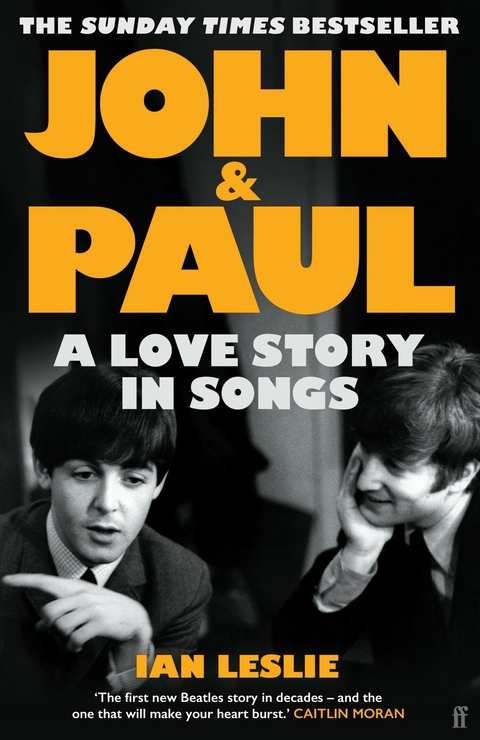
John and Paul (eBook)
416 Seiten
Faber & Faber (Verlag)
978-0-571-37614-8 (ISBN)
Ian Leslie is the author of acclaimed books on human psychology and behaviour, translated into over a dozen languages. Malcolm Gladwell describes him as 'one of my favourite writers'. Previous books include Curious, about the desire to learn, and How To Disagree, on the art and science of productive disagreement. Ian has written for the New Statesman, the Financial Times, the Economist and the New York Times on culture, technology and psychology and he is the author of a popular Substack newsletter, The Ruffian. Ian is a fellow of the Royal Society For Arts. He lives in London with his wife and two children. He has been a Beatles fan since he was seven.
THE SUNDAY TIMES AND NEW YORK TIMES BESTSELLERLONGLISTED FOR THE BAILLIE GIFFORD PRIZE FOR NON-FICTION** This book has been printed with an exclusive gold foil for the festive season. The edition you receive will depend on retailer stock. **'A triumph.' Deborah Levy, New Statesman'Tremendous.' Alwyn Turner, The Times'Revelatory.' Simon Schama, Financial Times'The gold standard of Beatles books.' Anthony Quinn, Observer'As enthralling and astonishing as their music.' Jon Dennis, Sunday Telegraph'A masterpiece.' Dylan Jones, Evening Standard'[Ian Leslie] reframes the whole relationship for me . . . He roots it in a kind of love. It's so moving, so moving. I was crying so much.' Paul Mescal'It's amazing. A fantastic book. And it broke my heart.' Ethan Hawke'I so loved John and Paul. I found it completely absorbing and painfully moving . . . It has rather turned me into a bit of a Beatles person.' Nigella Lawson'The first new Beatles story in decades - and the one that will make your heart burst.' Caitlin Moran'The most moving and revelatory book on Lennon and McCartney I have ever read. So joyful, so sad.' Tom Holland---A majestic biography of two young geniuses who merged their talents to create one of the greatest bodies of music in history. John ### Paul begins in 1957, when two teenagers in suburban Liverpool meet and decide to play rock n'roll together. It ends twenty-three years later, when one of them is murdered. In between, we see them become global stars, create countless indelible songs, and play a central role in shaping the modern world. Lennon and McCartney were more than friends, rivals or collaborators. They were intimates who both had the fabric of their world ruptured at a young age, and who longed to make emotional connections### with each other, and with audiences. The pop song was a vessel into which they poured feelings of grief and euphoria and everything in between. When they couldn't speak what they felt, they sang it. After the break-up of their group, they maintained a musical dialogue at a distance, in songs full of recrimination, regret, and affection. Ian Leslie traces the twists and turns of their relationship through the music it produced and offers rich insights into the nature of creativity, collaboration and human connection. Drawing on recently released footage and recordings, this is a startlingly fresh take on two of the greatest icons in music history. Leslie's majestic and wildly enjoyable biography will make us see and hear Lennon and McCartney anew. **Readers are raving about John & Paul:'I've never been so into a book.' ?????'A surprising fresh take on this relationship, after so much has been written.' ?????'The Beatles book I've been waiting for.' ?????'Thoroughly enjoyable, insightful and delightfully written.' ?????'I can't listen to another Beatles song in the same way ever again.' ?????'Such a fantastic book - really insightful and charming.' ?????'I read this book in more or less one go . . . Incredibly moving.' ?????'Rekindled my interest in The Beatles. A masterful work.' ?????'Full of love . . . A very worthwhile addition to the library of even the most jaded Beatles reader.' ?????'I cannot recommend this book highly enough.' ?????'Excellent. Just buy it.' ?????**Ian Leslie's book John & Paul was a Sunday Times Bestseller w/e 29-03-2025 through w/e 19-04-2025
They met on a hot day in July 1957 – twelve years after the war, ten years before Sgt. Pepper – amid the homespun pageantry of a suburban English garden party: brass band, fancy-dress parades, cake stalls and hoop-la games, police dogs jumping through rings of fire. Paul McCartney, fifteen years old, was a tourist that day, over from Allerton, a mile or two across the golf course. He didn’t hang out in Woolton much – it was a posh neighbourhood, a little prissy – but his friend from school, Ivan, lived there, and Ivan had suggested they go to the fete. There would be girls, plus Ivan had this local friend, John Lennon, whom Paul might like to meet, or at least see play with his group.
The church committee in charge of Woolton’s annual fete had decided to host a skiffle band this year – something for the youth – and they’d invited John Lennon’s group, the Quarry Men, to play (in Britain, skiffle was a more polite forerunner of rock and roll). Ivan knew Paul was a music nut, a sharp-fingered guitarist and an impressive singer. He was not a Teddy Boy like John – he wasn’t as flamboyantly rebellious – but he was a devotee of Elvis Presley and Little Richard. At around 4 p.m., he and Ivan arrived at St Peter’s church, and handed over three pence each to the lady at the gate (half price: the children’s price). The noise of Lennon’s group was billowing through humid air from the field next to the church. Paul sweated in his white sports coat and tight black trousers.
He had seen John around, on the bus, in the chip shop, and he was already fascinated by him. Paul was an intellectually hungry boy who was unconvinced by school and unimpressed by the prospect of an office job. Here was this older lad, nearly seventeen, a leather-jacketed, sideburned, vulpine rocker who seemed to have already made an irreversible break from workaday life. John Lennon was not someone you wanted to be seen paying attention to until you were ready for it to be returned. He carried a reputation for verbal and physical combat and was usually surrounded by a schoolboy entourage.
Now, as Paul and Ivan approached the makeshift stage, Paul McCartney was afforded a legitimate chance to gaze at John Lennon. To hear him, too. It must have been an awful, muddy, glorious racket. One lad scrubbing a washboard, another grabbing at a tea-chest bass, a drummer dutifully thumping. And up front: Lennon, the opposite of bashful, staring down the crowd and blasting out, in his rude, powerful voice, songs that Paul knew by heart.
Later, Paul remembered that he was struck by how good Lennon looked, and how good he sounded. He was also intrigued by what Lennon got wrong. Lennon played his guitar oddly, his left hand making simple but unfamiliar shapes on the fretboard, and he messed up the words in a way that Paul found almost inexplicably thrilling.
*
The first thing to note is that this was not a meeting of equals but fundamentally lopsided. For teenagers, age gaps are magnified: every year is a generation. John was not just older; he was already a big figure in the small world of south-east Liverpool teenagers. He had glamour, a gang of mates and a skiffle group of which he was the undisputed leader. He was, according to those around him at the time, magnetic, unignorable. Girls fancied him, boys feared him. Standing before that stage, looking up, Paul knew that if he wanted to be friends with John, or to join him up there one day, he was the one who would have to make the effort. John Lennon didn’t care.
Paul also knew that he had a shot at propelling himself into John’s orbit through their shared love of rock and roll – a love of listening to and playing it. Indeed, this was the reason he wanted to meet John in the first place. Paul was seeking out partners who were as crazy about music as he was. What started on his dad’s piano had become a full-blown obsession after he acquired a guitar. He would play it on his bed, in the living room, on the toilet, every minute his hands were free. He learnt the chords for skiffle and rock and roll songs and sang along. He got pretty good, and he knew it. For all that he was looking up to the older boy that day, he was also auditioning him.
Other than music and a pronounced suspicion of authority, John and Paul shared something else: they were walking wounded. Each, in his short life, had experienced jarring, alienating, soul-rending events that left permanent scars.
*
By the time he met John Lennon, Paul McCartney’s mother had been dead for eight months. Mary Mohin came from Catholic Irish stock and was raised in poverty, the second child of four. Her own mother died in childbirth when Mary was nine. Mary’s father, who was from County Monaghan, took the family back to Ireland, tried and failed to make a living in farming, and returned them all to Liverpool, this time broke, and with a new wife and stepchildren, with whom Mary and her siblings did not get on. In Mary, this chaos seems to have instilled a steely self-reliance. She threw herself into a nursing career, specialising in midwifery. At thirty she was a ward sister, and unmarried. Mary Mohin had been friendly with the McCartneys, a Protestant Irish family, for years, and had recently moved in with her friend Ginny McCartney. Gin’s older brother Jim, a cotton salesman, handyman and former leader of a semi-professional jazz band, was still single, despite being in his late thirties. Whether it was late-blooming love, loneliness or some mixture of both it’s impossible to know, but in April 1941, Mary and Jim married. Their first child, James Paul, was born fourteen months later. Peter Michael (‘Mike’) arrived eighteen months afterwards.
As a young child Paul was good at getting what he wanted, usually without anyone minding or even realising what had happened. In 1953, he passed the eleven-plus and gained entry to a prestigious grammar school, the Liverpool Institute. It was one of the last times that Paul did just what his parents wanted. After observing how much he liked playing on the piano they had in the living room, Mary and Jim found a teacher for Paul, but Paul abandoned the lessons after a few weeks. He didn’t want to learn scales and dots on a page; he wanted to get straight to playing what he loved. His parents encouraged him to audition for the choir at Liverpool Cathedral – he could sing beautifully – and Paul deliberately flubbed it. His school years would be marked by this kind of self-sabotage. It wasn’t that he had any difficulty learning; quite the opposite: he was a remarkably quick study. Nor was it that he didn’t like his teachers or fellow pupils – he was a socially supple, unfailingly charming boy. It was just that he was very clear on what interested him and what bored him, and he had a stubborn aversion to being told what to do.
Mary was the engine of family life. Jim McCartney was genial, dapper and funny, but it was Mary who set standards of dress, cleanliness and manners, and insisted they were kept to. She was warm, too, a liberal dispenser of hugs and kisses. As an adolescent, Paul guarded his independence from her – even Mary could not make Paul do piano lessons if he didn’t want to. Still, he admired her. He saw how hard she worked, for one thing. A midwife and a health visitor, Mary, who had responsibility for families on their estate, was a highly respected local figure who received presents from grateful new parents. She created happiness! It was also Mary to whom Paul looked for comfort when he was anxious (he later wrote a song about this, ‘Let It Be’). On Sundays, Mary made roast dinner, while Paul lay on the carpet and listened to his father play songs at the piano – ‘Lullaby of the Leaves’, ‘Stairway to Paradise’. The piano was at the heart of the home and the heart of social life – wherever the wider McCartney clan gathered, at home or in the pub, a sing-song usually ensued, often with Paul’s father leading proceedings. The association of music-making with love and happiness became ingrained. Paul lived inside the ordinary miracle of a loving family and, like everyone else who does so, took it for granted. Until it was taken away.
The McCartneys were not well off. The cotton industry was in a bad way, Jim’s job did not pay well, and he was said to be overly fond of a flutter on the horses. But thanks to Mary taking extra shifts at the hospital, the family did well enough to move out of their house on a poverty-stricken, often violent estate in Speke, to a similar but newer house on Forthlin Road in Allerton, on the southern edge of the city. Paul was nearly fourteen. He loved the house and how on leaving it he could quickly find himself in another world of fields and meadows and cows. Within a year, though, he crossed another kind of borderline. When Mary McCartney felt a pain in her breast she put it down to the menopause. Doctors told her to forget it, but it got worse. She went to see a cancer specialist who recommended immediate surgery, but by then it was too late. Mary was forty-seven when she died. It all happened within a month. Paul and Michael knew almost nothing about it until their mother went into hospital for a mysterious reason, while they were shipped out to their aunt and uncle’s house. Gathered in the living room to be told the news...
| Erscheint lt. Verlag | 25.3.2025 |
|---|---|
| Sprache | englisch |
| Themenwelt | Literatur ► Biografien / Erfahrungsberichte |
| Literatur ► Romane / Erzählungen | |
| Kunst / Musik / Theater | |
| Geschichte ► Teilgebiete der Geschichte ► Kulturgeschichte | |
| Geisteswissenschaften ► Psychologie ► Sozialpsychologie | |
| Sozialwissenschaften ► Kommunikation / Medien ► Kommunikationswissenschaft | |
| ISBN-10 | 0-571-37614-2 / 0571376142 |
| ISBN-13 | 978-0-571-37614-8 / 9780571376148 |
| Informationen gemäß Produktsicherheitsverordnung (GPSR) | |
| Haben Sie eine Frage zum Produkt? |
 EPUB (Adobe DRM)
Kopierschutz: Adobe-DRM
Adobe-DRM ist ein Kopierschutz, der das eBook vor Mißbrauch schützen soll. Dabei wird das eBook bereits beim Download auf Ihre persönliche Adobe-ID autorisiert. Lesen können Sie das eBook dann nur auf den Geräten, welche ebenfalls auf Ihre Adobe-ID registriert sind.
Details zum Adobe-DRM
Dateiformat: EPUB (Electronic Publication)
EPUB ist ein offener Standard für eBooks und eignet sich besonders zur Darstellung von Belletristik und Sachbüchern. Der Fließtext wird dynamisch an die Display- und Schriftgröße angepasst. Auch für mobile Lesegeräte ist EPUB daher gut geeignet.
Systemvoraussetzungen:
PC/Mac: Mit einem PC oder Mac können Sie dieses eBook lesen. Sie benötigen eine
eReader: Dieses eBook kann mit (fast) allen eBook-Readern gelesen werden. Mit dem amazon-Kindle ist es aber nicht kompatibel.
Smartphone/Tablet: Egal ob Apple oder Android, dieses eBook können Sie lesen. Sie benötigen eine
Geräteliste und zusätzliche Hinweise
Buying eBooks from abroad
For tax law reasons we can sell eBooks just within Germany and Switzerland. Regrettably we cannot fulfill eBook-orders from other countries.
aus dem Bereich