Ecocide in Ukraine (eBook)
246 Seiten
Polity (Verlag)
978-1-5095-6251-0 (ISBN)
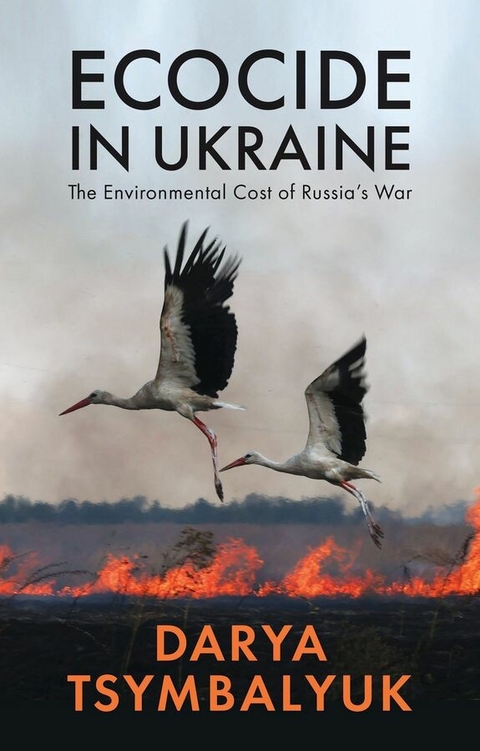
In this poignant book, Ukrainian researcher Darya Tsymbalyuk offers an intimate portrait of her beloved homeland against the backdrop of Russia's war and ecocide. In elegant and moving prose, she describes the damage to the country's rivers, the grasslands of the steppes, animals, insects, and colonies of birds, as a result of Russia's ground and air operations. Alongside the everyday experiences of people in Ukraine living with the environmental consequences of the war, we share Tsymbalyuk's own reckoning with the changing nature of cherished places and the loss of familiar worlds caused by the ongoing Russian invasion.
Darya Tsymbalyuk is an Assistant Professor at the Department of Slavic Languages and Literatures at the University of Chicago. Her academic papers and public essays explore narratives about environments, multispecies worlds, displacement, embodied knowledge, and entangled colonial histories of Ukraine. Her writing has appeared on the BBC's Future Planet and openDemocracy websites, among many other publications. In addition to her research and writing, Darya also works with images through drawing, painting, collage, and video essays.
Russia s war on Ukraine has not only destroyed millions of human lives, it has also been catastrophic for the environment. Forests and fields have been burned to the ground, animal and plant species pushed to the brink of extinction, soil and water contaminated with oil products, debris, and mines. On a single day in June 2023, the breached Kakhovka Dam flooded thousands of kilometres of protected natural habitat, as well as villages, towns, and agricultural land. The devastation of biodiversity and ecosystems across Ukraine has been immeasurable, long-lasting and its consequences stretch beyond national borders. In this poignant book, Ukrainian researcher Darya Tsymbalyuk offers an intimate portrait of her beloved homeland against the backdrop of Russia s war and ecocide. In elegant and moving prose, she describes the damage to the country s rivers, the grasslands of the steppes, animals, insects, and colonies of birds, as a result of Russia s ground and air operations. Alongside the everyday experiences of people in Ukraine living with the environmental consequences of the war, we share Tsymbalyuk s own reckoning with the changing nature of cherished places and the loss of familiar worlds caused by the ongoing Russian invasion.
Preface
I was not in Ukraine when, on 24 February 2022, Russia escalated its almost eight-year-long war on Ukraine to a full-scale invasion. When I finally returned to see my family for the first time since the invasion, crossing from Poland on a night train to Kyiv, I could not stop looking out of the window. I wanted to imprint in my memory every little tree, every bird echoing a cloud, every glimpse of the river which kept disappearing all too quickly. Nowhere do I experience such shimmering joy just by looking at things, just by being in a place, as I do in Ukraine these days.
It is from this place of love that my sorrow comes too. Out of the train window, villages were disappearing too quickly for me to be able to read their names and I kept turning my head in hope of deciphering them. While writing this book, I thought a lot about how we learn about things only when they disappear, and the deep injustice of such learning. In the book, I call this process an episteme of death. The episteme of death put a morbid spotlight on certain species endangered by the war, on habitats and ecosystems, and on Ukraine’s communities overall.
When the environmental cost of Russia’s war on Ukraine is discussed domestically and internationally, it is often engaged through the lens of ecocide, which is also reflected in the title of this book. While today the term ‘ecocide’ is being applied to a wide range of crimes of environmental destruction, it originally emerged in the context of US herbicide warfare in Vietnam.1 In 2021, an Independent Expert Panel at Stop Ecocide International, a global campaign fighting to amend the Rome Statute at the International Criminal Court, defined ecocide as ‘unlawful or wanton acts committed with knowledge that there is a substantial likelihood of severe and either widespread or long-term damage to the environment being caused by those acts’.2 The Ukrainian state is also working on adding ecocide to the Rome Statute as a fifth core international crime.
On the domestic level, Ukraine is one of little more than a dozen countries in the world that have an article for ecocide in their criminal code (Article 441). In 2021, just before Russia escalated its war to a full-scale invasion, the Specialized Environmental Prosecutor’s Office was established in Ukraine. Today, this Office investigates cases of ecocide, and it served its first notices of suspicion in February 2024. Among the cases that the Office works on, perhaps the most well-known is the destruction of the Kakhovka Dam, which, according to Jojo Mehta, co-founder of Stop Ecocide International, is ‘a textbook ecocide case’.3 In the last couple of years, ecocide has become central to Ukraine’s understanding of the war’s environmental impact as entangled with other war crimes committed by Russia, as well as to Ukraine’s understanding of justice. The evidence for ecocide in the country is painstakingly collected by prosecutors, investigators, forensic specialists, and environmentalists, often in life-threatening circumstances.
The lens of ecocide sets the frame of my work. However, I am not a legal scholar, and my intention in this book is not to provide evidence of the crime of ecocide in specific cases. Here, my focus is on tracking how experiences of witnessing and living through ecocide change one’s understandings of environments and one’s home(land). I argue that the impacts of ecocide spill beyond specifically designated (legal) cases, into the most intimate and everyday realities. As a result, places which were once familiar now hold danger. To very different degrees of violence, the war displaces everyone, not only the people who have fled from it. Even if you do not evacuate but remain in your hometown, suddenly you find yourself in a different world, where the river stores unexploded bomblets, and the forest trail might be mined. I have been in a privileged position, living abroad in places removed from direct danger and unaffected by severe shortages of water and electricity. Yet, even at such a distance, the Russian invasion also changed my understandings of environments. Shelterbelts, skies, corridors, and walking paths feel different. It is these re-mapped spatial relations that I trace in this book. What are the changing meanings of water, bodies, air, land/ground/soil, plants, and energy? How does the war disrupt, violate, and condition life and survival? What places could serve as potential places of shelter? What is this changing world of ‘home’? I also argue that only through an environmental lens can we begin to comprehend the scale and anguish of the devastation, the loss of whole worlds inhabited by plants, animals, rocks, people, and others, caused by Russia’s war.
In Ecocide in Ukraine, I do not aim to provide an exhaustive overview of the environmental destruction in Ukraine and beyond its borders. Such a comprehensive account would be impossible, as the data are often scarce, and, most importantly, the war is not over. In the future, other scholars will take on this task and will be better equipped to write an overview from a position of analytical and historical distance. Instead, I invite you to approach Ecocide in Ukraine as a situated account that speaks among other voices and does not aim to represent but, in the words of Trinh T. Minh-ha, ‘speaks nearby’.4 Here, the act of writing is a process of understanding and of piecing the fragments together, not necessarily to make sense – it is impossible to make sense of war – but to pause and think, and to invite readers to pause and think with me.
These days Ukraine is frequently featured in the news through horrific images of violence, and these experiences are at the heart of this book too. Yet, here, I also want to tell you about Ukraine as a place which is loved, about Ukraine as a home, for humans and other species. While based on research, this book is also an imperfect and personal document, and my knowledge is rooted in places familiar to me. This past year of working on the manuscript ironically marks my life as divided into two exact parts: the one that I lived in the south of Ukraine, and the one that I have lived between many other places away from the south. Russia’s war deepened the pull of home for me; it made me constantly think of disrupted living patterns and of the many returns – of people, water, birds, and stories. Hence, I write more about the south of Ukraine than about other regions.
Yet, I do not intend the personal to be exclusive. As we know all too well, environmental destruction is not contained by regional or national borders: the rain that fell from the radioactive Chornobyl clouds contaminated lands a long way from Kyiv Oblast, the epicentre of the 1986 nuclear catastrophe. The impacts of Russia’s war on Ukraine are also felt across the globe, from food shortages to the loss of biodiversity and the pollution and militarization of the Black Sea. Ukraine’s contribution to the international legal campaign to amend the Rome Statute will have implications in places and contexts far beyond Ukraine too. Finally, experiences of living in war ecologies are not unique to Ukraine, and while writing this book I have been following with horror the multitude of past and present stories from other places devastated by wars and violence.
In writing the book I have relied on interviews, conversations, reports, journalists’ investigations, social media posts, and my journeys across Ukraine (photos from these journeys open the chapters of the book), and I am especially grateful to everyone on the ground who is documenting the Russian invasion. Most of this documentary work is done in Ukrainian, usually in life-threatening conditions, and is often not available in other languages. I build on this knowledge that shapes my understanding of the situation on the ground to share with readers who might not know much about my homeland. This book is a form of distant witnessing; not a first-hand account of events, but a re-telling, a re-piecing, and a meditation. This experience of witnessing, even from afar, is anchored in the cultural thickness of stories and images about storks, feathergrass, reedbeds, and rivulets of the Lower Dnipro. Without an understanding of the long histories of shared lives contained in these stories and images, it is not possible to comprehend the full extent of the loss caused by Russia’s ecocide; therefore, in addition to environmental reports, data, and witness accounts, in Ecocide in Ukraine I also rely on poems, films, and paintings.
The following chapters present the diverse stories I have collected, while trying to understand how my homeland is changing and how people and other species have responded to these changes. The stories are arranged thematically, but just as it is sometimes hard to tell where the aquatic worlds end and the terrestrial worlds begin, the stories in this book often flow across several chapters, with each chapter bringing different elements into focus. These stories are also often fragmented, just like the places they come from, now shattered by the war. While shattered, they are still lived places, beautiful places, and beautifully lived places.
In one of the videos from Kherson, flooded as the result of the Kakhovka Dam disaster, a woman is asked whether she will be evacuating.5 Liudmyla replies that she will be staying, using the word perebudemo, where the suffix pere- translates as over-, and budemo is a conjugation from the verb buty, to exist, to...
| Erscheint lt. Verlag | 14.3.2025 |
|---|---|
| Sprache | englisch |
| Themenwelt | Sozialwissenschaften ► Politik / Verwaltung ► Vergleichende Politikwissenschaften |
| Schlagworte | Climate catastrophe • conflict pollution • Ecocide • Environmental Destruction • Environmental Humanities • Environmental Impact of War • extinction • floods • global greenhouse emissions • impact of war on the environment • Natural Environment • pollution from war • pollution in Ukraine • Russia’s war in Ukraine • War in Ukraine • war pollution |
| ISBN-10 | 1-5095-6251-6 / 1509562516 |
| ISBN-13 | 978-1-5095-6251-0 / 9781509562510 |
| Informationen gemäß Produktsicherheitsverordnung (GPSR) | |
| Haben Sie eine Frage zum Produkt? |
 EPUB (Adobe DRM)
Kopierschutz: Adobe-DRM
Adobe-DRM ist ein Kopierschutz, der das eBook vor Mißbrauch schützen soll. Dabei wird das eBook bereits beim Download auf Ihre persönliche Adobe-ID autorisiert. Lesen können Sie das eBook dann nur auf den Geräten, welche ebenfalls auf Ihre Adobe-ID registriert sind.
Details zum Adobe-DRM
Dateiformat: EPUB (Electronic Publication)
EPUB ist ein offener Standard für eBooks und eignet sich besonders zur Darstellung von Belletristik und Sachbüchern. Der Fließtext wird dynamisch an die Display- und Schriftgröße angepasst. Auch für mobile Lesegeräte ist EPUB daher gut geeignet.
Systemvoraussetzungen:
PC/Mac: Mit einem PC oder Mac können Sie dieses eBook lesen. Sie benötigen eine
eReader: Dieses eBook kann mit (fast) allen eBook-Readern gelesen werden. Mit dem amazon-Kindle ist es aber nicht kompatibel.
Smartphone/Tablet: Egal ob Apple oder Android, dieses eBook können Sie lesen. Sie benötigen eine
Geräteliste und zusätzliche Hinweise
Buying eBooks from abroad
For tax law reasons we can sell eBooks just within Germany and Switzerland. Regrettably we cannot fulfill eBook-orders from other countries.
aus dem Bereich