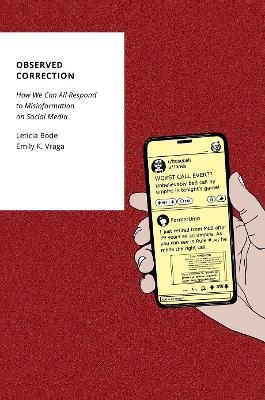
Observed correction
Oxford University Press Inc (Verlag)
978-0-19-756590-2 (ISBN)
In Observed Correction, Leticia Bode and Emily K. Vraga consider both the power of and the barriers to "observed correction"--users witnessing other users correct misinformation on social media. Bode and Vraga argue that when people view others directly and publicly correct misinformation on social media, their understanding of the topic becomes more accurate. Yet, while many members of the public value correction, Bode and Vraga find that they are often reluctant to correct misinformation they see on social media. This same reluctance to correct is seen among expert fact checkers and health communicators, compounded by the constraints of limited resources and competing priorities. To empower people to respond to misinformation, Bode and Vraga offer a set of practical recommendations for how observational correction can be implemented. In some cases, simple messages addressing concerns can increase users' willingness to respond to misinformation. In other cases, they argue that platforms will need to promote corrections and protect the correctors while experts can contribute by creating accessible curated evidence (ACE) to facilitate user corrections and build social norms around responding to misinformation.
Including analysis of eleven experiments, seven surveys, and dozens of interviews with social media users, health professionals, fact checkers, and platform employees about their efforts to curb misinformation online, Bode and Vraga make the case that observed correction is an effective and scalable tool in the fight against bad content on the Internet.
Leticia Bode is a Professor in the Communication, Culture, and Technology program at Georgetown University, and the inaugural Research Director of the Knight-Georgetown Institute. She researches the intersection of communication, technology, attitudes, and behavior, emphasizing the role communication technologies may play in the acquisition, use, effects, and implications of both information and misinformation. Emily K. Vraga is the Don and Carole Larson Professor in Health Communication at the University of Minnesota's Hubbard School of Journalism and Mass Communication. Her research tests methods to identify and correct misinformation on social media, to improve audience resiliency through news literacy training, and to encourage attention to more diverse content.
Chapter 1: Introduction
Chapter 2: The Theory of Observed Correction
Chapter 3: Observed Correction Increases Accuracy
Chapter 4: Correction Recall
Chapter 5: Perception of Correction
Chapter 6: Conflicted Correctors
Chapter 7: Motivating Correction
Chapter 8: Constrained Experts
Chapter 9: Accessible Curated Evidence
Chapter 10: Conclusions
Notes
References
Index
| Erscheinungsdatum | 01.07.2025 |
|---|---|
| Reihe/Serie | Oxford Studies in Digital Politics |
| Verlagsort | New York |
| Sprache | englisch |
| Maße | 157 x 229 mm |
| Gewicht | 318 g |
| Themenwelt | Geisteswissenschaften ► Philosophie |
| Mathematik / Informatik ► Informatik ► Web / Internet | |
| Sozialwissenschaften ► Kommunikation / Medien ► Medienwissenschaft | |
| Sozialwissenschaften ► Politik / Verwaltung ► Staat / Verwaltung | |
| Sozialwissenschaften ► Politik / Verwaltung ► Vergleichende Politikwissenschaften | |
| ISBN-10 | 0-19-756590-5 / 0197565905 |
| ISBN-13 | 978-0-19-756590-2 / 9780197565902 |
| Zustand | Neuware |
| Informationen gemäß Produktsicherheitsverordnung (GPSR) | |
| Haben Sie eine Frage zum Produkt? |
aus dem Bereich