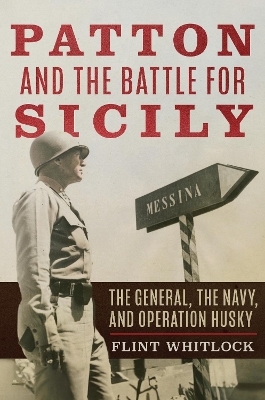
Patton and the Battle for Sicily
Naval Institute Press (Verlag)
978-1-61251-691-2 (ISBN)
The largest amphibious assault to date came at a crucial moment, and both the planning and execution presented many conflicts for the Allies. Despite the success of Operation Torch in North Africa, the U.S. was still considered not fully tested or trusted by their British partners, and Stalin was clamoring for the Allies to open a second front to take the pressure off his Soviet Union.
Patton's dreams of martial glory and his all-consuming desire to best his chief Allied rival, General Bernard Montgomery, head of the British Eighth Army, to the ultimate prize—the port of Messina—often clouded his judgment. His primary motivation, however, was to prove to “Monty” and other dismissive British generals that the American soldier was as good, if not better, than his British counterpart.
Using Patton’s personal letters and diaries, Whitlock reveals the scathing opinions he held of Montgomery and almost everyone else in the Allied hierarchy (Eisenhower, Marshall, Clark, Bradley, and Alexander, among others)—even Adm. H. Kent Hewitt, USN, whose Eighth Fleet carried Patton’s troops to the beaches and supported them once on shore. In fact, it was the guns from Hewitt’s warships that halted the fierce German and Italian attacks that nearly threw the Americans back into the sea.
From Tunisia to the landing beaches on the south coast of Sicily to the final fight for Messina, this book chronicles how Husky would prove pivotal for both sides. The operation was criticized by some historians as a wasteful effort by the Allies that squandered valuable troops and resources while allowing many of the Italian and German troops to escape in the battle’s final days—an “Axis Dunkirk.” Here, Whitlock makes the case that Husky caused the downfall of Benito Mussolini and the neutralization of fascist Italy, and opened the second front to help Stalin. Moreover, the fight for Sicily proved the worth of American soldiers and seamen—as well as combined Army-Navy planning and logistics capabilities. Ultimately, lessons learned from Husky would be integrated into the Operation Overlord plan launched against France’s Normandy coast the following year.
Flint Whitlock, a former U.S. Army officer and Vietnam War veteran, is the award-winning author of seventeen books, the majority dealing with World War II. He has appeared on the History Channel and in numerous documentaries, leads battlefield tours, and was editor of WWII Quarterly magazine for twelve years. Notable titles include Desperate Valor: Triumph at Anzio (2018), Given Up for Dead: American POWs in the Nazi Concentration Camp at Berga (2005), and The Fighting First: The Untold Story of the Big Red One on D-Day (2004).
Introduction
Backstory: The Decision for Sicily
Chapter 1: The Airborne—First to Fight
Chapter 2: Ladbroke: Risky Bet
Chapter 3: Rangers Lead the Way
Chapter 4: Big Red One Arrives
Chapter 5: Here Come the Thunderbirds
Chapter 6: Marnemen Hit the Beach
Chapter 7: D-day at Gela
Chapter 8: D-Plus One: The Crisis
Chapter 9: Disaster in the Sky
Chapter 10: Massacre at Biscari
Chapter 11: Reconnaissance in Force
Chapter 12: Palermo and Beyond
Chapter 13: Rough Road to Messina
Chapter 14: Capturing a Town, Losing a Commander
Chapter 15: A Fall from Grace
Chapter 16: The Slaps Heard Round the World
Sources
Bibliography
| Erscheinungsdatum | 22.10.2025 |
|---|---|
| Zusatzinfo | 5 Maps, 12 B-W Photos |
| Verlagsort | Annopolis |
| Sprache | englisch |
| Maße | 152 x 228 mm |
| Themenwelt | Geschichte ► Allgemeine Geschichte ► 1918 bis 1945 |
| Geschichte ► Teilgebiete der Geschichte ► Militärgeschichte | |
| Sozialwissenschaften ► Politik / Verwaltung | |
| ISBN-10 | 1-61251-691-2 / 1612516912 |
| ISBN-13 | 978-1-61251-691-2 / 9781612516912 |
| Zustand | Neuware |
| Informationen gemäß Produktsicherheitsverordnung (GPSR) | |
| Haben Sie eine Frage zum Produkt? |
aus dem Bereich