


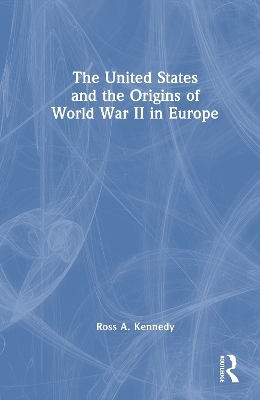
The United States and the Origins of World War II in Europe
Seiten
2025
Routledge (Verlag)
978-1-032-22334-6 (ISBN)
Routledge (Verlag)
978-1-032-22334-6 (ISBN)
This volume spans 1914–1939 to provide a concise interpretation of the role the United States played in the origins of the Second World War. It synthesizes recent scholarship about interwar international politics while also presenting an original interpretation of the sources of American policy.
The book shows how the drive for international reform, beginning with Woodrow Wilson, reflected both America’s unusual power and its fears about maintaining its domestic freedoms in a world dominated by arms races and the threat of war. The American desire to reform or to escape from the existing international system reshaped Europe’s balance of power from 1914 to 1929, leaving it precarious and unlikely to produce lasting stability. America’s power continued to loom globally in the 1930s, as first its isolationism and, after 1938, its open hostility toward Germany and Japan influenced the policies of the West and of Hitler. The coda at the end of the volume analyzes how the United States affected the strategic choices made by Great Britain, Nazi Germany, and Japan from 1939 to 1941 that globalized the conflict.
This book will appeal to undergraduate and graduate students in history and political science, especially courses focused on World War II and the history of U.S. foreign relations.
The book shows how the drive for international reform, beginning with Woodrow Wilson, reflected both America’s unusual power and its fears about maintaining its domestic freedoms in a world dominated by arms races and the threat of war. The American desire to reform or to escape from the existing international system reshaped Europe’s balance of power from 1914 to 1929, leaving it precarious and unlikely to produce lasting stability. America’s power continued to loom globally in the 1930s, as first its isolationism and, after 1938, its open hostility toward Germany and Japan influenced the policies of the West and of Hitler. The coda at the end of the volume analyzes how the United States affected the strategic choices made by Great Britain, Nazi Germany, and Japan from 1939 to 1941 that globalized the conflict.
This book will appeal to undergraduate and graduate students in history and political science, especially courses focused on World War II and the history of U.S. foreign relations.
Ross A. Kennedy is Professor of History and Chair at Illinois State University. He is the author of The Will to Believe: Woodrow Wilson, World War I, and America’s Strategy for Peace and Security (2009) as well as numerous other publications on the First World War.
Introduction 1. The First World War 2. The 1920s 3. Fractures: 1929–1934 4. The Abyss Opens Up: 1933–1936 5. Into the Abyss: 1936–1939 Conclusion and Coda: 1940–1941
| Erscheinungsdatum | 03.05.2025 |
|---|---|
| Zusatzinfo | 7 Halftones, black and white; 7 Illustrations, black and white |
| Verlagsort | London |
| Sprache | englisch |
| Maße | 152 x 229 mm |
| Gewicht | 750 g |
| Themenwelt | Geschichte ► Allgemeine Geschichte ► 1918 bis 1945 |
| Geisteswissenschaften ► Geschichte ► Regional- / Ländergeschichte | |
| Geschichte ► Teilgebiete der Geschichte ► Militärgeschichte | |
| Sozialwissenschaften ► Politik / Verwaltung | |
| ISBN-10 | 1-032-22334-0 / 1032223340 |
| ISBN-13 | 978-1-032-22334-6 / 9781032223346 |
| Zustand | Neuware |
| Informationen gemäß Produktsicherheitsverordnung (GPSR) | |
| Haben Sie eine Frage zum Produkt? |
Mehr entdecken
aus dem Bereich


aus dem Bereich
Deutschland 1933 bis 1945
Buch | Hardcover (2025)
S. Fischer (Verlag)
CHF 47,60
ein Psychologe erlebt das Konzentrationslager
Buch | Hardcover (2024)
Kösel (Verlag)
CHF 30,80


