


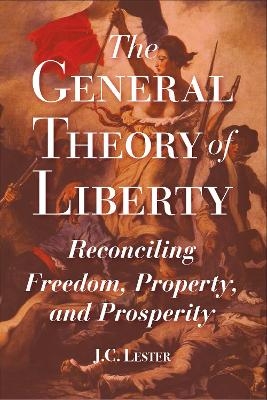
The General Theory of Liberty
Reconciling Freedom, Property, and Prosperity
Seiten
2026
Open Universe (Verlag)
978-1-63770-071-6 (ISBN)
Open Universe (Verlag)
978-1-63770-071-6 (ISBN)
- Noch nicht erschienen (ca. Mai 2026)
- Portofrei ab CHF 40
- Auch auf Rechnung
- Artikel merken
Liberty, or freedom, is the absence of some sort of constraint on something. Most people think their own liberty is important. Classical liberals and libertarians love interpersonal or political liberty and almost worship it, but most of them, sadly, can’t explain what it is. Other people, even socialists, often declare that they like liberty a lot, but usually they too can’t tell us what it is.
Interpersonal liberty is not about the freedom to jump over buildings or levitate. That people are constrained by natural laws is not the issue. At first glance, interpersonal liberty looks to be about the absence of interpersonal or social constraints: people not interfering with (or constraining) each other in certain ways.
Sometimes people, including classical liberals, explicitly adapt the notion of liberty that Thomas Hobbes appealed to. They say that someone is free when other people don’t or can’t stop him from doing or having what he wants. The big problem with this is that it’s zero-sum. If I have the liberty to murder or rob you, then you don’t have the liberty not to be murdered or robbed (and vice versa). We can only choose which liberties we prefer by using some other, apparently higher, principle than liberty; such as utility, happiness, or prudential choice.
Hobbes’s liberty is a common-sense intuition, but John Locke had a better one. Roughly, we have liberty when people don’t interfere with or constrain us in our person or property. In this sense, not being murdered or robbed is part of liberty but murdering or robbing is not: murder and robbery are impositions or licenses. Such liberty can be decreased or increased. This is what most people, including classical liberals, intend to advocate. We see how it promotes human welfare as the satisfaction of wants or preferences: people don’t want to be imposed on and do want the products of free markets.
But we still have a big problem. Liberty, property, and welfare (well-being) have been conflated. What is the abstract theory of liberty that is being presupposed, independently of property and human well-being? How does that theory relate to property and well-being or prosperity? Can want-satisfaction be an adequate theory of welfare?
J.C. Lester’s new book starts by explaining and defending the abstract theory of liberty and then applying it until libertarian property is eventually derived. The bulk of the book defends many aspects of the overall theory from criticisms. It concludes with some important and controversial applications.
Interpersonal liberty is not about the freedom to jump over buildings or levitate. That people are constrained by natural laws is not the issue. At first glance, interpersonal liberty looks to be about the absence of interpersonal or social constraints: people not interfering with (or constraining) each other in certain ways.
Sometimes people, including classical liberals, explicitly adapt the notion of liberty that Thomas Hobbes appealed to. They say that someone is free when other people don’t or can’t stop him from doing or having what he wants. The big problem with this is that it’s zero-sum. If I have the liberty to murder or rob you, then you don’t have the liberty not to be murdered or robbed (and vice versa). We can only choose which liberties we prefer by using some other, apparently higher, principle than liberty; such as utility, happiness, or prudential choice.
Hobbes’s liberty is a common-sense intuition, but John Locke had a better one. Roughly, we have liberty when people don’t interfere with or constrain us in our person or property. In this sense, not being murdered or robbed is part of liberty but murdering or robbing is not: murder and robbery are impositions or licenses. Such liberty can be decreased or increased. This is what most people, including classical liberals, intend to advocate. We see how it promotes human welfare as the satisfaction of wants or preferences: people don’t want to be imposed on and do want the products of free markets.
But we still have a big problem. Liberty, property, and welfare (well-being) have been conflated. What is the abstract theory of liberty that is being presupposed, independently of property and human well-being? How does that theory relate to property and well-being or prosperity? Can want-satisfaction be an adequate theory of welfare?
J.C. Lester’s new book starts by explaining and defending the abstract theory of liberty and then applying it until libertarian property is eventually derived. The bulk of the book defends many aspects of the overall theory from criticisms. It concludes with some important and controversial applications.
J.C. Lester, PhD, holds degrees from Warwick University and the London School of Economics. He is the author of Escape from Leviathan (2000), Arguments for Liberty (2012), Explaining Libertarianism (2014), and Two Dialogues (2016), as well as numerous scholarly articles and online posts.
| Erscheint lt. Verlag | 28.5.2026 |
|---|---|
| Zusatzinfo | Illustrations |
| Sprache | englisch |
| Maße | 152 x 228 mm |
| Themenwelt | Geisteswissenschaften ► Philosophie |
| Sozialwissenschaften ► Politik / Verwaltung ► Politische Systeme | |
| Sozialwissenschaften ► Politik / Verwaltung ► Politische Theorie | |
| ISBN-10 | 1-63770-071-7 / 1637700717 |
| ISBN-13 | 978-1-63770-071-6 / 9781637700716 |
| Zustand | Neuware |
| Informationen gemäß Produktsicherheitsverordnung (GPSR) | |
| Haben Sie eine Frage zum Produkt? |
Mehr entdecken
aus dem Bereich


aus dem Bereich
Das politische System der USA und die Zukunft der Demokratie
Buch | Hardcover (2025)
C.H.Beck (Verlag)
CHF 39,20
Russland, Europa, Amerika
Buch | Softcover (2025)
C.H.Beck (Verlag)
CHF 25,20


