


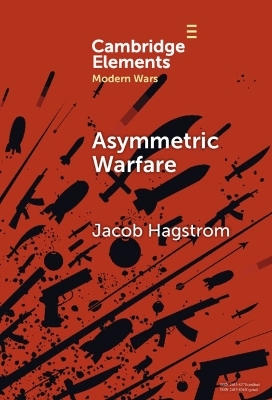
Asymmetric Warfare
Politics and Cultures of Violence in the Modern Era
Seiten
2025
Cambridge University Press (Verlag)
978-1-009-56760-2 (ISBN)
Cambridge University Press (Verlag)
978-1-009-56760-2 (ISBN)
The forces that fight asymmetric wars are so distinct that one side avoids direct military confrontation in favor of political, social, or otherwise unorthodox means of resistance. These conflicts have been a mainstay of modern times. This Element discusses how weak powers have neutralized typical advantages of strong military states.
The forces that fight asymmetric wars are so distinct that one side avoids direct military confrontation in favor of political, social, or otherwise unorthodox means of resistance. These conflicts have been a mainstay of modern times, though scholars have often separated them into various designations by era. Observers have referred, in chronological order, to Indian warfare, petite guerre (small war), guerrilla warfare, irregular or revolutionary war, and terrorism. The proliferation of labels over time has obscured the continuity of asymmetric wars throughout modernity. Stark distinctions in resources and capabilities have shaped the reasons why states and societies have decided to fight, and the manner in which they have fought. Across the modern era, mismatches arose in the domains of technology, intelligence production, and law. But in recent decades, so-called weak powers have neutralized many of the typical advantages of strong military states.
The forces that fight asymmetric wars are so distinct that one side avoids direct military confrontation in favor of political, social, or otherwise unorthodox means of resistance. These conflicts have been a mainstay of modern times, though scholars have often separated them into various designations by era. Observers have referred, in chronological order, to Indian warfare, petite guerre (small war), guerrilla warfare, irregular or revolutionary war, and terrorism. The proliferation of labels over time has obscured the continuity of asymmetric wars throughout modernity. Stark distinctions in resources and capabilities have shaped the reasons why states and societies have decided to fight, and the manner in which they have fought. Across the modern era, mismatches arose in the domains of technology, intelligence production, and law. But in recent decades, so-called weak powers have neutralized many of the typical advantages of strong military states.
1. Introduction: learning from unfair fights; 2. Asymmetry and revolutions (1492–1815); 3. Asymmetry and empires (1815–1914); 4. Asymmetry and global wars (1914–1950); 5. Asymmetry and the cold war (1950–1990); 6. Asymmetry, rogue states, and terrorism (1990–present); 7. Leveling the asymmetric battlefield: technology, intelligence, and law.
| Erscheinungsdatum | 01.05.2025 |
|---|---|
| Reihe/Serie | Elements in Modern Wars |
| Zusatzinfo | Worked examples or Exercises |
| Verlagsort | Cambridge |
| Sprache | englisch |
| Themenwelt | Geisteswissenschaften ► Geschichte ► Allgemeine Geschichte |
| Geschichte ► Teilgebiete der Geschichte ► Militärgeschichte | |
| Sozialwissenschaften ► Politik / Verwaltung | |
| ISBN-10 | 1-009-56760-8 / 1009567608 |
| ISBN-13 | 978-1-009-56760-2 / 9781009567602 |
| Zustand | Neuware |
| Informationen gemäß Produktsicherheitsverordnung (GPSR) | |
| Haben Sie eine Frage zum Produkt? |
Mehr entdecken
aus dem Bereich


aus dem Bereich
von der Wiederbewaffnung bis zur Zeitenwende
Buch | Softcover (2025)
C.H.Beck (Verlag)
CHF 16,80
Deutschlands großer Volksaufstand
Buch | Softcover (2024)
Propyläen Verlag
CHF 30,80


