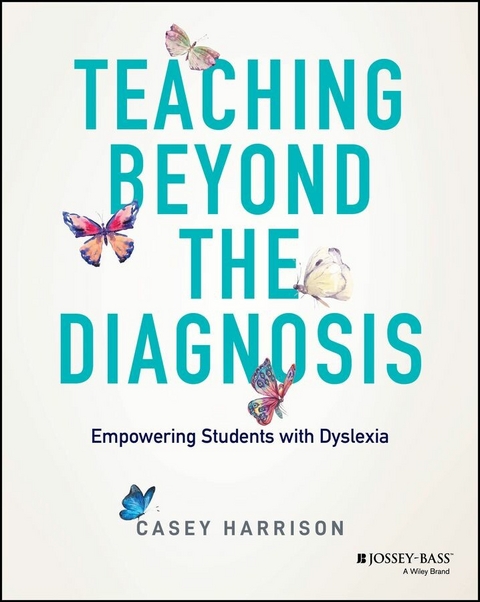
Teaching Beyond the Diagnosis (eBook)
395 Seiten
Jossey-Bass (Verlag)
9781394196333 (ISBN)
Tips for tailoring instruction and meeting the needs of dyslexic learners
Looking through both academic and social-emotional lenses, this book will deepen your understanding of dyslexia and help you feel confident in your interactions and implementation of instruction with your dyslexic learners. Written for educators and schools looking for ways to meet the social and emotional needs of dyslexic learners, scaffold instruction, and successfully implement accommodations, Teaching Beyond the Diagnosis provides a concrete framework for promoting self-confidence and student success. Author Casey Harrison, creator of The Dyslexia Classroom, shares her unique approach to creating dyslexia-friendly classrooms, providing accommodations and in the moment scaffolds as well as helping students build self-advocacy skills. This book will allow you to:
- Meet the needs of dyslexic learners both academically and emotionally
- Understand what dyslexia is, how it impacts learning, and what implications it has beyond the reading classroom
- Learn research-based techniques to enhance, differentiate and scaffold instruction, promoting learning in students with dyslexia
- Develop empathy and understanding, both in yourself and in the broader educational community, and promote inclusive classrooms
This book is for anyone who wants to help students with dyslexia find self-confidence and success: K-12 educators, as well as parents, administrators, and aspiring teachers.
Casey Harrison is a Certified Academic Language Therapist, Dyslexia Therapist, and educator. She created The Dyslexia Classroom, an organization that helps teachers and parents of dyslexic learners by breaking down the science of reading into manageable pieces. Harrison co-hosts the Together in Literacy podcast. Find her online at www.thedyslexiaclassroom.com and on Instagram @thedyslexiaclassroom.
Tips for tailoring instruction and meeting the needs of dyslexic learners Looking through both academic and social-emotional lenses, this book will deepen your understanding of dyslexia and help you feel confident in your interactions and implementation of instruction with your dyslexic learners. Written for educators and schools looking for ways to meet the social and emotional needs of dyslexic learners, scaffold instruction, and successfully implement accommodations, Teaching Beyond the Diagnosis provides a concrete framework for promoting self-confidence and student success. Author Casey Harrison, creator of The Dyslexia Classroom, shares her unique approach to creating dyslexia-friendly classrooms, providing accommodations and in the moment scaffolds as well as helping students build self-advocacy skills. This book will allow you to: Meet the needs of dyslexic learners both academically and emotionally Understand what dyslexia is, how it impacts learning, and what implications it has beyond the reading classroom Learn research-based techniques to enhance, differentiate and scaffold instruction, promoting learning in students with dyslexia Develop empathy and understanding, both in yourself and in the broader educational community, and promote inclusive classrooms This book is for anyone who wants to help students with dyslexia find self-confidence and success: K-12 educators, as well as parents, administrators, and aspiring teachers.
Introduction
Take a moment and look at this artwork titled Dyslexia Beach by Paddy Donnelly (see Figure 1). You see a young child sitting on the beach surrounded by letters. Notice his isolation as his peers sail away after figuring out how to put those lines and squiggles together to represent the sounds in the words that set them on their reading journey. This artwork highlights how many children with dyslexia feel. Alone and anxious about being left behind. Looking closer, you will see the little boy holding the letter Y. Why?
Figure 1 Dyslexia Beach.
Source: https://lefft.com/dyslexia-beach/. Reprinted with permission.
As each school year starts, parents and students head off to school excited to learn to read and write. However, year after year, the stories parents share with me contain a common thread. Parents come with heavy hearts, sharing stories of their child’s struggle to read. More often than not, their child began school happy and excited about learning, and as the struggles with reading and writing became more apparent, the child’s emotions were also impacted. Much like the little boy sitting on the beach, they saw their peers taking off in reading and writing, leaving them to withdraw, act out, or silently struggle—all impacting their self-esteem and confidence, leaving parents wondering what to do.
Our dyslexic students are often left behind. They are also the leading indicators of what is and isn’t working. We can determine how effective our teaching approach is by observing how our struggling readers progress. They are often the ones who first signal what is wrong. Yet, we may not recognize the impact of their early struggles nor reflect on why we are leaving some kids behind.
Teachers desire all children in their classrooms to achieve proficient reading and writing and also feel this lingering question of why. Why isn’t this child responding to my instruction? Why wasn’t I given the tools to help those with dyslexia in my teacher preparation courses? As a reading teacher and educator, I, too, held these questions of why, which led me to seek out specific knowledge and training to understand dyslexia and profoundly shifted my teaching. Two decades later, I remain steadfast in my resolve to bring awareness of dyslexia, literacy, and change to our classrooms. This is my why, because in today’s society, the written word is everywhere. While reading well is something many of us take for granted, overlooking the significance of the difficulty of achieving literacy cannot occur. I hear the same questions from educators time and time again. Why?
- Why is it so hard for this child, and why can’t he do what others do?
- Why are they struggling when they are clearly bright?
- Why are reading and writing so challenging for this student?
- Why isn’t this child able to keep up with the lessons?
- Why isn’t he progressing?
- Why can’t I teach him?
All the while, the child also asks why. Why can’t I do what others are doing? Why is this so hard? Why isn’t this making sense? Why can’t the teacher help me? Why am I so bad at reading? Why? Although they may not realize those exact questions, their self-esteem and confidence are shaken. Through my years of working as a dyslexia therapist and educator, I have seen the impacts that dyslexia can have on students when we fail to address academics properly, as well as the impacts students encounter in their daily lives. Students with dyslexia are often confused as to why they aren’t able to do what seems to come so easily for their peers. They are confused about why the teacher or parents tell them they are bright, yet reading and writing are so hard. They may begin not to trust themselves or the adults in their lives as things feel contradictory.
When working with students, I can see that this question of why surrounds our children and impacts their academics and self-esteem. I have also seen the tremendous impact that a teacher who understands dyslexia can have on their student’s learning when we reshape the teaching framework we use to one that answers the call to provide the proper support to address academic needs and a more comprehensive look at dyslexia. Through my work, an integrated framework has become the backbone of my lesson. One that intentionally weaves in proper instruction with executive function skills and metacognition, self-esteem, and agency, all to empower the student within and beyond the educational setting. This integrated framework is carefully laid out in the pages of this book to guide and empower our practice and, in turn, the students whom we serve.
Reflection:
As we move through the book and the integrated framework, remember this young boy or think of a child in your classroom or home who is left behind in the sand. Throughout the framework, return to this child and reflect on ways in which intentionally implementing the integrated framework can support academics and well-being.
What Is the Integrated Framework for Teaching and Empowering Students with Dyslexia?
The integrated framework for teaching and empowering students with dyslexia aims to connect the vital importance of the academic pursuit of teaching students with dyslexia to the whole child—the development of self-advocacy skills, accommodations, metacognitive processes, and meaningful scaffolds to help all children with dyslexia reach their potential (see Figure 2). All of these set the student up for success and self-confidence.
Figure 2 The integrated framework.
The integrated framework for teaching and empowering students with dyslexia encompasses the following elements, laying the foundation for our work. We begin with the big picture, a more extensive viewpoint, and an idea of where we are going along this journey and the path to success, then break down these elements throughout the book’s chapters.
The integrated framework for teaching and empowering students with dyslexia includes:
- A deep understanding of dyslexia—In this part of the journey, it is imperative that all learning team members (educators, students, parents, schools) understand what dyslexia is/isn’t and its impacts on academics and beyond. We need to be empowered to say the word “dyslexia” to deepen our understanding and look at impacts within and beyond academics.
- Appropriate academic instruction and support—This part of the journey focuses on research and what this means for our instructional practices. Proper instruction, scaffolds, and support must be grounded in a deep understanding of research and evidence-based instructional practices encompassing multisensory, explicit instruction in all components of literacy development tailored to address the intensity, duration, and needs of the student based on their learning profile.
- Executive function skills and metacognitive processes—Dyslexia instruction should not be isolated from metacognitive processes but instead woven into lessons in meaningful ways. Fostering executive function skills, metacognition, and critical thinking skills for both teachers and students is a key part of the integrated framework that supports student learning performance and considers the academic outcomes as well as the emotional well-being of the student.
- Accommodations and self-advocacy skills—The knowledge and use of accommodations and the role of self-advocacy to support learner outcomes empower teachers and students on this journey. By empowering students with the tools, language, and skills that set them up for success within the classroom and beyond, they can embrace agency in their journey.
- Success and confidence—Our goal as we walk along this path with students is to leave them empowered with the knowledge and confidence in themselves as learners with dyslexia.
The integrated framework is the path that came from this desire to create a better system for students and to assist children in attaining the goal of preserving their self-confidence while understanding themselves as learners and their journey with dyslexia. It is not done in lock-step or isolation but becomes a tapestry of parts that enhance learning and empower students, families, and educators. I have found that the integrated framework assists children in achieving academic success while preserving or building up their self-esteem, metacognitive strategies, and self-advocacy skills. The lasting impact of this framework of instruction is apparent in the words shared by students. Through their words, they show the confidence and pride they now hold for themselves as they walk into classrooms and the world and speak to the power of the integrated framework.
“I want teachers to know that they should not put a ceiling on what I can do. Just because I’m dyslexic doesn’t mean that I can only read aloud one sentence while my classmates read whole paragraphs. I can do the very same things that they do!”
—S. (student)
“My brain just processes information in a different way. It has nothing to do with how smart I am. If how you are teaching isn’t working for me, just explain it to me in a different way. Break it down and give me time.”
—G. (student)
Too often in education, we solely focus on the academic deficits and...
| Erscheint lt. Verlag | 5.3.2025 |
|---|---|
| Sprache | englisch |
| Themenwelt | Sozialwissenschaften ► Pädagogik ► Sonder-, Heil- und Förderpädagogik |
| Schlagworte | Differentiation • dyslexia • dyslexia education • dyslexia instruction • dyslexia pedagogy • dyslexia teacher book • dyslexia teaching • reading scaffolding • reading teacher book • Special education • special education teacher book • Teaching reading |
| ISBN-13 | 9781394196333 / 9781394196333 |
| Informationen gemäß Produktsicherheitsverordnung (GPSR) | |
| Haben Sie eine Frage zum Produkt? |
 EPUB (Adobe DRM)
Kopierschutz: Adobe-DRM
Adobe-DRM ist ein Kopierschutz, der das eBook vor Mißbrauch schützen soll. Dabei wird das eBook bereits beim Download auf Ihre persönliche Adobe-ID autorisiert. Lesen können Sie das eBook dann nur auf den Geräten, welche ebenfalls auf Ihre Adobe-ID registriert sind.
Details zum Adobe-DRM
Dateiformat: EPUB (Electronic Publication)
EPUB ist ein offener Standard für eBooks und eignet sich besonders zur Darstellung von Belletristik und Sachbüchern. Der Fließtext wird dynamisch an die Display- und Schriftgröße angepasst. Auch für mobile Lesegeräte ist EPUB daher gut geeignet.
Systemvoraussetzungen:
PC/Mac: Mit einem PC oder Mac können Sie dieses eBook lesen. Sie benötigen eine
eReader: Dieses eBook kann mit (fast) allen eBook-Readern gelesen werden. Mit dem amazon-Kindle ist es aber nicht kompatibel.
Smartphone/Tablet: Egal ob Apple oder Android, dieses eBook können Sie lesen. Sie benötigen eine
Geräteliste und zusätzliche Hinweise
Buying eBooks from abroad
For tax law reasons we can sell eBooks just within Germany and Switzerland. Regrettably we cannot fulfill eBook-orders from other countries.
aus dem Bereich