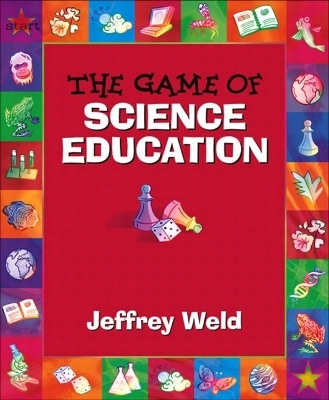
Game of Science Education, The, MyLabSchool Edition
Pearson
978-0-205-46492-0 (ISBN)
- Titel ist leider vergriffen;
keine Neuauflage - Artikel merken
Each chapter begins with "Chapter in Brief" and "Introduction" and concludes with "Conclusion," "The Game in Action," "Reflecting on the Game," "References," and "Additional Resources."
Preface: Inquisitive Young Scullions.
I. THE COACHES.
1. COACHING TO WIN, by John Penick Ph.D.
The Object of the Game.
A Rationale for Teaching.
The National Science Education Standards.
Creating a Winning Classroom Learning Climate.
The Role of the Winning Coach.
Curriculum for Success.
Assessment and Evaluation in the Winning Classroom.
2. All STAR PERFORMERS: SCIENCE TEACHERS AT THE TOP OF THEIR GAME, by Gary Varrella, Ph.D.
Shooting for the Top: A State of Mind, a State of Being.
Level and Art in Skillful Play.
Game Highlights Featuring Beliefs and Performance (Results of One Study).
Are Experts Born or Made?
3. NEW SCIENCE COACHES: PREPARATION IN THE NEW RULES OF SCIENCE EDUCATION, by Pradeep M. Dass Ph.D.
Capturing the Essence of the New Rules: Multiple Domains of Science.
Coaching by the New Rules: Instruction in Multiple Domains of Science.
An Overall Coaching Strategy: The Science-Technology-Society (STS) Approach.
4. SINK OR SWIM: THE TRANSFORMATIVE STUDENT TEACHING EXPERIENCE IN SCIENCE, by Jill C. McNew.
The Goals of Student Teaching.
The University Supervisor.
The Cooperating/Mentor Teacher.
The Student Teacher.
Becoming a teacher.
University Concerns.
Optimizing the Student Teaching Experience.
II. THE PLAYERS.
5. LEARNERS IN SCIENCE: NO ROOM ON THE BENCH, by Karen Dawkins, Ed.
What is Constructivism: Understanding the Game.
Nature of Science and Science Education.
Summarizing the Nature of Constructivism.
Implications for Practice: What does it All Mean?
Playing the Game.
Constructivism as an Implicit Element in Reform Documents.
6. FAIR PLAY IN SCIENCE EDUCATION: MOVING BEYOND SCIENCE FOR ALL, by Rebecca Meyer Monhardt, Ph.D.
Cause for Concern: Minority Success and Participation in Science.
Science Education: Who Are the Players
Making Sense of the Game.
Parents as Part of the Team.
Creating Equitable Contexts for Playing the Game.
Are the Rules the Same for All.
Culturally Familiar Role Models.
The Language of the Game.
Learning the Language of the Game.
Whose Game Is it?
7. ACCESSIBLE SCIENCE EDUCATION: EVERY STUDENT A PLAYER, by John Stiles, Ph.D.
Sports Games vs. Science Education.
Changing the Rules.
Making Their Own Rules.
The Player as Coach.
Learning to Play by the New Rules.
What Research Says about Science and Disabilities.
The New Breed of Coach: Modifying Instructional Strategies to Ensure Success.
III. THE EVOLVING GAME.
8. THE NATURE OF SCIENCE: UNDERSTANDING HOW THE GAME IS PLAYED, by Michael Clough, Ph.D.
Why Understanding the Nature of Science is Critical.
Important "Rules" of Science Appropriate for Middle and High School Students.
Effectively Teaching the Nature of Science.
Game Plan for Accurately Conveying the Game of Science.
The Value of Comparing Science to a Game.
9. THE WAVE: COMMUNITY EVOLUTION FROM SPECTATOR TO SUPPORTER OF SCIENCE EDUCATION, by Jeffrey Weld, Ph.D.
The Wave in Science Education.
The Value of Engaged Spectators.
A Win-Win Enterprise.
How to Build A Wave of Support for Science Education.
10. TECHNOLOGY TRANSFORMS THE GAME OF SCIENCE TEACHING, by David Wetzel, Ph.D.
Technology's Place in the Game.
How Does Technology Fit the Game Plan?
Science-Technology Player's Manual.
Technology's Role In the Classroom.
11. TESTING AND ASSESSMENT IN SCIENCE EDUCATION: SETTING PAR FOR THE COURSE, by Peter Veronesi, Ph.D.
Schools of Thought on Assessment
The Scorecard Model
High Stakes Versus High Yield Exams
The High Road to High Yield Assessments
Types of Authentic Assessment.
Designing a New Scorecard.
IV. REFLECTING ON THE GAME.
12. REFLECTING ON THE GAME: ACTION RESEARCH IN SCIENCE EDUCATION, by John Tillotson, Ph.D., Moses Ochanji, and Thomas Diana, jr.
What is Action Research and How Does it Create an Environment. @AHEADS = For Coaching the Game of Science.
Why Play the Game?
Action Research: An Individual or Team Effort.
Action Research: Developing the Playbook.
Practice Makes Perfect: How Action Research makes Better Players.
Connecting Action Research with the Literature Base.
Achieving Higher Standards Through Action Research.
Barriers to the Game.
Maximizing the Score: Range of Applications for Action Research.
Action Research as Professional Development Tool.
Action Research as a Link Between The University and the Classroom.
13. THE FUTURE OF THE GAME OF SCIENCE EDUCATION, by Robert Yager, Ph.D.
Keeping Up With the Times.
Does Anybody Really Know What Time It Is.
As Science Advances, Science Teaching Lags.
Science Education Permutations.
True Winds of Change.
Birth of Meaningful Reform.
A Recipe for Science Education's Future.
APPENDIX A. Building The Student-Centered Classroom, by Robin Lee Harris, Ph.D.
APPENDIX B. TEACHING STANDARDS OF THE NATIONAL SCIENCE EDUCATION STANDARDS.
| Erscheint lt. Verlag | 15.2.2005 |
|---|---|
| Sprache | englisch |
| Maße | 191 x 232 mm |
| Gewicht | 658 g |
| Themenwelt | Sozialwissenschaften ► Pädagogik ► Allgemeines / Lexika |
| Sozialwissenschaften ► Pädagogik ► Bildungstheorie | |
| Sozialwissenschaften ► Pädagogik ► Schulpädagogik / Grundschule | |
| Sozialwissenschaften ► Pädagogik ► Schulpädagogik / Sekundarstufe I+II | |
| ISBN-10 | 0-205-46492-0 / 0205464920 |
| ISBN-13 | 978-0-205-46492-0 / 9780205464920 |
| Zustand | Neuware |
| Informationen gemäß Produktsicherheitsverordnung (GPSR) | |
| Haben Sie eine Frage zum Produkt? |
aus dem Bereich