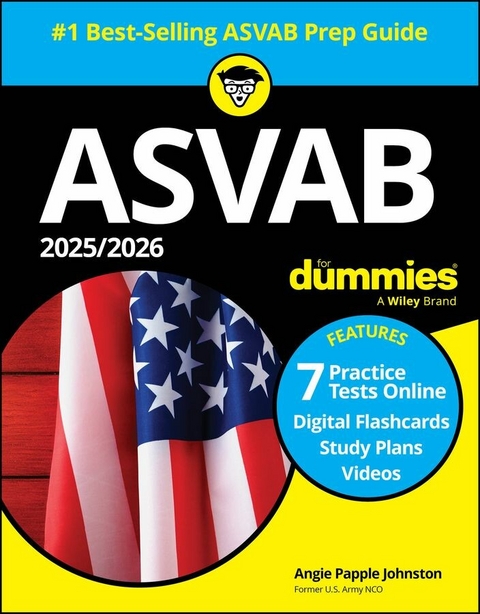
2025/2026 ASVAB For Dummies (eBook)
1182 Seiten
For Dummies (Verlag)
978-1-394-32347-0 (ISBN)
Score high on the ASVAB and launch your military career!
The latest edition of ASVAB For Dummies is here, packed with content to guide you through the military's aptitude test in 2025/2026. Whether you're aiming for a top-tier job or just need to secure that qualifying score, this book's got you covered. With expanded content on paragraph comprehension and more science practice questions than ever before, this test prep guide will help you do your best on test day. Plus, you'll get full access to online practice tests, digital flashcards, and videos to boost your confidence. Recommended by recruiters nationwide, ASVAB For Dummies shares insider strategies to help you excel when it counts.
- Clear, straightforward explanations of every ASVAB section, with plenty of tools to help you study smarter
- New information on Space Force career paths
- Full-length practice tests with detailed answers, so you can learn from your mistakes and raise your score
- Instructional videos, hundreds of practice questions, and digital flashcards online
ASVAB For Dummies has been the go-to resource for military hopefuls for years-now it's your chance to get ahead!
Angie Papple Johnston joined the U.S. Army in 2006 as a Chemical, Biological, Radiological, and Nuclear Specialist, ready to tackle chemical weapons in a Level-A HAZMAT suit. She's the author of several Dummies books, including ASVAB: 1001 Practice Questions For Dummies and Veteran's Benefits Guide For Dummies.
Chapter 1
Putting the ASVAB under a Microscope
IN THIS CHAPTER
Checking out the different versions of the ASVAB
Figuring out what each subtest covers
Computing the Armed Forces Qualification Test (AFQT) score
Taking the ASVAB again
The Armed Services Vocational Aptitude Battery (ASVAB) consists of ten tests that cover subjects ranging from general science principles to vocabulary. Your ASVAB test results determine whether you qualify for military service and, if so, which jobs you qualify for. The ASVAB isn’t an IQ test. The military isn’t trying to figure out how smart you are. The ASVAB specifically measures your ability to be trained to do a specific job. Although you don’t see the same questions in this book that appear on the test — ASVAB materials are tightly controlled items — you do see the same concepts. (Read that as “Don’t waste your time memorizing the answers to these questions. Focus on the concepts instead.”)
The famous Chinese general Sun Tzu said, “Know your enemy.” To develop an effective plan of study (check out Chapter 3) and score well on the ASVAB, it’s important to understand how the ASVAB is organized and how the military uses the scores from the subtests. This chapter describes the different versions of the ASVAB, the organization of the subtests, how the AFQT score is calculated, and the various services’ policies for retaking the ASVAB.
Knowing Which Version You’re Taking
Regardless of the military branch you want to join, you take the same ASVAB everyone else takes. That goes for the Army, Air Force, Navy, Marine Corps, Coast Guard, and Space Force. Every test-taker gets questions from the same pool, so you and every other potential enlistee are all on equal ground.
However, the ASVAB comes in five versions, depending on where and why you take it. The varieties of the test are essentially the same; they’re just administered differently. Table 1-1 boils them down.
TABLE 1-1 Versions of the ASVAB
| Version | How You Take It | Format | Purpose |
|---|
| Student | Given to juniors and seniors in high school; it’s administered through a cooperative program between the Department of Education and the Department of Defense at high schools across the United States | Paper | Its primary purpose is to provide a tool for guidance counselors to use when recommending civilian career areas to high school students (though it can be used for enlistment if taken within two years of enlistment). For example, if a student scores high in electronics, the counselor can recommend electronics career paths. If a student is interested in military service, the counselor then refers them to the local military recruiting offices. |
| Enlistment | Given through a military recruiter at a Military Entrance Processing Station (MEPS) or at a satellite testing site | Usually computer, may be paper | This version of the ASVAB is used by all the military branches for the purpose of enlistment qualification and to determine which military jobs a recruit can successfully be trained in. |
| Enlistment Screening Test (EST) | Given at the discretion of a military recruiter for a quick enlistment qualification screening | Computer | These mini-ASVABs aren’t qualification tests; they’re strictly recruiting and screening tools. The EST contains about 50 questions similar but not identical to questions on the AFQT portion of the ASVAB. The test is used to help estimate an applicant’s probability of obtaining qualifying ASVAB scores. |
| Pre-screening, internet-delivered Computerized Adaptive Test (PiCAT) | Online, on your own time after receiving an access code from your recruiter | Computer | The PiCAT is an unproctored, full version of the ASVAB. You take it on your own time, but you must take a verification test at a MEPS to validate your score. The verification test typically takes 25 to 30 minutes to complete. |
| Armed Forces Classification Test (AFCT) | Given at installation educational centers to people already in the military through the Defense Manpower Data Center | Computer | At some point during your military career, you may want to retrain for a different job. If you need higher ASVAB scores to qualify for such retraining, or if you’re a commissioned officer who wants to become a warrant officer, you can take the AFCT. The AFCT is essentially the same as the other versions of the ASVAB. |
The vast majority of military applicants are processed through a MEPS, where they take the computerized format of the ASVAB (called the CAT-ASVAB, short for computerized-adaptive testing ASVAB), undergo a physical exam, and run through a security screening, many times all in one trip. The paper-and-pencil (P&P) version is most often given in high school and at Mobile Examination Test (MET) sites located throughout the United States. Most MET sites use paper versions of the test.
Mapping Out the ASVAB Subtests
The computerized format of the ASVAB contains ten separately timed subtests, with the Auto & Shop Information subtest split in two. The paper format of the test has nine subtests (the Auto & Shop Information subtests are combined). The two formats differ in the number of questions in each subtest and the amount of time you have for each one. The CAT-ASVAB now often contains tryout questions. These questions haven’t been used on an officially scored ASVAB; test-makers use your responses to them to ensure the questions are good enough to use on future versions of the test. Each tester sees 15 tryout questions in two, three, or four of the subtests. These questions don’t count toward your score, but you still have to answer them. The tryout questions are only on the computerized version of the test; they’re not on the paper version. When you get tryout questions in a subtest, you get extra time to complete it.
Table 1-2 outlines the ASVAB subtests in the order that you take them in the enlistment (computerized or paper) and student (paper only) versions of the test; you can also see which chapters to turn to when you want to review that content.
TABLE 1-2 The ASVAB Subtests in Order
| Subtest | Questions/Time without Tryout Questions (CAT-ASVAB) | Possible Questions/Time with Tryout Questions (CAT-ASVAB) | Questions/Time (Paper Version) | Content | Chapter |
|---|
| General Science (GS) | 15 questions, 12 minutes | 30 questions, 25 minutes | 25 questions, 11 minutes | General principles of biological and physical sciences | Chapters 10, 11, and 12 |
| Arithmetic Reasoning (AR) | 15 questions, 55 minutes | 30 questions, 113 minutes | 30 questions, 36 minutes | Word problems involving high school math concepts that require calculations |
| Word Knowledge (WK) | 15 questions, 9 minutes | 30 questions, 18 minutes | 35 questions, 11 minutes | Correct meaning of a word; occasionally antonyms (words with opposite meanings) |
| Paragraph Comprehension (PC) | 10 questions, 27 minutes | 25 questions, 75 minutes | 15 questions, 13 minutes | Questions based on passages (usually a couple of hundred words) that you read |
| Mathematics Knowledge (MK) | 15 questions, 31 minutes | 30 questions, 65 minutes | 25 questions, 24 minutes | High school math, including algebra and geometry | Chapters 6, 7, and 8 |
| Electronics Information (EI) | 15 questions, 10 minutes | 30 questions, 21 minutes | 20 questions, 9 minutes | Electrical principles, basic electronic circuitry, and electronic terminology |
| Auto & Shop Information (AS) | 10 Auto Information questions, 7 minutes; 10 Shop Information questions, 7 minutes | 25 Auto Information questions, 18 minutes; 25 Shop Information questions, 17 minutes | 25 questions, 11 minutes | Knowledge of automobiles, shop terminology, and tool use | Chapters 13 and 14 |
| Mechanical Comprehension (MC) | 15 questions, 22 minutes | 30 questions, 42 minutes | 25 questions, 19 minutes | Basic mechanical and physical... |
| Erscheint lt. Verlag | 4.3.2025 |
|---|---|
| Sprache | englisch |
| Themenwelt | Schulbuch / Wörterbuch |
| Sozialwissenschaften ► Pädagogik ► Erwachsenenbildung | |
| Schlagworte | AFQT • air force asvab • ASVAB • asvab 2025 • asvab 2026 • asvab book • asvab flash cards • ASVAB guide • asvab practice test • asvab prep • asvab study guide • asvab workbook • join the military • military entrance test • Military recruitment • space force asvab |
| ISBN-10 | 1-394-32347-6 / 1394323476 |
| ISBN-13 | 978-1-394-32347-0 / 9781394323470 |
| Informationen gemäß Produktsicherheitsverordnung (GPSR) | |
| Haben Sie eine Frage zum Produkt? |
 EPUB (Adobe DRM)
Kopierschutz: Adobe-DRM
Adobe-DRM ist ein Kopierschutz, der das eBook vor Mißbrauch schützen soll. Dabei wird das eBook bereits beim Download auf Ihre persönliche Adobe-ID autorisiert. Lesen können Sie das eBook dann nur auf den Geräten, welche ebenfalls auf Ihre Adobe-ID registriert sind.
Details zum Adobe-DRM
Dateiformat: EPUB (Electronic Publication)
EPUB ist ein offener Standard für eBooks und eignet sich besonders zur Darstellung von Belletristik und Sachbüchern. Der Fließtext wird dynamisch an die Display- und Schriftgröße angepasst. Auch für mobile Lesegeräte ist EPUB daher gut geeignet.
Systemvoraussetzungen:
PC/Mac: Mit einem PC oder Mac können Sie dieses eBook lesen. Sie benötigen eine
eReader: Dieses eBook kann mit (fast) allen eBook-Readern gelesen werden. Mit dem amazon-Kindle ist es aber nicht kompatibel.
Smartphone/Tablet: Egal ob Apple oder Android, dieses eBook können Sie lesen. Sie benötigen eine
Geräteliste und zusätzliche Hinweise
Buying eBooks from abroad
For tax law reasons we can sell eBooks just within Germany and Switzerland. Regrettably we cannot fulfill eBook-orders from other countries.
aus dem Bereich