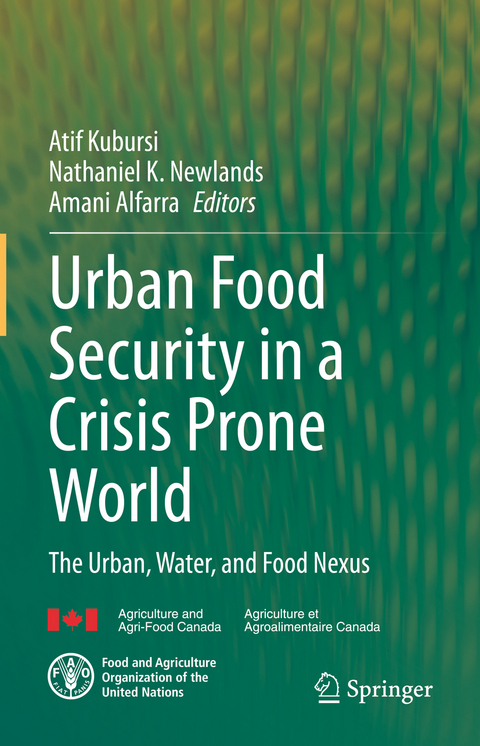
Urban Food Security in a Crisis Prone World
Springer International Publishing (Verlag)
978-3-031-89439-8 (ISBN)
The world will likely exceed 9 billion people by 2050 and is unlikely to stabilize in the 21st century, requiring 70 100% more food production, while an increasing number of countries are reaching alarming levels of water scarcity. Water for irrigation and food production constitutes one of the greatest pressures on freshwater resources. Agriculture accounts for around 70% of global freshwater withdrawals (up to 90% in some fast-growing economies), impacting environmental flows, downstream access to water, groundwater levels, and reducing the extent and functions of wetlands including the ecological functions of biodiversity, nutrient retention, and flood control. Agriculture is also one of the largest contributors to non-point source pollution. Rapid population growth combined with changing diets due to increased income levels will likely result in an 70% increase in food demand by 2050. Urbanization will also concentrate the portions of populations needing meat, dairy products, and processed food.
The corona pandemic has ravaged economies, lives, livelihoods, availability, affordability, and access to food the world over. Its negative consequences will likely escalate and spread widely. Invigorating urban food systems is seen as a feasible and necessary strategy to mitigate the many negative consequences of the pandemic by strengthening community resilience buttressed by environmentally friendly programs. Agriculture and Agri-Food Canada (AAFC, Government of Canada) and The Food and Agriculture Organization of the United Nations (UN-FAO) bring together a distinguished group of authors to analyse and prescribe policies and measures that can effectively meet and sustain the sustainable development goals not only in the area of food security, but also in several areas within the nexus of food, energy, green economy and health.
The book provides a synthesis of perspectives, knowledge, and insights within the urban-food-water nexus. Each chapter guides reads through the complex nexus landscape citing a wide body of recent, relevant literature sources (print and open access, online) for readers. Literature sources include peer-reviewed journal publications, books, as well as governmental and UN reports.
Atif Kubursi is an Emeritus Professor of Economics at McMaster University. Dr. Kubursi was Visiting Scholar at University of Cambridge in 1974/75, Member of the Institute for Social and Economic Policy in the Middle East at Harvard University, 1987-1997, Acting as Executive Secretary of UNESCWA, 2006-2007. He is an Adjunct Professor at York University School of the Environment and Urban Change and President of Econometric Research Ltd., Burlington, Ontario, Canada.
Nathaniel K. Newlands is a Research Scientist with Agriculture and Agri-Food Canada (AAFC) in Summerland, British Columbia, Canada. He is Editor-in-Chief of the Journal of Environmental Statistics and Data Science, Co-chair of the Global Expert Working Group in Ecosystem-based Solutions (UN-FAO) and President-Elect of the International Environmetrics Society (TIES).
Amani Alfarra is Water Officer in the Land and Water Division of the United Nations Food and Agriculture Organization. She holds a PhD in water resources management from Karlsruhe Institute for Technology, Germany. Her work and research focused on addressing interconnected challenges, in the food-water-energy nexus and an ecosystem-based approach to address water management and integrated watershed issues.
crisis prone world urban food-water nexus: an introduction.- redesigning and transforming food systems to be more resilient to disruption and disaster: lessons learned from covid.- environmental resilience and agricultural best-practices.- peri-urban agriculture and food security in mena countries.- self-provisioning and urban agriculture in canada.- economic and commercial urban farming.- the role of livestock production in urban food systems: urbanization and urban consumer demand trends for livestock products.- organizing urban farmers in a post-covid-19 economic recovery.- selecting allotment gardens in urban and peri-urban areas.- tackling ecological overshoot: the food system s 10 impossible imperatives .- covid-19 and food security in mena countries.- aligning urban farming with green city aspirations.- global impacts of the ukraine invasion: a resource perspective.- urban food sustainability and multilateral environmental governance frameworks- directional and operational complexities and opportunities.- summary, recommendations and roadmap for global food security.
| Erscheinungsdatum | 29.11.2025 |
|---|---|
| Zusatzinfo | XI, 266 p. 48 illus., 46 illus. in color. |
| Verlagsort | Cham |
| Sprache | englisch |
| Maße | 155 x 235 mm |
| Themenwelt | Naturwissenschaften ► Biologie ► Ökologie / Naturschutz |
| Naturwissenschaften ► Geowissenschaften ► Hydrologie / Ozeanografie | |
| Sozialwissenschaften ► Politik / Verwaltung ► Staat / Verwaltung | |
| Schlagworte | Agriculture • climate change • Crisis • disaster risk reduction • Food insecurity • shock • Urban Agriculture • urban studies |
| ISBN-10 | 3-031-89439-1 / 3031894391 |
| ISBN-13 | 978-3-031-89439-8 / 9783031894398 |
| Zustand | Neuware |
| Informationen gemäß Produktsicherheitsverordnung (GPSR) | |
| Haben Sie eine Frage zum Produkt? |
aus dem Bereich