


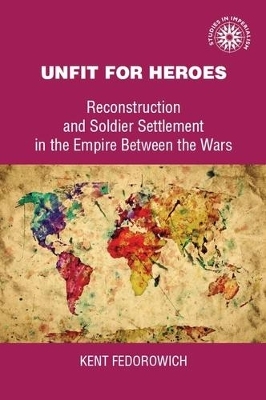
Unfit for Heroes
Reconstruction and Soldier Settlement in the Empire Between the Wars
Seiten
1995
Manchester University Press (Verlag)
978-0-7190-4108-2 (ISBN)
Manchester University Press (Verlag)
978-0-7190-4108-2 (ISBN)
- Titel ist leider vergriffen;
keine Neuauflage - Artikel merken
Over 5 million service personnel were demobilized by Great Britain and her four self-governing dominions after World War I. For many, their adjustment to civilian life was difficult. This book studies one of the principal solutions advanced by the reconstruction planners - resettlement on the land.
Research on soldier settlement has to be set within the wider history of emigration and immigration. This book examines two parallel but complementary themes: the settlement of British soldiers in the overseas or 'white' dominions, Australia, Canada, New Zealand and South Africa, between 1915 and 1930. One must place soldier settlement within the larger context of imperial migration prior to 1914 in order to elicit the changes in attitude and policy which occurred after the armistice. The book discusses the changes to Anglo-dominion relations that were consequent upon the incorporation of British ex-service personnel into several overseas soldier settlement programmes, and unravels the responses of the dominion governments to such programmes. For instance, Canadians and Australians complained about the number of ex-imperials who arrived physically unfit and unable to undertake employment of any kind. The First World War made the British government to commit itself to a free passage scheme for its ex-service personnel between 1914 and 1922. The efforts of men such as L. S. Amery who attempted to establish a landed imperial yeomanry overseas is described. Anglicisation was revived in South Africa after the second Anglo-Boer War, and politicisation of the country's soldier settlement was an integral part of the larger debate on British immigration to South Africa. The Australian experience of resettling ex-servicemen on the land after World War I came at a great social and financial cost, and New Zealand's disappointing results demonstrated the nation's vulnerability to outside economic factors. -- .
Research on soldier settlement has to be set within the wider history of emigration and immigration. This book examines two parallel but complementary themes: the settlement of British soldiers in the overseas or 'white' dominions, Australia, Canada, New Zealand and South Africa, between 1915 and 1930. One must place soldier settlement within the larger context of imperial migration prior to 1914 in order to elicit the changes in attitude and policy which occurred after the armistice. The book discusses the changes to Anglo-dominion relations that were consequent upon the incorporation of British ex-service personnel into several overseas soldier settlement programmes, and unravels the responses of the dominion governments to such programmes. For instance, Canadians and Australians complained about the number of ex-imperials who arrived physically unfit and unable to undertake employment of any kind. The First World War made the British government to commit itself to a free passage scheme for its ex-service personnel between 1914 and 1922. The efforts of men such as L. S. Amery who attempted to establish a landed imperial yeomanry overseas is described. Anglicisation was revived in South Africa after the second Anglo-Boer War, and politicisation of the country's soldier settlement was an integral part of the larger debate on British immigration to South Africa. The Australian experience of resettling ex-servicemen on the land after World War I came at a great social and financial cost, and New Zealand's disappointing results demonstrated the nation's vulnerability to outside economic factors. -- .
Kent Fedorowich is Reader in British Imperial and Commonwealth History at the University of the West of England, Bristol
Past policies and precedents, 1650-1914; empire migration, soldier settlement and British wartime initiative, 1914-1922; maintaining a tradition; soldier settlement in Canada - a dominion responsibility; anglicization, soldier settlement and the politicization of British immigration to South Africa; Australia and New Zealand - the failure of the Anzac legend. Conclusion: foredoomed to failure.
| Erscheint lt. Verlag | 2.3.1995 |
|---|---|
| Reihe/Serie | Studies in Imperialism |
| Zusatzinfo | bibliography, index |
| Verlagsort | Manchester |
| Sprache | englisch |
| Themenwelt | Geschichte ► Allgemeine Geschichte ► Neuzeit (bis 1918) |
| Sozialwissenschaften | |
| ISBN-10 | 0-7190-4108-2 / 0719041082 |
| ISBN-13 | 978-0-7190-4108-2 / 9780719041082 |
| Zustand | Neuware |
| Informationen gemäß Produktsicherheitsverordnung (GPSR) | |
| Haben Sie eine Frage zum Produkt? |
Mehr entdecken
aus dem Bereich

aus dem Bereich
Geschichte einer wilden Handlung
Buch | Hardcover (2024)
C.H.Beck (Verlag)
CHF 47,60


