


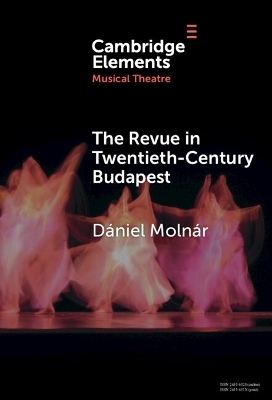
The Revue in Twentieth-Century Budapest
From Cosmopolitan Night-Clubs to Stalinist Dogma
Seiten
2025
Cambridge University Press (Verlag)
978-1-009-49445-8 (ISBN)
Cambridge University Press (Verlag)
978-1-009-49445-8 (ISBN)
This Element discusses Budapest from the 1920s until 1968. The field of entertainment began to be considered a cultural product that had to adhere to new political requirements. By 1968, the revue's cultural relevance had become almost insignificant with the appearance of new genres of entertainment.
Since the introduction of modern revues in 1925, the genre faced near-constant political scrutiny in Budapest. Yet by the 1930s, the city had become the capital of Central European cosmopolitan nightlife. The closure of Hungary's borders after World War II ended any hope of reclaiming this international status. Under communism and the Stalinist totalitarian regime, the revue—despite its popularity—remained politically stigmatized. For the first time, entertainment was treated as a cultural matter rather than merely a law enforcement issue, but it was forced to conform to ideological expectations. Three attempts to legitimize the genre in the 1950s ultimately failed, shaping the trajectory of live entertainment in the era. By the 1960s, revues were officially accepted, yet their cultural significance had faded amid the rise of new entertainment forms.
Since the introduction of modern revues in 1925, the genre faced near-constant political scrutiny in Budapest. Yet by the 1930s, the city had become the capital of Central European cosmopolitan nightlife. The closure of Hungary's borders after World War II ended any hope of reclaiming this international status. Under communism and the Stalinist totalitarian regime, the revue—despite its popularity—remained politically stigmatized. For the first time, entertainment was treated as a cultural matter rather than merely a law enforcement issue, but it was forced to conform to ideological expectations. Three attempts to legitimize the genre in the 1950s ultimately failed, shaping the trajectory of live entertainment in the era. By the 1960s, revues were officially accepted, yet their cultural significance had faded amid the rise of new entertainment forms.
1. Sources, methods, contexts; 2. From local importance to international fame: 'Budapest Broadway', 1920–1944; 3. Revues in crisis; 4. The socialist revue experiments; 5. Changes in set and costume design: the politics of visual representation; 6. The recuperation and stabilisation of revues in socialist Hungary after 1953; 7. Epilogue: the legacy of the Stalinist-era revue in Hungary; References.
| Erscheinungsdatum | 13.05.2025 |
|---|---|
| Reihe/Serie | Elements in Musical Theatre |
| Zusatzinfo | Worked examples or Exercises |
| Verlagsort | Cambridge |
| Sprache | englisch |
| Themenwelt | Kunst / Musik / Theater ► Musik ► Klassik / Oper / Musical |
| Kunst / Musik / Theater ► Theater / Ballett | |
| Sozialwissenschaften ► Soziologie | |
| ISBN-10 | 1-009-49445-7 / 1009494457 |
| ISBN-13 | 978-1-009-49445-8 / 9781009494458 |
| Zustand | Neuware |
| Informationen gemäß Produktsicherheitsverordnung (GPSR) | |
| Haben Sie eine Frage zum Produkt? |
Mehr entdecken
aus dem Bereich


aus dem Bereich
Essays und Gespräche
Buch | Hardcover (2025)
Wallstein Erfolgstitel (Verlag)
CHF 29,90


