


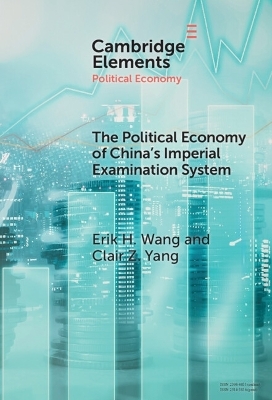
The Political Economy of China's Imperial Examination System
Seiten
2025
Cambridge University Press (Verlag)
978-1-009-66329-8 (ISBN)
Cambridge University Press (Verlag)
978-1-009-66329-8 (ISBN)
This Element argues that the Imperial Examination System (Keju) contributed to political stability in China with consequences initially unanticipated by its contemporaries. It documents the emergence of Keju using evidence from early Chinese empires to the end of the Tang Dynasty. This title is also available as Open Access on Cambridge Core.
Just as councils and assemblies were central to European polities for centuries, the Imperial Examination System (Keju) constituted the cornerstone of state institutions in China. This Element argues that Keju contributed to political stability, and its emergence was a process, not a shock, with consequences initially unanticipated by its contemporaries. The Element documents the emergence of Keju using evidence from early Chinese empires to the end of the Tang Dynasty in the 10th century, including epitaphs and government documents. It then traces the selection criteria of Keju and trends in social mobility over the second millennium, leveraging biographical information from over 70,000 examinees and 1,500 ministers and their descendants. The Element uses a panel of 112 historical polities to quantify Keju's association with country-level political indicators against the backdrop of global convergence in political stability and divergence in institutions. This title is also available as Open Access on Cambridge Core.
Just as councils and assemblies were central to European polities for centuries, the Imperial Examination System (Keju) constituted the cornerstone of state institutions in China. This Element argues that Keju contributed to political stability, and its emergence was a process, not a shock, with consequences initially unanticipated by its contemporaries. The Element documents the emergence of Keju using evidence from early Chinese empires to the end of the Tang Dynasty in the 10th century, including epitaphs and government documents. It then traces the selection criteria of Keju and trends in social mobility over the second millennium, leveraging biographical information from over 70,000 examinees and 1,500 ministers and their descendants. The Element uses a panel of 112 historical polities to quantify Keju's association with country-level political indicators against the backdrop of global convergence in political stability and divergence in institutions. This title is also available as Open Access on Cambridge Core.
1. Introduction; 2. The origins; 3. Early development; 4. Evolution of Keju over time; 5. Keju and political stability; References.
| Erscheinungsdatum | 20.05.2025 |
|---|---|
| Reihe/Serie | Elements in Political Economy |
| Zusatzinfo | Worked examples or Exercises |
| Verlagsort | Cambridge |
| Sprache | englisch |
| Maße | 152 x 229 mm |
| Gewicht | 268 g |
| Themenwelt | Sozialwissenschaften ► Pädagogik ► Allgemeines / Lexika |
| Wirtschaft ► Volkswirtschaftslehre ► Wirtschaftspolitik | |
| ISBN-10 | 1-009-66329-1 / 1009663291 |
| ISBN-13 | 978-1-009-66329-8 / 9781009663298 |
| Zustand | Neuware |
| Informationen gemäß Produktsicherheitsverordnung (GPSR) | |
| Haben Sie eine Frage zum Produkt? |
Mehr entdecken
aus dem Bereich


aus dem Bereich
ihr individueller Weg: von der Themensuche zum Doktortitel
Buch | Softcover (2025)
UTB (Verlag)
CHF 26,45
Einführung in die Theorie transformatorischer Bildungsprozesse
Buch | Softcover (2023)
Kohlhammer (Verlag)
CHF 47,60


