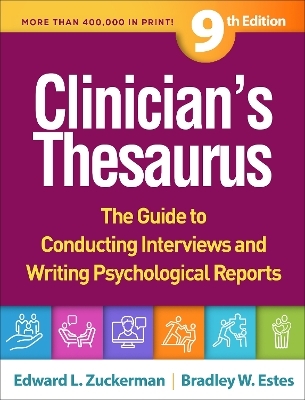
Clinician's Thesaurus, Ninth Edition
Guilford Press (Verlag)
978-1-4625-5808-7 (ISBN)
New to This Edition
Updated for DSM-5-TR and ICD-10-CM code changes for 2025.
Updated and new listings of assessment and screening tools.
Revised descriptors and terms pertaining to internet use, gender and sexuality, relationships, race and ethnicity, and more.
Updated treatment planning tips, web links, and psychiatric drug information.
Edward L. Zuckerman, PhD, consults and creates effective practice tools for clinicians. He found his life’s passion while working as a psychiatric aide at New York’s Bellevue Hospital in the 1960s. Dr. Zuckerman has worked with adults in a variety of clinical contexts, acted as liaison with state hospitals, taught undergraduates and professional clinicians, and maintained an independent practice in general clinical psychology for many years. He lives in Pittsburgh, Pennsylvania. Bradley W. Estes, PsyD, is a clinical neuropsychologist with a passion for serving others through diagnostics, psychotherapy, and professional consultation. Dr. Estes has worked with children and adults of all ages in a variety of settings, including psychiatric hospitals, rehabilitation hospitals, skilled nursing facilities, and schools. He lives in Indiana, where he has an independent practice focused on clinical and forensic neuropsychological and psychological assessment. Dr. Estes is also a faculty advisor for the Brain Health Initiative.
Getting Oriented to the Clinician’s Thesaurus
A Functional Guide to Report Construction
I. Conducting a Mental Health Evaluation
1. Beginning and Ending the Interview
2. Mental Status Evaluation Questions/Tasks
3. Questions about Signs, Symptoms, and Other Behavior Patterns
II. Standard Terms and Statements for Wording Psychological Reports
A. Introducing the Report
4. Beginning the Report: Preliminary Information
5. Referral Reasons
6. Background Information and History
B. The Person in the Evaluation
7. Behavioral Observations
8. Responses to Aspects of the Examination
9. Presentation of Self
10. Emotional/Affective Symptoms and Disorders
11. Cognition and Mental Status
12. Abnormal Signs, Symptoms, and Syndromes
13. Personality Patterns
C. The Person in the Environment
14. Activities of Daily Living
15. Social/Community Functioning
16. Couple and Family Relationships
17. Vocational/Academic Skills
18. Recreational Functioning
19. Other Specialized Evaluations
D. Completing the Report
20. Summary of Findings and Conclusions
21. Diagnostic Statement/Impression
22. Recommendations
23. Prognostic Statements
24. Closing Statements
III. Useful Resources
25. Treatment Planning and Treatment Plan Formats
26. Formats for Reports, Evaluations, and Summaries
27. Treatments for Specific Disorders and Concerns
28. Listing of Common Psychiatric and Psychoactive Drugs
29. Psychiatric Masquerade of Medical Conditions
Appendices
A. Abbreviations in Common Use
B. Annotated Readings in Assessment, Interviewing, and Report Writing
Feedback Solicitation Form
References
| Erscheinungsdatum | 26.09.2025 |
|---|---|
| Verlagsort | New York |
| Sprache | englisch |
| Gewicht | 1180 g |
| Themenwelt | Geisteswissenschaften ► Psychologie |
| Medizin / Pharmazie ► Medizinische Fachgebiete ► Psychiatrie / Psychotherapie | |
| Sozialwissenschaften ► Pädagogik ► Sozialpädagogik | |
| Sozialwissenschaften ► Soziologie | |
| ISBN-10 | 1-4625-5808-9 / 1462558089 |
| ISBN-13 | 978-1-4625-5808-7 / 9781462558087 |
| Zustand | Neuware |
| Informationen gemäß Produktsicherheitsverordnung (GPSR) | |
| Haben Sie eine Frage zum Produkt? |
aus dem Bereich