


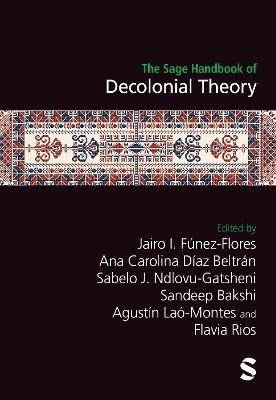
The Sage Handbook of Decolonial Theory
SAGE Publications Ltd (Verlag)
978-1-5296-6781-3 (ISBN)
The Sage Handbook of Decolonial Theory is a groundbreaking transdisciplinary resource that expands the epistemological and geographical horizons of decolonial thought. This handbook prioritizes the Global South, fostering South-North and South-South inter-epistemic dialogues and situating decolonial thought in sites of struggle. It builds on decolonial thought and praxis from Latin America and the Caribbean, Africa, Asia, and Palestine, among other regions and countries. Addressing the erasure of knowledge production from the Global South in dominant academic spaces, this handbook brings together decolonial scholars and activist intellectuals from the Global South and engages with politically committed scholars in the Global North. It emphasizes the geopolitics and ethics of knowledge production and the importance of situating one’s work in historically excluded regions and communities.
Organized into five parts, the handbook includes conceptual essays and empirical studies on decolonial thought and praxis. It covers a range of topics from (de)coloniality, geopolitics, and transdisciplinarity to decolonial feminisms, gender and sexuality studies, and racial capitalism. The chapters convey a sense of urgency and a committed political voice, demonstrating how decolonial theory can interrogate and intervene in the modern/colonial racial capitalist heteropatriarchal world.
The Sage Handbook of Decolonial Theory is not just for academics; it is written for anyone interested in radical thought and praxis. It recognizes decolonial theory as a plural and dynamic field, concerned with power hierarchies, historiography, and epistemological critiques of Eurocentrism. Ultimately, it teaches us how to think with and act alongside struggles for liberation.
Part I: Key Debates in Decolonial Theory
Part II: Geopolitics and Geographies
Part III: Transdisciplinarity
Part IV: Feminisms, Genders, & Sexualities
Part V: Racial Capitalism
Jairo I. Fúnez-Flores is an Assistant Professor of Curriculum Studies at Texas Tech University. He is the Program Chair of the Decolonial, Postcolonial, and Anti-Colonial Studies in Education SIG for the American Educational Research Association. His research is situated at the intersection of sociocultural studies in curriculum theory, decolonial theory, critical ethnography, and social movement research. Currently, he is advancing what he calls insurgent decolonial theory to situate thought in sites of struggle. He has published articles in Theory, Culture & Society, Globalisation, Societies and Education, Sociology Compass, and Educational Studies. He is also the co-editor of the Bristol University Press book series Decolonization and Social Worlds, lead editor of the Routledge book series Decolonial Entanglements: Praxis, Pedagogy, and Social Theory, and lead editor of the SAGE Handbook of Decolonial Theory. Ana Carolina Díaz Beltrán is an Assistant Professor of Social Studies Education at the University of Texas Rio Grande Valley. Her research focuses on the living experiences of citizenship and belonging of transnational Latine youth, intergenerational schooling experiences of Black families in the US, and decolonial thought and praxis. She has published articles in Curriculum Inquiry, Theory & Research in Social Education, and Educational Studies. She currently serves as chair for the Decolonial, Postcolonial and Anti-colonial Studies in Education SIG at the American Educational Research Association. Sabelo J. Ndlovu-Gatsheni is currently Research Professor and Director of Scholarship at the Department of Leadership and Transformation (DLT) in the Principal and Vice-Chancellor’s Office at the University of South Africa (UNISA). Professor Ndlovu-Gatsheni has published over a hundred publications and his major book publications include Empire, Global Coloniality and African Subjectivity (New York & Oxford: Berghahn Books, June 2013); Coloniality of Power in Postcolonial Africa: Myths of Decolonization (Dakar: CODESRIA, 2013); Decolonizing the University, Knowledge Systems and Disciplines (North Carolina, Carolina Academic Press, April 2016) co-edited with Siphamandla Zondi; The Decolonial Mandela: Peace, Justice and Politics of Life (New York and Oxford: Berghahn Books, March 2016); and Epistemic Freedom in Africa: Deprovincialization and Decolonization (London & New York: Routledge, July 2018). His latest publication is Decolonization, Development and Knowledge in Africa: Turning Over A New Leaf (Routledge, May 2020). Sandeep Bakshi (Université Paris Cité, ECHELLES UMR 8264) researches on transnational queer and decolonial enunciation of knowledges. He received his PhD from the School of English, University of Leicester, UK, and is currently employed as an Associate Professor of Decolonial, Postcolonial and Queer Studies at University Paris Cité. He convened two research seminars, “Peripheral Knowledges” and “Empires, Souths, Sexualities,” (2019-2024) and currently co-convenes the research seminar, “Undiscipline, Decolonise, Repair”. He leads the Pôle Société Civile of the Cité du Genre Institute, Université Paris Cité. Co-editor of Decolonizing Sexualities: Transnational Perspectives, Critical Interventions (Oxford: Counterpress, 2016), ‘Decolonial Trajectories’, special issue of Interventions (2020), and Qu’est-ce que l’Intersectionnalité? Dominations plurielles : sexe, classe et race (2021), he has published on queer and race problematics in postcolonial literatures and cultures. He is the co-founder and co-director of the Decolonizing Sexualities Network (https://decolonizingsexualities.org) Agustin Lao-Montes has a Ph.D. in Sociology from the State University of New York–Binghamton. He is a Professor of Sociology & Afro-American Studies at UMass Amherst. His fields of specialty include world-historical sociology and globalization, political sociology (especially social movements and the sociology of state and nationalism), social identities and social inequalities, sociology of race and ethnicity, urban sociology/community-university partnerships, African Diaspora and Latino Studies, sociology of culture and cultural studies, and contemporary theory and postcolonial critique. He has published numerous articles on decolonial theory and is the author of Mambo Montage: The Latinization of New York and Contrapunteos diaspóricos: Cartografías políticas de Nuestra Afroamérica. Flavia Rios is a Professor of Sociology at the Universidade Federal Fluminense (UFF), Brazil. She was a Visiting Student Researcher Collaborator (VSRC) in the Department of Sociology at Princeton University (2013). Her main interests are Social Movements, racial inequalities, Affirmative Actions, and Black thought. Flavia’s current research focuses on intersections between gender, race, and democracy. She is the author of numerous articles building upon Black decolonial feminisms and struggles in Brazil.
PART I: KEY DEBATES IN DECOLONIAL THEORY
1The Coloniality of Power and Social Classification
2Decolonial Praxis and Decolonizing Paths: Notes for These Times
3Palestine, the War against Decolonization, and Combative Decoloniality
4Encruzilhada: The Concept of Crossroads in the Afro-Diasporic Cosmovision as a Decolonizing Theoretical Practice
5The Struggle for the Decolonial Liberation of Palestine
6Occupations of Language: Queer Praxis Grounding Decolonial Approaches
7A Never-Ending Historicity: The Antifuturist Discourses of Abya Yala and their Confrontation with the Finite Time of Western Modernity
8Decoloniality is Agency
9Insurgent Decoloniality: Situating Thought in Sites of Struggle
10The Rise and Fall of Decolonial Social Theory: Co-Optation, Intellectualisation, and the Epistemic Decolonial Turn
PART II: GEOPOLITICS AND GEOGRAPHIES
11Demystifying Decolonization: Reclaiming Palestinian Authorship of their Destiny
12We Can’t theorize Without an Image of the World: Toward a Heterogeneous, Relational, and Planetary Imagination
13The Earth of the (Un)Damned: Meditations on Planetary Decolonisation
14Mapping Euromodern Geographies: Plantations, Prisons and Modernity—Toward Afromodern Decolonial Politics
15“Estamos Bien:” A Framework for Interrogating the Coloniality of Resilience for Postsecondary Education in Puerto Rico
16The Black Diaspora and the International: Learning with the Difference
17Geographies of Loss: Dispossession, Tourism, Mestizaje, and (Un) Settler Colonialism in Mexico
18Hindu Nationalism and Indigeneity: Theoretical Challenges and Opportunities for the Decolonial School of Thought
PART III: TRANSDISCIPLINARITY
19Peace and (de)coloniality
20Towards Decolonial Islamophobia Studies
21Unlikely Sources of Decolonial Theorizing: My Jamaican Grandmother’s Stories of Resistance, Reclaiming, and Revitalization
22Lamentations, Combat Breathing and Black Women′s Creative Practice as Episteme
23Anti-racism, Decoloniality and Institutions: Between Rocks and Hard Places…
24Spaces of Coloniality and Anthropological Practices in Southern Abya Yala Between the Late 19th and Early 20th Century
25Embodying the Land: Diversity in Indigenous Health Knowledge Production from Palestine to the Great Plains
26Towards a Transdisciplinary Decolonial Research Praxis: Insights from Using Decolonial Theory in Collaborative Research
PART IV: FEMINISMS, GENDERS, & SEXUALITIES
27An Inherently Decolonial Existence: Defining Palestinian Feminist Praxis
28The World of the One: Colonizing to Exist and the Relevance of Indigenous Epistemologies of Co-existence
29A Feminist Decolonial Positionality: Bodies, Resistance, Knowing
30Coloniality of Sexuality: Enacting Impositions
31Holding Some Ground on a Greasy Dancefloor: Decoloniality, Caste, and South Asian Queer Diaspora
32Arrested Possibilities, Islam Otherwise, and Queer Life: Thinking Liberation, Religion, and Decoloniality alongside Shia Muslim Scholars
PART V: RACIAL CAPITALISM
33Racial Capitalism as a Theory of History
34Racial Capitalism: A Guide for the Naysayer
35It Has Been Racial Capitalism Since the Beginning
36Towards a Decolonial Pan-Africanism of the Twenty-First Century: A Philosophy of Liberation Perspective
37On Decoloniality and/in “Eastern Europe”
38Racial Capitalism and Fascism
39Entrepreneurship as Counterinsurgency in the Global South
40Economic Orders after Sovereignty: Decolonization and Combative Decoloniality in Ghana
41Decoloniality and Racial Capitalism
42Climate Policy and Social Death: how Euro-American Green New Deals Reinforce the Disposability of African Life in the “Post”-colonial
| Erscheinungsdatum | 22.07.2025 |
|---|---|
| Verlagsort | London |
| Sprache | englisch |
| Maße | 174 x 246 mm |
| Gewicht | 1350 g |
| Themenwelt | Sozialwissenschaften ► Soziologie ► Allgemeines / Lexika |
| ISBN-10 | 1-5296-6781-X / 152966781X |
| ISBN-13 | 978-1-5296-6781-3 / 9781529667813 |
| Zustand | Neuware |
| Informationen gemäß Produktsicherheitsverordnung (GPSR) | |
| Haben Sie eine Frage zum Produkt? |
aus dem Bereich


