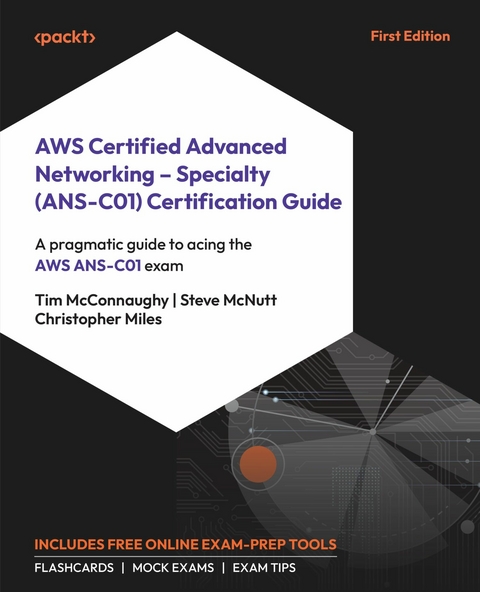
AWS Certified Advanced Networking - Specialty (ANS-C01) Certification Guide (eBook)
650 Seiten
Packt Publishing (Verlag)
978-1-83508-809-8 (ISBN)
The AWS Certified Advanced Networking - Specialty certification exam focuses on leveraging AWS services alongside industry standards to create secure, resilient, and scalable cloud networks.
Written by industry experts with decades of experience in the field, this comprehensive exam guide will enable you to transform into an AWS networking expert, going beyond the ANS-C01 exam blueprint to maximize your impact in the field. You'll learn all about intricate AWS networking options and services with clear explanations, detailed diagrams, and practice questions in each chapter. The chapters help you gain hands-on experience with essential components, such as VPC networking, AWS Direct Connect, Route 53, security frameworks, and infrastructure as code. With access to mock exams, interactive flashcards, and invaluable exam tips, you have everything you need to excel in the AWS ANS-C01 exam.
This book not only prepares you to confidently take the exam, but also deepens your understanding and provides practical insights that are vital for a successful career in AWS cloud networking.
By the end of this exam guide, you'll be thoroughly trained to take the AWS ANS-C01 exam and efficiently design and maintain network architectures across a wide range of AWS services.
Become proficient in networking in AWS and prepare to confidently pass the certification exam by using exam-specific study materialsPurchase of this book unlocks access to web-based exam prep resources including practice tests, flashcards, exam tips, and the eBook PDFKey FeaturesGet a thorough understanding of the latest AWS ANS-C01 exam objectivesExplore AWS networking options, services, features, and their relationshipsPrepare for exam success with mock exams that correctly reflect exam-level difficultyBook DescriptionThe AWS Certified Advanced Networking Specialty certification exam focuses on leveraging AWS services alongside industry standards to create secure, resilient, and scalable cloud networks. Written by industry experts with decades of experience in the field, this comprehensive exam guide will enable you to transform into an AWS networking expert, going beyond the ANS-C01 exam blueprint to maximize your impact in the field. You ll learn all about intricate AWS networking options and services with clear explanations, detailed diagrams, and practice questions in each chapter. The chapters help you gain hands-on experience with essential components, such as VPC networking, AWS Direct Connect, Route 53, security frameworks, and infrastructure as code. With access to mock exams, interactive flashcards, and invaluable exam tips, you have everything you need to excel in the AWS ANS-C01 exam. This book not only prepares you to confidently take the exam, but also deepens your understanding and provides practical insights that are vital for a successful career in AWS cloud networking. By the end of this exam guide, you ll be thoroughly trained to take the AWS ANS-C01 exam and efficiently design and maintain network architectures across a wide range of AWS services.What you will learnBuild resilient, scalable networks by using AWS network constructsIntegrate hybrid connectivity models by using AWS and third-party architectureAssess the various load balancing and DNS options that AWS providesExamine security frameworks in AWS and the constructs that support secure connectivityUtilize AWS monitoring tools to optimize and diagnose network connectivityComprehend AWS ANS-C01 exam questions to maximize your chances of answering correctlyWho this book is forThis book is for professional networkers who want to achieve certification in AWS cloud networking. Anyone currently working as a network engineer or architect, as well as individuals looking to transition into AWS networking will also find this book valuable. A foundational understanding of basic network concepts and an in-depth knowledge of the cloud service connectivity model, specifically the distinctions between IaaS, PaaS, and SaaS services.]]>
Preface
The cloud has been made famous by the apps that run there. Application developers and IT infrastructure professionals have embraced public clouds such as Amazon Web Services (AWS) to build highly available and resilient resources. However, just like how IT has functioned for the last few decades, when these services are not functioning, who gets blamed first? The network.
The network engineers of today have been building scalable and resilient networks for decades and the networks running within AWS cloud environments are no different. AWS cloud computing teams need engineers and architects with strong networking capabilities to support the design and deployment of networks just as they do on-premises. However, networking in the public cloud differs from the way things are done on-premises. Network operators need to be able to effectively build and operate complex networks within AWS to function as an extension of the enterprise networks they are responsible for.
This is the purpose of the AWS Certified Advanced Networking – Specialty (ANS-C01) exam: to demonstrate the skills and knowledge to build and maintain AWS cloud networks. As defined by the blueprint for this exam, individuals looking to take this exam should be able to perform the following tasks:
- Design and deploy core networking functionality within and across AWS accounts
- Implement hybrid networking solutions to connect with traditional networks and third-party networks
- Integrate other core AWS services with networking solutions for functionality with DNS, load balancing, and content distribution
- Implement security within AWS networks utilizing native services and constructs
- Deploy AWS network solutions using infrastructure as code (IaC) for optimization and automation
- Operate AWS networks using native analysis tools and services
The goal of this book is to prepare candidates specifically for the ANS-C01 version of the AWS Certified Advanced Networking – Specialty exam. This book will not only cover the topics outlined in the exam blueprint but also provide real-world examples about operating AWS cloud networks from the experience of the authors.
Who This Book Is For
This guide is meticulously crafted for experienced cloud networking professionals, network architects, and solution designers who are committed to mastering advanced networking concepts within the Amazon Web Services (AWS) ecosystem. It is specifically tailored to support candidates preparing for the ANS-C01 examination, providing comprehensive coverage of complex networking technologies, design patterns, and implementation strategies unique to AWS infrastructure.
Networking and AWS Constructs You Should Already Know
This certification guide is going to make some assumptions about what you should already know with respect to computer networking and AWS services.
When going by the AWS blueprint for the ANS-C01 exam, there is an expectation that candidates need to be very comfortable working with computer networking. The following description is taken directly from the AWS Certified Advanced Networking – Specialty (ANS-C01) exam guide:
The target candidate possesses the knowledge, skills, experience, and competence to design, implement, and operate complex AWS and hybrid networking architectures. The target candidate is expected to have 5 or more years of networking experience with 2 or more years of cloud and hybrid networking experience.
Note
The details for the AWS Certified Advanced Networking – Specialty exam, including the blueprint, can be found here: https://aws.amazon.com/certification/certified-advanced-networking-specialty/.
Here are the key network fundamentals that you should have a strong level of comfort with before proceeding with this chapter. If any of the topics below are unfamiliar to you, please refer to the appendices to develop a baseline on these concepts:
- The OSI layer - (Appendix 1, Network Fundamentals)
- IP Addressing fundamentals (v4 and v6) - (Appendix 1, Network Fundamentals)
- IP Subnetting & CIDR notation - (Appendix 1, Network Fundamentals)
- Public vs Private IP Addressing - (Appendix 1, Network Fundamentals)
- IP Routing - (Appendix 2, IP Routing Fundamentals)
- Dynamic Routing (for later chapters) - (Appendix 2, IP Routing Fundamentals)
- BGP Basics (for later chapters) - (Appendix 2, IP Routing Fundamentals)
In addition to the above network fundamentals, there are a few AWS constructs that you will need to be familiar with to proceed. These items are typically covered within another certification track, like the AWS Certified Cloud Practitioner. Additional reading for each of these components will be linked below.
Here are the AWS constructs you should already be familiar with before proceeding:
- AWS Regions and Zones
- Amazon Simple storage service (S3)
- Amazon Elastic cloud compute (EC2)
- Amazon Elastic block store (EBS)
- AWS Service Quotas
Note
Further detail on the above mentioned AWS topics can be found at the links below
https://docs.aws.amazon.com/AWSEC2/latest/UserGuide/using-regions-availability-zones.html
https://docs.aws.amazon.com/AmazonS3/latest/userguide/Welcome.html
https://docs.aws.amazon.com/AWSEC2/latest/UserGuide/concepts.html
https://docs.aws.amazon.com/AWSEC2/latest/UserGuide/storage_ebs.html
https://docs.aws.amazon.com/servicequotas/latest/userguide/intro.html
AWS Certified Advanced Networking – Specialty Exam Outline
The ANS-C01 exam is divided into separate domains. Each domain includes specific statements that outline what candidates should be able to demonstrate. This outline briefly covers each domain and how these statements should be interpreted by candidates for the exam.
Test Domains
The ANS-C01 exam is divided into four test domains. These domains identify, at a high level, areas of expertise that the candidate will be tested on. You can see in the following table that each domain holds a significant amount of weight on the exam; therefore, the candidate needs to make sure they can demonstrate their knowledge and skills adequately in each domain. These weights only represent the scored content on the exam.
| Domain | Weight (%) |
| Domain 1: Network Design | 30% |
| Domain 2: Network Implementation | 26% |
| Domain 3: Network Management and Operation | 20% |
| Domain 4: Network Security, Compliance, and Governance | 24% |
| Total | 100% |
Table 0.1: Test domain weighting
Task Statements
Each domain contains a set of task statements relating to the content covered on the exam. While not a comprehensive list of the content of the exam, each task statement on the blueprint provides additional context to help candidates prepare for the exam. The additional context per task statement identifies items that the candidate will need knowledge of versus skills in. As the reader, you can logically separate these two statements as theory versus hands-on experience.
For areas that require knowledge of, you will be expected to demonstrate your knowledge of how that item fits into an overall solution. This may require detailing the components of the technology/service being asked about and/or what use case it can address. For areas that require skills in, you will be expected to demonstrate your knowledge of how to configure, validate, or troubleshoot a selected technology...
| Erscheint lt. Verlag | 28.2.2025 |
|---|---|
| Sprache | englisch |
| Themenwelt | Mathematik / Informatik ► Informatik ► Theorie / Studium |
| Mathematik / Informatik ► Informatik ► Web / Internet | |
| Informatik ► Weitere Themen ► Zertifizierung | |
| Sozialwissenschaften ► Pädagogik | |
| ISBN-10 | 1-83508-809-0 / 1835088090 |
| ISBN-13 | 978-1-83508-809-8 / 9781835088098 |
| Informationen gemäß Produktsicherheitsverordnung (GPSR) | |
| Haben Sie eine Frage zum Produkt? |
 EPUB (Ohne DRM)
Digital Rights Management: ohne DRM
Dieses eBook enthält kein DRM oder Kopierschutz. Eine Weitergabe an Dritte ist jedoch rechtlich nicht zulässig, weil Sie beim Kauf nur die Rechte an der persönlichen Nutzung erwerben.
Dateiformat: EPUB (Electronic Publication)
EPUB ist ein offener Standard für eBooks und eignet sich besonders zur Darstellung von Belletristik und Sachbüchern. Der Fließtext wird dynamisch an die Display- und Schriftgröße angepasst. Auch für mobile Lesegeräte ist EPUB daher gut geeignet.
Systemvoraussetzungen:
PC/Mac: Mit einem PC oder Mac können Sie dieses eBook lesen. Sie benötigen dafür die kostenlose Software Adobe Digital Editions.
eReader: Dieses eBook kann mit (fast) allen eBook-Readern gelesen werden. Mit dem amazon-Kindle ist es aber nicht kompatibel.
Smartphone/Tablet: Egal ob Apple oder Android, dieses eBook können Sie lesen. Sie benötigen dafür eine kostenlose App.
Geräteliste und zusätzliche Hinweise
Buying eBooks from abroad
For tax law reasons we can sell eBooks just within Germany and Switzerland. Regrettably we cannot fulfill eBook-orders from other countries.
aus dem Bereich