


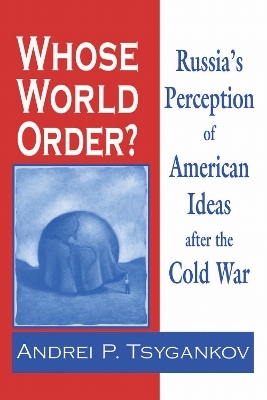
Whose World Order?
Russia's Perception of American Ideas After the Cold War
Seiten
2004
University of Notre Dame Press (Verlag)
978-0-268-04229-5 (ISBN)
University of Notre Dame Press (Verlag)
978-0-268-04229-5 (ISBN)
Intellectual ideas on ""international community"" can contribute to how cultures perceive one another. These ideas can be misunderstood if they are framed in a culturally exclusive way. This text examines how Russian elites engage American ideas of world order and why they perceive them as unlikely to promote a just or stable international system.
In Whose World Order? Andrei P. Tsygankov examines how Russian elites engage American ideas of world order and why Russians perceive these ideas as unlikely to promote a just or stable international system. Tsygankov focuses on Francis Fukuyama's "end of history" thesis, which argues for the global ascendancy of Western-style market democracy, and Samuel Huntington's "clash of civilizations," which drew attention to what Huntington perceived to be an increasingly dominant global disorder. Tsygankov argues that Russian intellectuals received the ideas of these two prominent American scholars critically. Tsygankov traces the reasons for Russian perceptions to the ethnocentric nature of the two sets of ideas and the inability of their authors to fully appreciate Russia's distinctive historical, geopolitical, and institutional perspectives.
Throughout this rich study Tsygankov points to the need for scholars to study cultural perceptions in world politics as a means of eliminating some of the obstacles that stand in the way of a truly global society. He also raises the issue of whether or not intellectuals should accept moral responsibility for the ideas they produce and what implications this may have for international relations theory.
In Whose World Order? Andrei P. Tsygankov examines how Russian elites engage American ideas of world order and why Russians perceive these ideas as unlikely to promote a just or stable international system. Tsygankov focuses on Francis Fukuyama's "end of history" thesis, which argues for the global ascendancy of Western-style market democracy, and Samuel Huntington's "clash of civilizations," which drew attention to what Huntington perceived to be an increasingly dominant global disorder. Tsygankov argues that Russian intellectuals received the ideas of these two prominent American scholars critically. Tsygankov traces the reasons for Russian perceptions to the ethnocentric nature of the two sets of ideas and the inability of their authors to fully appreciate Russia's distinctive historical, geopolitical, and institutional perspectives.
Throughout this rich study Tsygankov points to the need for scholars to study cultural perceptions in world politics as a means of eliminating some of the obstacles that stand in the way of a truly global society. He also raises the issue of whether or not intellectuals should accept moral responsibility for the ideas they produce and what implications this may have for international relations theory.
Andrei P. Tsygankov is professor of international relations and political science at San Francisco State University.
| Erscheint lt. Verlag | 14.4.2004 |
|---|---|
| Zusatzinfo | 14 b/w tables - 14 Tables, black and white |
| Verlagsort | Notre Dame IN |
| Sprache | englisch |
| Maße | 152 x 229 mm |
| Gewicht | 308 g |
| Themenwelt | Sozialwissenschaften ► Politik / Verwaltung ► Europäische / Internationale Politik |
| ISBN-10 | 0-268-04229-2 / 0268042292 |
| ISBN-13 | 978-0-268-04229-5 / 9780268042295 |
| Zustand | Neuware |
| Informationen gemäß Produktsicherheitsverordnung (GPSR) | |
| Haben Sie eine Frage zum Produkt? |
Mehr entdecken
aus dem Bereich


aus dem Bereich
Amerikas Strategie der Vorherrschaft und der Kampf um Eurasien
Buch | Softcover (2024)
NOMEN Verlag
CHF 27,95
kurze Geschichte einer langen Beziehung
Buch | Hardcover (2025)
Suhrkamp (Verlag)
CHF 36,40
erfolgreiche Interessenvertretung durch Prozesskompetenz im komplexen …
Buch | Hardcover (2023)
Wiley-VCH (Verlag)
CHF 58,75


