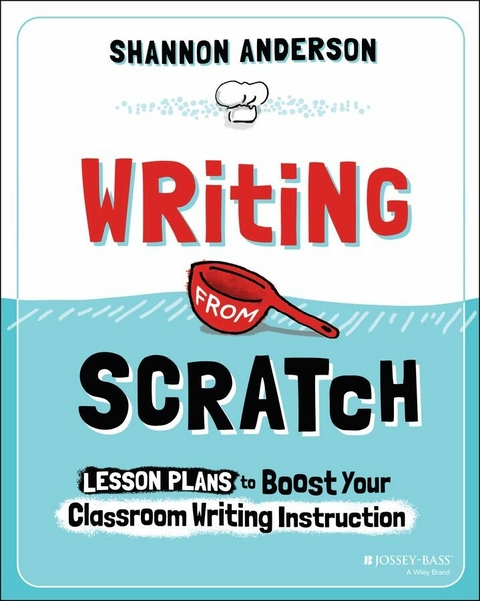
Writing from Scratch (eBook)
315 Seiten
Jossey-Bass (Verlag)
978-1-394-28100-8 (ISBN)
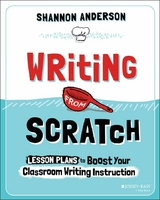
Effective, engaging strategies that will boost your confidence in teaching writing
Writing from Scratch is a positive, encouraging book full of practical techniques for elementary teachers and students to get the most out of their writing time. Award-winning author Shannon Anderson presents specific, skill-based lessons through a running theme of baking and cooking. Each lesson, or 'recipe,' will help you serve up effective instruction on writing topics like idea generation, figurative language, plotting, and structure. This book is designed not just to develop student writing, but to develop students as writers. The experiences and guidance in Writing From Scratch will inspire you to plan a year-long curriculum-or jump in mid-year-for writing instruction that will make a difference for students today, and into the future.
- Get practical ideas for incorporating writing lessons into your elementary classroom
- Build writing exercises into content lessons, for added writing instruction
- Inspire students to get excited about writing and explore their identities as writers
- Gain the confidence you need to plan a full writing curriculum
Teachers in K-5 settings, as well as principals and education leaders, will benefit from this hands-on writing instruction guide. Perfect for solo use or as a guide for professional development, Writing From Scratch will have you cooking up fantastic writing lessons in no time!
SHANNON ANDERSON is an award-winning children's author, educator, and speaker. She taught for 25 years, from first grade through college level, and was named one of 10 Teachers who Awed and Inspired by The Today Show in 2019. Anderson currently teaches at Franklin College as an Instructor of Education.
Effective, engaging strategies that will boost your confidence in teaching writing Writing from Scratch is a positive, encouraging book full of practical techniques for elementary teachers and students to get the most out of their writing time. Award-winning author Shannon Anderson presents specific, skill-based lessons through a running theme of baking and cooking. Each lesson, or recipe, will help you serve up effective instruction on writing topics like idea generation, figurative language, plotting, and structure. This book is designed not just to develop student writing, but to develop students as writers. The experiences and guidance in Writing From Scratch will inspire you to plan a year-long curriculum or jump in mid-year for writing instruction that will make a difference for students today, and into the future. Get practical ideas for incorporating writing lessons into your elementary classroom Build writing exercises into content lessons, for added writing instruction Inspire students to get excited about writing and explore their identities as writers Gain the confidence you need to plan a full writing curriculum Teachers in K-5 settings, as well as principals and education leaders, will benefit from this hands-on writing instruction guide. Perfect for solo use or as a guide for professional development, Writing From Scratch will have you cooking up fantastic writing lessons in no time!
09 Organizing Fiction Writing
Kids may not be aware of all of the different ways that stories can be organized. For example, you could share some of Jan Brett's or Laura Numeroff's stories that have full‐circle structures. You could read one of Lisa McCourt's Stinky Face books, which are organized around a dialogue between a mother and her son. Kevin Henkes's book, Wemberly Worried, follows a problem–solution structure. Wemberly has a worrying problem that we see her work through.
For the youngest writers, you may simply make a beginning, middle, and ending graphic organizer or planner for a story. Fold a piece of paper lengthwise into thirds to create three sections. The kids can open each flap to jot a few details of what will happen in the beginning, middle, and end of their stories.
For more experienced writers, students can use a traditional story plot arc graphic organizer to detail the exposition, rising action, climax, falling action, and resolution. Or they can use a planner for the character motivation, inciting incident, multiple attempts and failures, and ultimate result. In this section, we will look at ways to organize personal narratives and fiction writing. We can plan out how to organize our stories and also look specifically at each part of our stories: the beginning, middle, ending, characters, and setting.
Recipe: Two Rectangles + Four Squares Planner
Notes from the Chef
- This is an easy planner to use with younger kids to plan a story that is only four to six sentences long. It is also a great planner for older kids to plan a story with four to six paragraphs. You can use it accordingly.
Ingredients
- Two Rectangles + Four Squares Planner
Appetizer
- Discussion: When organizing a piece of writing, we have some kind of beginning, or introduction. The writing in the middle is organized into chunks of information, or paragraphs.
- We also have some kind of conclusion at the end. Using Two Rectangles + Four Squares is a way to “shape up” what we're going to write about. How could we use these shapes to plan what we want to write? Show example with the shapes labeled.
Cooking Demonstration and Practice
- Model writing a personal narrative. Choose something from your ME Page, or use the example here to talk through how you would plan your personal narrative.
- Be sure to brainstorm and talk aloud as you figure out the introduction, what to say in each paragraph, and how you would wrap it all up. Be sure to point out that besides the beginning and the ending, you are not using complete sentences. These are just notes.
- Ask students to choose a topic from their ME Page. Pass out the planner PDF to fill out.
- Allow plenty of time for students to fill out ideas on their planner. Have students save these for a future writing assignment when they will actually write out their narratives.
Dessert
- Students will not be writing their narratives today. This is just showing them an efficient way to plan. Demonstrate using your planner to orally tell what your story may say once complete. Allow students to partner with someone to orally tell their story, using their planners.
Recipe: Narrative Beginnings
Notes from the Chef
- The beginning of a story is a big deal. From an author's perspective, we want the beginning to hook the reader in and cause them to want to keep reading. From a reader's perspective, you want to get a feel for the tone and type of story it is.
- You want to feel grounded in some way or have your curiosity peaked. There are several ways you can do this. This lesson will share all kinds of ways we can begin our stories.
Ingredients
- Plate, cup, utensils, napkin
- Mentor narrative texts with different types of beginnings
- Chart paper
- ME Page
Appetizer
- Set a table in your room with a place setting: plate, cup, utensils, and napkin. Ask a student volunteer to knock on the classroom door and pretend they are coming to your house for dinner for the first time.
- You answer the door and whisk the student off to the table, set them down, put the fork in their hand, and say, “Eat!”
- The student will probably be a bit confused at this abrupt behavior, and rightly so. Share with the class that we wouldn't welcome someone into our house for dinner like that.
- Have the student knock on the door again. This time you may have other volunteers act as your spouse, kids, dog, or others in your home. When you answer, invite them in the door and welcome them. Introduce them to your family. Show them around. Then walk them to the table. Maybe even ask what they'd like to drink.
- This time, you've introduced your guest to some “characters” and the “setting.” You gave them some grounding before jumping in to the main course. This analogy is like our stories. We want to introduce the readers to something. We can welcome them into our story with the characters, setting, or many other things before hopping into the main events.
Cooking Demonstration and Practice
- Gather 5–10 books with different beginning lines. Read each beginning and have students decide what the author was using as a technique or introducing the reader to. Record each on chart paper as you go. Here are some example books I use year after year:
- Verdi: “On a small, tropical island, the sun rose high above the steamy jungle.” (Setting)
- Me First: “Pinkerton was pink, plump, and pushy.” (Character and alliteration)
- Bridge to Terabithia: “Ba‐room, ba‐room, ba‐room, bariptiy, baripity, baripity, baripity—Good. His dad had the pickup going.” (Onomatopoeia)
- Coasting Casey: “Casey, please pay attention!” says my teacher, Mr. Tay. Oops! He caught me drifting off… .It happens every day. (Dialogue)
- Charlotte's Web: “Where's Papa going with that ax?” (Question)
- Have kids go to their seats to retrieve a book they are currently reading. Let some students share the beginning lines of their books. Discuss which type of beginning the author used. If they're not already on the chart, add the new types of beginnings.
- Project up your ME Page, from the beginning of the year. Allow a student to pick a topic from it. Then allow a student to choose three different beginning techniques from the chart you just created. Using the chosen topic, model writing the three types of beginnings the student chose. Think aloud as you figure out your three different beginnings.
- Have students get out their ME Pages and choose a topic. On three separate pieces of paper or documents, have students craft three different beginnings.
Dessert
- Allow several students to share their favorite beginning out of their three examples. Have students save these beginnings in their writing folders for future use.
Recipe: Which Is the Real Intro?
Notes from the Chef
- This lesson is a great way to have kids practice writing a beginning and assessing the beginnings others write. It is gamified, as students are trying to trick classmates into believing that their beginning is the one written by the author.
Ingredients
- Mentor text that students aren't familiar with
- Enough lined paper for all students
- Whiteboards and markers for students
- Optional: prize for the winner
Appetizer
- Show the cover of an unfamiliar book. (You can do this activity with any or all genres.) Have kids think about what the introduction to a book like that might say. Explain that you're having a contest to see who can get the most points. They can earn five points for guessing the actual introduction by the author, or get two points for each time other students guess that their written introduction is the correct one.
- This activity causes kids to use the higher‐order thinking skills of judgment and evaluation. They not only have to discern while trying to write a professional‐sounding introduction but also when hearing the writing of others.
Cooking Demonstration and Practice
- Have each student craft a two‐ to three‐sentence introduction for the book.
- Collect all of these digitally or on paper. If you have them write on paper, be sure to write the actual introduction on identical paper. Mix up all of the introductions and number them from one through however many intros you have.
- Have students come back to your sharing area with a whiteboard and a marker.
Dessert
- Read aloud each beginning and its corresponding number. Students who believe an introduction might be the real one can record the number of the intro on their boards.
- After reading all of the intros, take a show of hands for how many people voted for each one. If the intro doesn't get at least 10 votes, it is taken out of the contest. This should significantly narrow down the selections.
- Reread the few selections left and have students record their final vote on their boards for which number they think is the real...
| Erscheint lt. Verlag | 31.1.2025 |
|---|---|
| Sprache | englisch |
| Themenwelt | Sozialwissenschaften ► Pädagogik ► Bildungstheorie |
| Schlagworte | elementary professional development • elementary writing • k-5 lesson plans • k-5 writing • professional development writing • Teaching writing • Writing across the curriculum • writing curriculum • writing lesson plans • writing lessons • Writing teacher |
| ISBN-10 | 1-394-28100-5 / 1394281005 |
| ISBN-13 | 978-1-394-28100-8 / 9781394281008 |
| Informationen gemäß Produktsicherheitsverordnung (GPSR) | |
| Haben Sie eine Frage zum Produkt? |
 EPUB (Adobe DRM)
Kopierschutz: Adobe-DRM
Adobe-DRM ist ein Kopierschutz, der das eBook vor Mißbrauch schützen soll. Dabei wird das eBook bereits beim Download auf Ihre persönliche Adobe-ID autorisiert. Lesen können Sie das eBook dann nur auf den Geräten, welche ebenfalls auf Ihre Adobe-ID registriert sind.
Details zum Adobe-DRM
Dateiformat: EPUB (Electronic Publication)
EPUB ist ein offener Standard für eBooks und eignet sich besonders zur Darstellung von Belletristik und Sachbüchern. Der Fließtext wird dynamisch an die Display- und Schriftgröße angepasst. Auch für mobile Lesegeräte ist EPUB daher gut geeignet.
Systemvoraussetzungen:
PC/Mac: Mit einem PC oder Mac können Sie dieses eBook lesen. Sie benötigen eine
eReader: Dieses eBook kann mit (fast) allen eBook-Readern gelesen werden. Mit dem amazon-Kindle ist es aber nicht kompatibel.
Smartphone/Tablet: Egal ob Apple oder Android, dieses eBook können Sie lesen. Sie benötigen eine
Geräteliste und zusätzliche Hinweise
Buying eBooks from abroad
For tax law reasons we can sell eBooks just within Germany and Switzerland. Regrettably we cannot fulfill eBook-orders from other countries.
aus dem Bereich