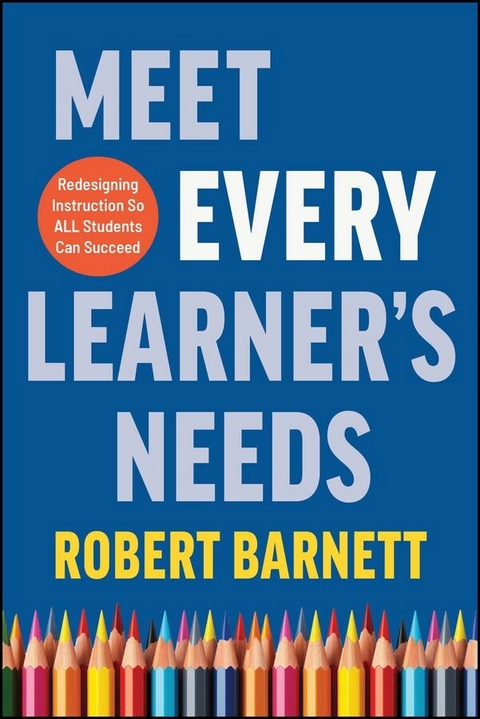
Meet Every Learner's Needs (eBook)
328 Seiten
Jossey-Bass (Verlag)
978-1-394-27490-1 (ISBN)
Classroom-tested strategies to inspire true student learning
Meet Every Learner's Needs delivers research-backed techniques to transform classrooms into dynamic learning environments in which all students are appropriately challenged-and appropriately supported-every day.
Based on teacher and Modern Classrooms Project cofounder Robert Barnett's experience training thousands of teachers worldwide, this book provides a methodology for K-12 educators to design lessons and courses that respond to individual learners' unique needs and help every learner develop authentic understanding. This approach has empowered educators and students in all grade levels and content areas, everywhere from underperforming inner-city public schools to elite international schools, across all fifty states and over 150 countries.
The book includes highly practical tips and templates, which busy teachers can use to provide better instruction immediately. Throughout the book, readers will learn how to:
- Make direct instruction accessible and engaging to all learners
- Develop strong personal relationships with and between learners
- Create efficient learning experiences that give learners ownership and autonomy
- Share this approach with their colleagues and communities
Meet Every Learner's Needs will leave readers both inspired and empowered to redesign instruction in their classrooms and communities. It will help educators, administrators, and parents take immediate action to create learning experiences that help all students truly succeed.
Robert Barnett is a former teacher and the Co-Founder of the Modern Classrooms Project. He taught math, computer science, English, social studies, and law, from the middle-school to university levels, at public and private schools in the United States and abroad. He hopes his own children will learn in Modern Classrooms someday.
Classroom-tested strategies to inspire true student learning Meet Every Learner's Needs delivers research-backed techniques to transform classrooms into dynamic learning environments in which all students are appropriately challenged and appropriately supported every day. Based on teacher and Modern Classrooms Project cofounder Robert Barnett's experience training thousands of teachers worldwide, this book provides a methodology for K-12 educators to design lessons and courses that respond to individual learners' unique needs and help every learner develop authentic understanding. This approach has empowered educators and students in all grade levels and content areas, everywhere from underperforming inner-city public schools to elite international schools, across all fifty states and over 150 countries. The book includes highly practical tips and templates, which busy teachers can use to provide better instruction immediately. Throughout the book, readers will learn how to: Make direct instruction accessible and engaging to all learners Develop strong personal relationships with and between learners Create efficient learning experiences that give learners ownership and autonomy Share this approach with their colleagues and communities Meet Every Learner's Needs will leave readers both inspired and empowered to redesign instruction in their classrooms and communities. It will help educators, administrators, and parents take immediate action to create learning experiences that help all students truly succeed.
Introduction: The Fundamental Challenge of Teaching
Do you ever struggle to…
- Challenge the most advanced learners in your class?
- Support learners with below‐grade‐level skills?
- Help chronically absent students catch up?
When I taught in the way I was trained to teach—delivering a single new lesson to all of my students every day—I struggled to do any of these things well. I spent hours preparing my lessons, then did my best to deliver them. But most of the time, my advanced students seemed bored. My students who lacked grade‐level skills seemed lost. And my students who were absent missed out altogether. I was working as hard as I could, but it always felt like there were students I just couldn't reach.
This was exhausting—and disheartening. My job was to help every learner succeed. Every day, I fell short.
No matter what I did, my lessons always seemed too easy for some students and too hard for others. I tried desperately to keep my students engaged, but they all needed different things—and there was just one of me. Each day that I failed to challenge the students who were ahead, or to support those who had fallen behind, felt like a precious day wasted. And I had no idea what to do about the learners who weren't there. I loved my students, but I was miserable. I often wanted to quit.
If I was going to make it as a teacher—and help my students achieve their full potential—I needed a new approach.
So I redesigned my lessons. Rather than delivering the same content at the same time to all of my students, whether they were prepared for it or not, I explained my content using short instructional videos, then gave each learner the time they actually needed to master each new skill. That kept every student appropriately challenged—and therefore engaged—every day. It freed me up to spend class time working closely with my students. And it was fun!
Next I redesigned my courses. I let my students learn at their own paces for days at a time, and required that each student master foundational skills before accessing more advanced content. I sat down with my students, got to know them as human beings, and marveled as I saw each of them, no matter their prior knowledge, take ownership and pride in their learning.
Finally I shared this approach—now called the Modern Classroom instructional model—with my colleagues. I showed Kareem Farah, who taught downstairs from me, and we founded the Modern Classrooms Project (MCP) in order to show others. Today there are thousands of educators, all over the world, leading their own Modern Classrooms in every subject you can imagine, from kindergarten to college and beyond.
Research shows that these teachers feel happier and more effective, while their students feel more engaged and more capable. I want you to experience these benefits too, so I've written this book to share the Modern Classroom model with you. In reading it you'll discover evidence‐based practices you can use right away, as well as insights from educators who use this approach in their classrooms every day.
Before you start redesigning instruction, however, there are four realities you should understand.
Reality #1: Teaching Is Really Hard
I didn't realize how hard teaching could be until my first week at Eastern Senior High School.
The week started off well enough. I had a few years of teaching experience by that point—I had worked as a classroom aide and taught at a small independent school—so I felt comfortable in front of a class. I found my new students intelligent, curious, and eager to succeed. I loved my content, loved working with young people, and felt excited to work in a comprehensive public high school in my hometown of Washington, DC. Teaching at Eastern was a dream.
Once I began my lessons, however, it became a nightmare. My job was to teach precalculus. Yet in every one of my classes, I had students who excelled in math, students who struggled with basic concepts like exponents and fractions, and students who rarely showed up at all. In my first‐period class, for instance, I taught:
- David, who loved math and wanted to become an engineer. He knew he would study calculus in college, and he wanted to be prepared.
- Anna, whose math skills were many years below grade level—and who dreaded math as a result. Anna had failed every standardized math test she had ever taken, but she was in my class anyway. All Anna wanted was to make it through the year.
- Troy, who often missed class or showed up late. I didn't know why Troy was absent so often, but I knew he had challenges at home. Even when he was in class, Troy often seemed distracted.
I realized that if I tried to push David, I'd lose Anna. If I slowed down to support Anna, I'd bore David. And when Troy showed up after missing class, he'd inevitably be confused. I had no idea how to deliver a single lesson that could meaningfully engage these three learners at the same time—let alone the other twenty students in the class! So I stood at the board, feeling helpless.
I faced the fundamental challenge of teaching: every learner has different needs. David needed a challenge; Anna needed support; Troy needed to get back on track. Until I figured out how to meet all their needs at once, none of these young people could achieve their full potential. Nor, for that matter, could I.
This challenge may seem unique to math, or to large public schools like Eastern. It isn't. Knowledge in every discipline builds upon itself, so students who lack foundational skills in any subject will inevitably struggle to access grade‐level content. In every school some students will inevitably learn faster than their peers; others will inevitably be late or absent. The learners in any given class, therefore, will inevitably need different things.
So I faced this challenge again at Leysin American School in Switzerland, the elite international boarding school where I taught both math and social studies after leaving Eastern. I see this challenge at play in my own children's classrooms today. In fact, I encounter the fundamental challenge of teaching everywhere I go: students like David need to be pushed, while students like Anna and Troy need help catching up. It's inevitable.
So when I speak with teachers—at least before they adopt the Modern Classroom model—I often hear the same things. No matter where or what they teach, educators tell me:
- “I don't have time to challenge my advanced students.”
- “I struggle to support students whose skills are below grade level.”
- “I can't teach students who aren't in class.”
- “I'm doing the best I can, but it's never enough.”
Maybe you've felt these things as well.
If you have, it's not your fault. Nor is it a reflection of your commitment or belief in your students. Helping every student succeed, in the limited amount of time you have together, is really hard! It's the fundamental challenge of teaching. And if you don't have a practical way to meet every learner's needs, it can make your job feel downright impossible.
Teacher Tip
Chris Gupton, High School Science Teacher (Franklin, Tennessee)
“I came to teaching from a career in the Army, where if you worked hard enough and you planned well enough, training would go smoothly. But teaching is different. No matter how hard you plan your lesson or how hard you work on setting up your room, the students have a vote in how that’s going to go. And if you haven’t taken into account their needs and their interests, then working hard and being smart isn’t enough.
“The Modern Classroom model really helped me respond to each of my students’ needs and interests, which made teaching and learning more effective and fun for all of us.”
Reality #2: Our Students Are Languishing
Let's be clear about the stakes here. Teaching is a tough job, but what students learn in school shapes the courses of their lives.
Unfortunately, our school system fails to provide many learners the instruction they need. Consider David, whose education often failed to challenge him. Consider Anna, whose education often failed to support her. Or consider Troy, who often missed out altogether. When these students' classes are consistently too easy, or too hard, or inaccessible, none of them can truly succeed.
So our young people languish. They are bored, or they are lost, or they simply don't know where to begin. They spend years of their lives in classes that fail to engage them, then leave school lacking essential skills as a result. Consider that, in 2022:
- Only 36% of American fourth‐graders were considered proficient in math, and just 33% were considered proficient in reading.1
- By eighth grade, only 26% of American students were considered proficient in math, and just 31% were considered proficient in reading.2
- Only 22% of American high‐school graduates were considered ready for college.3
- 28% of American students were considered chronically absent.4
These statistics were influenced by the COVID‐19 pandemic, but data before COVID tells the same story. A significant majority of American students have been considered below...
| Erscheint lt. Verlag | 29.1.2025 |
|---|---|
| Sprache | englisch |
| Themenwelt | Sozialwissenschaften ► Pädagogik ► Bildungstheorie |
| Schlagworte | better teaching • Education system • education theory • Elementary education • engaging education • High School Education • K12 education • middle school education • primary education • School system • student diversity • Student learning |
| ISBN-10 | 1-394-27490-4 / 1394274904 |
| ISBN-13 | 978-1-394-27490-1 / 9781394274901 |
| Informationen gemäß Produktsicherheitsverordnung (GPSR) | |
| Haben Sie eine Frage zum Produkt? |
 EPUB (Adobe DRM)
Kopierschutz: Adobe-DRM
Adobe-DRM ist ein Kopierschutz, der das eBook vor Mißbrauch schützen soll. Dabei wird das eBook bereits beim Download auf Ihre persönliche Adobe-ID autorisiert. Lesen können Sie das eBook dann nur auf den Geräten, welche ebenfalls auf Ihre Adobe-ID registriert sind.
Details zum Adobe-DRM
Dateiformat: EPUB (Electronic Publication)
EPUB ist ein offener Standard für eBooks und eignet sich besonders zur Darstellung von Belletristik und Sachbüchern. Der Fließtext wird dynamisch an die Display- und Schriftgröße angepasst. Auch für mobile Lesegeräte ist EPUB daher gut geeignet.
Systemvoraussetzungen:
PC/Mac: Mit einem PC oder Mac können Sie dieses eBook lesen. Sie benötigen eine
eReader: Dieses eBook kann mit (fast) allen eBook-Readern gelesen werden. Mit dem amazon-Kindle ist es aber nicht kompatibel.
Smartphone/Tablet: Egal ob Apple oder Android, dieses eBook können Sie lesen. Sie benötigen eine
Geräteliste und zusätzliche Hinweise
Buying eBooks from abroad
For tax law reasons we can sell eBooks just within Germany and Switzerland. Regrettably we cannot fulfill eBook-orders from other countries.
aus dem Bereich