Zum Hauptinhalt springen
Nicht aus der Schweiz? Besuchen Sie lehmanns.de
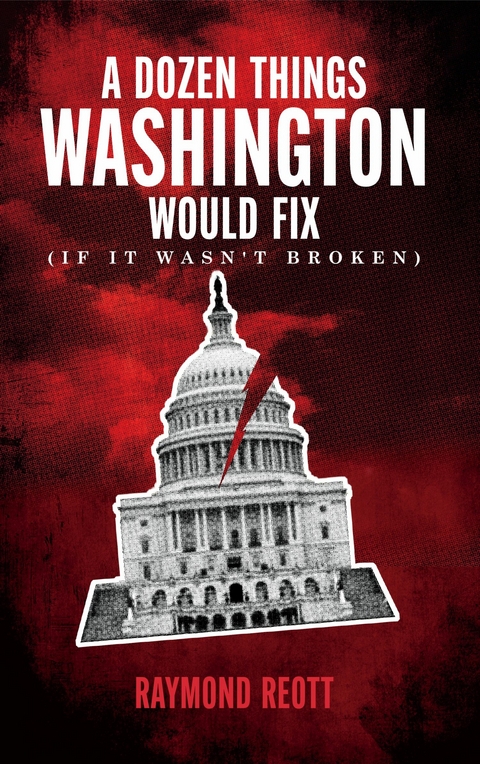
Dozen Things Washington Would Fix (If it Wasn't Broken) -  Raymond Reott

Dozen Things Washington Would Fix (If it Wasn't Broken) (eBook)

eBook Download: EPUB
2025 | 1. Auflage
148 Seiten
Bookbaby (Verlag)
979-8-3509-9223-6 (ISBN)
Systemvoraussetzungen
11,89 inkl. MwSt
(CHF 11,60)
Der eBook-Verkauf erfolgt durch die Lehmanns Media GmbH (Berlin) zum Preis in Euro inkl. MwSt.
  • Download sofort lieferbar
  • Zahlungsarten anzeigen
Washington is broken. The political interests control what happens instead of the needs and desires of the American people. This gridlock can still be fixed with a program of reasonable solutions that have widespread support among Americans. Instead of fighting over who will lead an ineffective House of Representatives, why not have a government proposing and analyzing solutions to problems like Social Security, Medicare and the tax system? This book offers concrete solutions to more than a dozen important issues.

Raymond Reott grew up in a modest home in Pittsburgh Pennsylvania with parents who fortunately saw the value in education. Ray is a1977 graduate of Georgetown University's College of Arts and Sciences. He then got a law degree from the University of Chicago where he served on the Law Review. After clerking for year for Judge Richard Cudahy on the United States Court of Appeals for the Seventh Circuit, he joined a Jenner & Block, a large Chicago law firm. Over time he became a partner and turned his litigation practice into a long career in environmental law. In 2002, Ray left Jenner to start his own firm specializing in environmental matters where he practices at the present. As part of that practice, he also has worked for over ten years in an of counsel capacity for Barack, Ferrazzano, Kirchbaum & Nagelberg LLP. For over twenty years, he was the editor of the Environmental Law Newsletter for the Illinois State Bar Association. Ray lives quietly in Chicago, travels frequently to Brookline Massachusetts to help care for his twin grandsons, is a serious board game player and is an avid but bad golfer.
Washington is broken. The political interests control what happens instead of the needs and desires of the American people. This gridlock can still be fixed with a program of reasonable solutions that have widespread support among Americans. Instead of fighting over who will lead an ineffective House of Representatives, why not have a government proposing and analyzing solutions to problems like Social Security, Medicare and the tax system? This book offers concrete solutions to more than a dozen important issues. Inside are specific proposals for making Social Security last forever without any cut to existing benefits. America has 4.3 million citizens living in its territories and the District of Columbia who pay taxes, are drafted and volunteer to defend America but who cannot vote in federal elections. They deserve representation. Americans support age and term limits. The book has a plan to get there. Immigration and Medicare are all discussed in terms of what Americans regularly want when asked by polling companies. We should have a tax system that ends its present millionaire welfare exemptions and deductions. We also should update our age-old laws on gambling, marijuana, and abortion with provisions that reflect this century, not the last. Right now, one federal judge chosen by a plaintiff can issue a national injunction to block major federal programs for the entire country. This is too much power for a judge picked precisely because of their views on the topic. Even if Congress saves the Social Security program, we need a better system of retirement plans to supplement Social Security. Educational debt relief is necessary to free the next generation from debts imposed by a system tilted against them by prior statutes and regulations. We need a better method of budgeting at the federal level to avoid budgeting by crisis in favor of real planning. Finally, the book has specific suggestions for ending the federal Superfund program, fixing the Postal System and adopting specific gun safety regulations already endorsed by a majority of Americans. It is an ambitious list but we have fallen behind with the lack of solutions from several recent administrations and a Congress that prefers to cast blame instead of solving problems.

CHAPTER 1:
FIXING SOCIAL SECURITY
Social Security benefits are among the most popular governmental programs with the American people with over 90% support in a July 2022 AARP poll. In survey after survey, Americans express favorable views of the Social Security program and do not want it to be curtailed or discontinued.
This sentiment is understandable. The Social Security program returns an unprecedented percentage of what it collects back to American citizens in benefits. With administrative costs accounting for less than 1%, over 99+% of the money taken in is paid out as benefits. The program itself is incredibly efficient.
THE PROBLEM
The Social Security Trust Fund is depleting its reserves. At present rates, the estimate is that it will be unable to pay full benefits in as little as 10 years. How did this happen?
Running a long-term income program for millions of Americans over nearly 80 years is very challenging. Precisely determining the amount of money that would be necessary to take from employers and workers during their lifetime to fund the stream of benefits promised by the program is no easy task. The periodic alarms raised in the press that Social Security is running out of money to pay full benefits highlight how the Social Security Administration has not been set up to take in enough money to sustain the promised stream of benefits.
Our leaders need to explain, with the help of fact-based media, and the American people need to understand, that the root cause for the shortfall is fundamentally that we have collected too little money for the program over the long period of its operations. This could have been a political calculation, of course, as it is politically more popular to give money away than to collect the needed taxes. Whether the shortfall is inadvertent or intentional, contrary to the urban myth, the program is not mismanaged nor has Congress pilfered the Social Security Trust Fund. Nothing nefarious has happened, just a miscalculation that set the Social Security tax rate too low for the promised benefits given current population trends.
Retirement planning is difficult for any individual or family. Your personal retirement planning is, in a sense, a miniature version of the calculations that go into making the Social Security program work. Have you saved enough money along the way to be able to live comfortably in old age? What are your sources of income going to be after you retire? What expenses will you have in your new retired lifestyle? Different retirement calculators yield varying results, reflecting the complexities of the task for even a single person. Having themselves engaged in these calculations, Americans should be able to understand the difficulty in running Social Security and making those types of calculations for the entire country.
THE PROPOSED SOLUTION
Washington currently is incapable of providing a long-term solution or even short-term solutions on a regular basis. Since the 1986 Social Security revisions, nearly forty years ago, Washington has watched while the program has weakened. The American people want action, as shown in the June-July 2023 Gallup poll, and 61% even support tax increases to fix the system.
There are three bedrock principles for any solution. First, you must balance the system with contributions from different portions of the population. All must contribute but you cannot bring the system into balance by only taxing the wealthy, only extending the full retirement benefits date or only raising the tax rate, to give examples of changes that affect very different populations. You cannot focus on a single solution like cutting benefits for the wealthy or extending the retirement date and then throw up your hands when it is not enough.
Second, small changes can have a big impact eventually because the whole process evolves over decades. While it may be attractive to make one grand change as is often proposed, it is easier politically and economically to make many, small changes and then assess their impact as they unfold. While there is an impending significant demographic problem with Social Security as the working population ages, there is still time, if we act now, to make fundamental changes that will preserve the current benefits.
Finally, to avoid the problems associated with using Social Security as a weapon in ongoing political debates, I propose enacting a statute that would implement a list of automatic changes to the Social Security program. These changes would occur annually each year, in sequence, whenever the annual calculation shows that the Trust Fund will be unable to pay full benefits 20 years in the future. You can quibble about the length of that period, and perhaps it should be set at 25-years, but the concept is that the Social Security program would become self-repairing.
A self-implementing solution is one that would take effect automatically each year if the annual calculation of the ability to pay full benefits falls below the selected long-term planning threshold (20 years). In this way, if the annual projection is that full benefits would last less than 20 years, then there would be an automatic change to an aspect of the Social Security program designed to bring revenues and benefits into balance in the future.
By adopting one set of future changes now, we could hopefully avoid or at least minimize the political controversies. We would avoid multiple political fights that otherwise occur each year in favor of one comprehensive set of revisions.
Because the list of annual changes would be set in year one, the annual estimate of the Trust Fund’s solvency could factor in the impact of these future changes. Nonetheless, because we have waited so long to fix Social Security, there would be annual changes for the first several years. Depending upon immigration, birth rates and the overall economy, hopefully corrections would become infrequent after the first decade of adjustments.
Immigration matters because it has an enormous positive influence on the solvency of the Trust Fund. Immigrants pay social security taxes but do not qualify for benefits. According to the Director of the Congressional Budget Office in testimony in June before Congress, the current immigrant surge will add $1 trillion (!) to the Trust Fund over 2021-2026.
Selecting the particular annual corrections starts by recognizing that there are different populations with divergent interests in how the Social Security program is funded and administered. For current beneficiaries, any reduction in benefits would be devastating. Gallup polls show that a large majority of Social Security recipients rely on their Social Security check for a “major” portion of their income. No workable solution would ever propose a cut to existing ongoing benefits. Such a change would leave the most exposed population vulnerable to a shortfall in their daily living expenses. Therefore, solutions must avoid cutting existing benefits while focusing on other ways to change the Social Security program and produce long-term funding solutions.
You can rearrange the order but here is my suggested list of eight changes that would be implemented at a rate of one each year in order until the 20-year funding for full benefits is achieved. If necessary, the list would just repeat in an endless cycle based on legislation adopted now until we bring the program into a 20-year balance. Congress could always intervene in the future to change the revisions, but the legislation would be designed to work in perpetuity until no further changes were necessary without further action by Congress.
I am not an actuary and cannot run the calculations to project how many of these changes would be necessary in the early years to reach a balance in the Trust Fund. My best guess is that it would take at least two cycles through the list of changes to correct the imbalance between collections and payments and leave the Trust Fund solvent. Regardless of how many changes are necessary, eventually, the program will balance and then function into the future.
1. Increase Contributions from the Wealthy
First, there is a group that has comfortable incomes but is not required to pay Social Security taxes on income over a certain level (currently $168,000 per year). As of the 2021 annual report from the Social Security Administration (SSA), the group receiving the income exemption has doubled from 3% to 6% of the population in recent years. As a result, the actual portion of the total income earned in the United States that is subject to Social Security taxes has dropped from 90% to 81%.
This group would be most financially able to absorb a modest change in its contributions because, by definition, these are people earning more than $168,000 per year. While this question is not polled often, older Gallup polls show that the American people support increasing contributions from the wealthy. (E.g. Gallup June 2010 poll finds 67% support). By itself, this would instantly add additional funds to the Social Security Trust Fund paid by those Americans who are more likely able to absorb that cost.
This change is particularly important because of what we have seen in the last five years. Much of the current Social Security shortfall is based upon the growing inequality in wages in the United States. There has been enough wage growth in the last five years that, if all of the increase in wages had been fully taxed, the Social Security program would be well-funded. However, the recent wage growth has been concentrated in the already wealthier side of the American population whose income is partially exempt from Social...

Erscheint lt. Verlag 28.1.2025
Sprache englisch
Themenwelt Sozialwissenschaften Politik / Verwaltung
ISBN-13 979-8-3509-9223-6 / 9798350992236
Informationen gemäß Produktsicherheitsverordnung (GPSR)
Haben Sie eine Frage zum Produkt?
EPUBEPUB (Ohne DRM)
Größe: 1,2 MB

Digital Rights Management: ohne DRM
Dieses eBook enthält kein DRM oder Kopier­schutz. Eine Weiter­gabe an Dritte ist jedoch rechtlich nicht zulässig, weil Sie beim Kauf nur die Rechte an der persön­lichen Nutzung erwerben.

Dateiformat: EPUB (Electronic Publication)
EPUB ist ein offener Standard für eBooks und eignet sich besonders zur Darstellung von Belle­tristik und Sach­büchern. Der Fließ­text wird dynamisch an die Display- und Schrift­größe ange­passt. Auch für mobile Lese­geräte ist EPUB daher gut geeignet.

Systemvoraussetzungen:
PC/Mac: Mit einem PC oder Mac können Sie dieses eBook lesen. Sie benötigen dafür die kostenlose Software Adobe Digital Editions.
eReader: Dieses eBook kann mit (fast) allen eBook-Readern gelesen werden. Mit dem amazon-Kindle ist es aber nicht kompatibel.
Smartphone/Tablet: Egal ob Apple oder Android, dieses eBook können Sie lesen. Sie benötigen dafür eine kostenlose App.
Geräteliste und zusätzliche Hinweise

Buying eBooks from abroad
For tax law reasons we can sell eBooks just within Germany and Switzerland. Regrettably we cannot fulfill eBook-orders from other countries.

Mehr entdecken
aus dem Bereich
Über ökologische und ökonomische Krisen

von Detlef Pietsch

eBook Download (2025)
Springer Fachmedien Wiesbaden (Verlag)
CHF 16,60
Design zeitgemäßer Ökonomie

von Johannes Wolf

eBook Download (2025)
Springer Fachmedien Wiesbaden (Verlag)
CHF 48,80