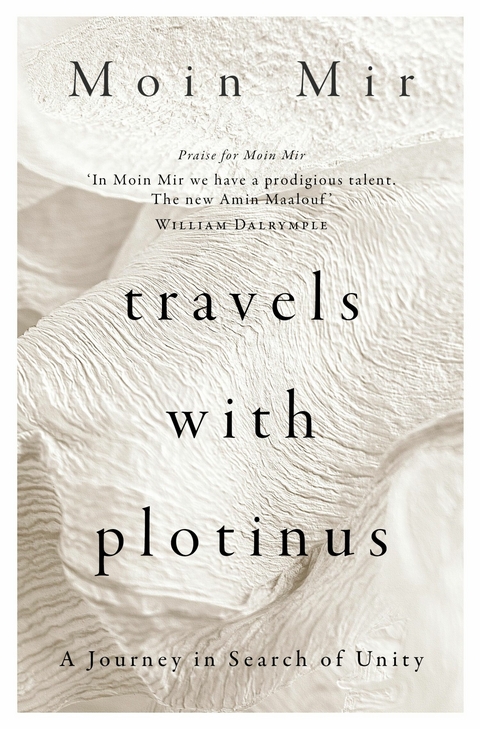
Travels with Plotinus (eBook)
288 Seiten
Unicorn (Verlag)
9781917458139 (ISBN)

Moin Mir is a British-Indian writer of non-fiction and fiction, based in London. His first non-fiction book The Prince Who Beat The Empire was published in 2018. His novel The Lost Fragrance of Infinity featured in Times of India's top five reads of 2021 and William Dalrymple described Mir as '...a prodigious talent, the new Amin Maalouf'.
Rome 242 CE
Emperor Gordian III flings open the doors of the temple of Janus signalling war as a crescendo of trumpets erupt in the air. The mighty Roman army is going to war with Persia. But one man, given neither to lance or sword, but to letters and thought, has embedded himself in the legions. Travelling with the army brings relative safety and assured provisions. He nurtures a secret dream – one of reaching India. Plotinus, an already renowned philosopher having studied Aristotle and Plato in Alexandria and Rome, now has an unquenchable thirst to drink from the fountains of knowledge in India. That faraway land which lies beyond Persia and beyond the flowing Indus has to offer the most mouth-watering prospect for any philosopher – the study of the Upanishads. In time, history would mark Plotinus as one of the greatest thinkers, but today as he watches emperor Gordian III approaching, he can only hope that the Persian campaign would end in victory, thus unlocking the road to India.
The Roman Empire is imploding with the loss of territories in Mesopotamia which must be regained. Under its audacious emperor Shapur I, Persia has stretched its borders and taken key towns in Mesopotamia that were part of the Roman Empire. The Persian advance must be checked. In response to the war trumpets, famed legions pour into the streets of Rome. Catching the first rays of the sun, armour plates of stalwart warriors glisten on robust chests. Crimson helmet tails of commanders ascend and descend in brilliant unison, and the nervous hooves of their majestic steeds exude a thunderous clamour whilst clashing against the stone road. Passing the Colosseum where in peace times gladiatorial contests between man and beast had entertained citizenry, the legions ride the straight path dotted with olive trees passing the marble pillared Forum of Augustus and the temple of Mars, finally making their way to the Pantheon – the temple of all gods. Here, emperor Gordian III standing on the porch between imposing pillars addresses his troops amidst wild cheering crowds.
After a rousing speech by the emperor, the army winds its way out of the city gates like a serpentine and into the pine-tree-lined hills. The borderlands with Persia are a long way away, and the legions will have to chart their course through the untamed woodlands of southern Italy from where they will board ships which will carry them across the dancing waves of the Adriatic and into the Roman colonies of Macedonia and Thrace, after which they will enter Asia Minor via Byzantium. From there the sweeping lands of Anatolia with its flowing rivers, rugged mountains, gorges, and ravines will open to them. Beyond these lands they will meet the Persian army. Amidst a sea of fluttering war banners and sparkling sabres, Plotinus sees his dream of reaching India becoming a reality.
Born in Egypt into a Greek family in 204 CE, Plotinus, aged thirty-nine and at the peak of his intellectual powers, can feel the excitement running through his veins. An adventure awaits him of which there can be no predicted end. Would he return once he had been enchanted by the charms and philosophical depth of India? What would life be in that distant land whose frontiers had barely been penetrated by Alexander the Great? But Plotinus’ dream to reach India would not come true. It would be shattered in Ctesiphon (modern-day Iraq), and he would be forced to return to Rome.
In time, Plotinus, who spoke and wrote in Greek, would go on to dictate to Porphyry (his devoted student) his most profound teachings which would eventually be compiled as The Enneads. The origins of the title are in the Greek word Ennea, meaning ‘nine’. An Ennea is a ‘niner’ because each Ennea is composed of nine treatises. The Enneads would eventually become the unimpeachable philosophical landmark in the study of metaphysics, the One creator, the concept of unity, the origin of intellect, soul, ‘othering’, beauty and happiness, origins of mathematics, and the study of the most delicious question of all time – how can we unite with God?
Porphyry describes Plotinus as such:
When he spoke his intellect was manifest even in the way it lit up his face. He was handsome to look at, but even more beautiful in those moments. He exuded kindliness; his face looked gentle but also intellectually rigorous when he was questioned…. A number of men and women of the highest social order (in Rome) brought their offspring to him when they were about to die. They would entrust them to him along with what remained of their property, treating his protection as sacred and god like…. He was, to those who had any dealings with him, kind and accessible. For this reason although he lived for 26 whole years in Rome, and acted as arbitrator in many cases of personal dispute, he never made a single enemy in his public life…. He certainly could not stand talking about his race, his parents or his original homeland and disliked the idea of being painted or sculpted that when Amelius asked him to allow an image to be made he said “Isn’t it enough that I have to carry around the image that nature has clothed me with?”4
The most impactful theory that Plotinus established in The Enneads is that ‘it is from “The One” that all beings are beings’. According to Plotinus ‘The One’ is indivisible, and in his writings, he often addresses ‘The One’ as ‘The Good’, ‘Unity’, ‘Simple’, ‘First Principle’ and ‘It’. All five are synonyms for ‘The One’. He believed ‘The One’ generates intellect, the activation of which brings about substance. The intellect then generates soul and being. The intellect also causes multiplicity. But for multiplicity to exist something singular and simple must be in existence prior to it and that is ‘The One’. The intellect and soul from the moment they come into existence are injected with a desire by ‘The One’ to know their originator and they succumb to this desire placing them in a constant quest to reunite with ‘The One’.
Plotinus’ thought has striking similarities with Brahman (the One – the absolute reality) in the Upanishads and the Atman (the individual soul that seeks union with Brahman). Around 350 years after Plotinus, a man would emerge from the silent sand dunes of Arabia, his heart ablaze with poetic expressions of ‘The One’ – his name was Mohammad. The philosophical concept of Tawheed in Islam where ‘The One’ is proclaimed as the Absolute and the Creator of the universe resonates deeply with Plotinian thought. And 1,700 years later, modern scientists would accept a theory called the ‘Big Bang singularity’ – a moment of creation that originated from singularity giving birth to space, time, and the universe.
One can imagine Plotinus crouched over his stone desk in Rome surrounded by flickering candles lamenting never having reached India, desiring only solitude while reciting to Porphyry the most exquisite poetry.
My soul is still in even stronger labour. Perhaps she is now at the point when she must bring forth, having reached the fullness of her birth-pangs in her eager longing for the One. But we must sing another charm to her, if we can find one anywhere to allay her pangs…. Intellect in love, when it goes out of its mind “drunk with the nectar”, simplified into happiness.5
Plotinus must have paused, giving his student time to reflect. More words were then uttered by the ageing philosopher in a whisper, for he was about to declare a mystical vision.
The soul in her natural state is in love with God and wants to be united with It; it is like the noble love of a girl for her noble father… in this way the Soul also loves the One - the Good, moved by it to love from the beginning…. So we must ascend again to the Good, which every soul desires. Anyone who has seen It knows what I mean when I say that It (the One) is beautiful… alone, simple, single and pure form on which all depends and to which all look: For the One is cause of life and mind and being… the knowledge or touching of the Good is the greatest thing and Plato says “it is the greatest study”.6
As Rome lay shrouded under a blanket of slumber, Porphyry’s heart was aglow with enlightenment, and one can imagine him making his way through the deserted mid-night streets of Rome reciting those words he had so diligently penned down for his teacher.
With these words Plotinus championed the following: There is ‘One’ creator, and He is the first cause of all beings that are in motion. This core principle is incontestably inspired by Aristotle’s famous presentation of God as an Unmoved First Mover, as an originator of all processes who Himself stands outside all change. In Aristotle’s words, ‘There is something that always moves the things in motion and the First Mover is itself Unmoved.’7
Plotinus emphasises that intellect...
| Erscheint lt. Verlag | 20.1.2025 |
|---|---|
| Verlagsort | London |
| Sprache | englisch |
| Themenwelt | Sachbuch/Ratgeber |
| Reisen ► Reiseführer | |
| Geisteswissenschaften ► Philosophie ► Allgemeines / Lexika | |
| Geisteswissenschaften ► Philosophie ► Philosophie Altertum / Antike | |
| Sozialwissenschaften | |
| Schlagworte | Alexandria • Ancient Egypt • Ancient Greece • ancient indian philosophy • Ancient Rome • A philosophical journey • Aristotle • Aristotle’s Academy • Forum • free will of intellect • Gordian III Caesar • Greece • Greek Philosophy • Hermetica • Intellect • Michelangelo • Pantheon • Philosophy • Plato • Plato’s Academy • Plotinus • Plotinus for our times • Plotinus for today • Raphael • Rome • The Enneads • ‘The One’ • ‘The One and the intellect’ • Travels in the footsteps of Plotinus • Travels with Plotinus • UNITY • Upanishads |
| ISBN-13 | 9781917458139 / 9781917458139 |
| Informationen gemäß Produktsicherheitsverordnung (GPSR) | |
| Haben Sie eine Frage zum Produkt? |
 EPUB (Wasserzeichen)
DRM: Digitales Wasserzeichen
Dieses eBook enthält ein digitales Wasserzeichen und ist damit für Sie personalisiert. Bei einer missbräuchlichen Weitergabe des eBooks an Dritte ist eine Rückverfolgung an die Quelle möglich.
Dateiformat: EPUB (Electronic Publication)
EPUB ist ein offener Standard für eBooks und eignet sich besonders zur Darstellung von Belletristik und Sachbüchern. Der Fließtext wird dynamisch an die Display- und Schriftgröße angepasst. Auch für mobile Lesegeräte ist EPUB daher gut geeignet.
Systemvoraussetzungen:
PC/Mac: Mit einem PC oder Mac können Sie dieses eBook lesen. Sie benötigen dafür die kostenlose Software Adobe Digital Editions.
eReader: Dieses eBook kann mit (fast) allen eBook-Readern gelesen werden. Mit dem amazon-Kindle ist es aber nicht kompatibel.
Smartphone/Tablet: Egal ob Apple oder Android, dieses eBook können Sie lesen. Sie benötigen dafür eine kostenlose App.
Geräteliste und zusätzliche Hinweise
Buying eBooks from abroad
For tax law reasons we can sell eBooks just within Germany and Switzerland. Regrettably we cannot fulfill eBook-orders from other countries.
aus dem Bereich