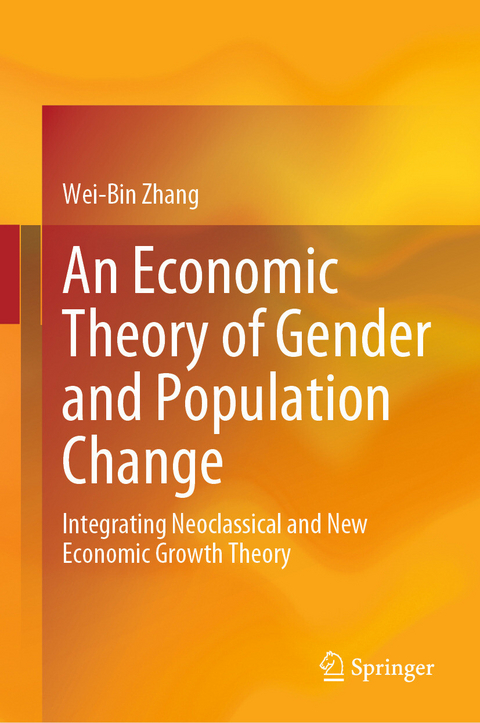
An Economic Theory of Gender and Population Change (eBook)
XV, 333 Seiten
Springer Nature Singapore (Verlag)
978-981-97-9605-2 (ISBN)
This book proposes an economic theory of gender and population change by integrating neoclassical and new economic theories. Modern economies are characterized by complicated dynamic interdependence between many variables such as population growth, human capital accumulation, wealth accumulation, gender division of labor, children caring, environmental changes, various types of conflicts, wars, and so on. However modern dynamic economic theories deal with simplified interdependence between a few variables. Any genuine modeling of economic dynamics result in high-dimensional nonlinear dynamics. Nevertheless, it is only in recent years that it is possible to examine the behavior of highly dimensional dynamics. This partly explains why economic theory has been dominated by modeling dynamic economic systems with a few variables with linear (linearized) relations. Since Malthus published his An Essay on the Principle of Population in 1798, economists have made great efforts to reveal the dynamic complexity of population change. Modern economies have experienced unprecedented population dynamics. No one in human history could even have rationally predicted the natural declination of the national population in modern times. These failures in predicting family structural changes and life expectancy lead to many socioeconomic problems, such as health costs in association with aging and pension systems, that many societies fail to be prepared for. This book contributes to the literature on macroeconomics based on microeconomics, neoclassical growth theory, new growth theory, and family economics by integrating some important ideas in neoclassical growth theory and family economics. This book extensively applies the ideas in the literature to deal with the complexity of population change.
This book proposes an economic theory of gender and population change by integrating neoclassical and new economic theories. Modern economies are characterized by complicated dynamic interdependence between many variables such as population growth, human capital accumulation, wealth accumulation, gender division of labor, children caring, environmental changes, various types of conflicts, wars, and so on. However modern dynamic economic theories deal with simplified interdependence between a few variables. Any genuine modeling of economic dynamics result in high-dimensional nonlinear dynamics. Nevertheless, it is only in recent years that it is possible to examine the behavior of highly dimensional dynamics. This partly explains why economic theory has been dominated by modeling dynamic economic systems with a few variables with linear (linearized) relations. Since Malthus published his An Essay on the Principle of Population in 1798, economists have made great efforts to reveal the dynamic complexity of population change. Modern economies have experienced unprecedented population dynamics. No one in human history could even have rationally predicted the natural declination of the national population in modern times. These failures in predicting family structural changes and life expectancy lead to many socioeconomic problems, such as health costs in association with aging and pension systems, that many societies fail to be prepared for. This book contributes to the literature on macroeconomics based on microeconomics, neoclassical growth theory, new growth theory, and family economics by integrating some important ideas in neoclassical growth theory and family economics. This book extensively applies the ideas in the literature to deal with the complexity of population change.
| Erscheint lt. Verlag | 10.1.2025 |
|---|---|
| Zusatzinfo | XV, 333 p. 116 illus., 115 illus. in color. |
| Sprache | englisch |
| Themenwelt | Sozialwissenschaften ► Soziologie ► Empirische Sozialforschung |
| Sozialwissenschaften ► Soziologie ► Gender Studies | |
| Wirtschaft ► Allgemeines / Lexika | |
| Wirtschaft ► Volkswirtschaftslehre ► Makroökonomie | |
| Schlagworte | birth rate • Complexity theory • Division of labor between genders • Economic Structure • family game • Gender • mortality rate • Nonlinear Dynamics |
| ISBN-10 | 981-97-9605-9 / 9819796059 |
| ISBN-13 | 978-981-97-9605-2 / 9789819796052 |
| Informationen gemäß Produktsicherheitsverordnung (GPSR) | |
| Haben Sie eine Frage zum Produkt? |
 PDF (Wasserzeichen)
DRM: Digitales Wasserzeichen
Dieses eBook enthält ein digitales Wasserzeichen und ist damit für Sie personalisiert. Bei einer missbräuchlichen Weitergabe des eBooks an Dritte ist eine Rückverfolgung an die Quelle möglich.
Dateiformat: PDF (Portable Document Format)
Mit einem festen Seitenlayout eignet sich die PDF besonders für Fachbücher mit Spalten, Tabellen und Abbildungen. Eine PDF kann auf fast allen Geräten angezeigt werden, ist aber für kleine Displays (Smartphone, eReader) nur eingeschränkt geeignet.
Systemvoraussetzungen:
PC/Mac: Mit einem PC oder Mac können Sie dieses eBook lesen. Sie benötigen dafür einen PDF-Viewer - z.B. den Adobe Reader oder Adobe Digital Editions.
eReader: Dieses eBook kann mit (fast) allen eBook-Readern gelesen werden. Mit dem amazon-Kindle ist es aber nicht kompatibel.
Smartphone/Tablet: Egal ob Apple oder Android, dieses eBook können Sie lesen. Sie benötigen dafür einen PDF-Viewer - z.B. die kostenlose Adobe Digital Editions-App.
Buying eBooks from abroad
For tax law reasons we can sell eBooks just within Germany and Switzerland. Regrettably we cannot fulfill eBook-orders from other countries.
aus dem Bereich