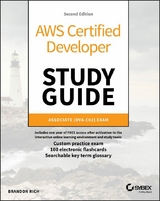
AWS Certified Developer Study Guide (eBook)
1277 Seiten
Sybex (Verlag)
978-1-394-27481-9 (ISBN)
The AWS Certified Developer exam has been updated. Your study guide should be, too.
The AWS Certified Developer Study Guide-Associate (DVA-C02) Exam is your ultimate preparation resource for the latest exam! Covering the exam objectives, this invaluable resource provides expert guidance, clear explanations, and the wisdom of experience with AWS best practices. You'll master core services and basic architecture, and equip yourself to develop, deploy, and debug cloud-based applications using AWS.
The AWS Developer certification is earned by those who demonstrate the technical knowledge and skill associated with best practices for building secure, reliable cloud-based applications using AWS technology. This book is your exam prep companion, providing everything you need to know to pass with flying colors.
- Study the AWS Certified Developer Exam objectives
- Gain expert insight on core AWS services and best practices
- Test your understanding of key concepts with challenging chapter questions
- Access online study tools including practice questions, electronic flashcards, a searchable glossary, and more
The AWS Certified Developer exam has been updated. Your study guide should be, too. The AWS Certified Developer Study Guide Associate (DVA-C02) Exam is your ultimate preparation resource for the latest exam! Covering the exam objectives, this invaluable resource provides expert guidance, clear explanations, and the wisdom of experience with AWS best practices. You ll master core services and basic architecture, and equip yourself to develop, deploy, and debug cloud-based applications using AWS. The AWS Developer certification is earned by those who demonstrate the technical knowledge and skill associated with best practices for building secure, reliable cloud-based applications using AWS technology. This book is your exam prep companion, providing everything you need to know to pass with flying colors. Study the AWS Certified Developer Exam objectives Gain expert insight on core AWS services and best practices Test your understanding of key concepts with challenging chapter questions Access online study tools including practice questions, electronic flashcards, a searchable glossary, and more When you re ready to get serious about your cloud credentials, the AWS Certified Developer Study Guide Associate Exam is the resource you need to pass the exam with flying colors.
Introduction
Developers bring innovation to life. They transform ideas into reality, imagining, designing, and implementing applications that fulfill a vision, be it for their organizations, their customers, or their own personal projects. For developers, there is no better way to realize those visions in a dynamic, code-forward, flexible, scalable, and automated way than with Amazon Web Services. If you’re a developer eager to launch or accelerate your cloud journey, you’ve come to the right place. From automatic scaling and continuous delivery to event-driven architectures and serverless applications, AWS helps you build amazing things in the cloud, and this book is your guide.
Not only that, but this study guide is also designed to provide you with the knowledge required to obtain the AWS Certified Developer – Associate certification. The guide covers topics relevant to the exam, referencing the exam blueprint throughout each chapter while providing context on how to bring applications to life with the services covered.
Beyond the test, this book can serve as a reference for building highly available applications that run on the AWS Cloud. While we assume you bring prior experience programming in Java, Python, .NET, and other languages, the study guide begins with an introduction to AWS core concepts and provides the knowledge on which the subsequent chapters are built. Because security is a top priority for all applications, the first chapter also describes how to create access keys by using AWS Identity and Access Management (IAM). The rest of the book covers topics ranging from compute services, storage services, databases, encryption, container orchestration, automation pipelines, and serverless-based applications.
The chapters were designed with the understanding that developers learn best by building. To enhance learning through hands-on experience, at the end of each chapter is an “Exercise” section with activities that help reinforce the main topic of the chapter.
Each chapter also contains a “Review Questions” section to assess your understanding of its concepts. Please note that while these review questions focus on chapter-specific content, the actual certification exam will test your ability to synthesize concepts, propose architectures, and evaluate optimal designs from multiple viable options.
To help you determine the level of your AWS knowledge and aptitude before reading the guide, we provide an assessment test with 57 questions at the end of this introduction. Later, you can gauge your readiness to take the certification test with the 91-question practice exam provided online.
By the end of this book, you won’t just be ready for the certification exam—you’ll be equipped to realize your vision for what’s possible in the cloud. Let’s begin.
What Does This Book Cover?
This book covers topics that you need to know to prepare for the Amazon Web Services (AWS) Certified Developer – Associate exam.
- Chapter 1: Introduction to Amazon Web Services This chapter provides an overview of how AWS works, including how resources are deployed across regions and availability zones. The chapter includes an introduction to the AWS command-line interface (CLI) and software development kits (SDKs). A review of AWS access keys and how to manage them using AWS Identity and Access Management (IAM) is also included.
- Chapter 2: Introduction to Compute and Networking This chapter reviews compute and networking environments in AWS. It provides an overview of resources such as Amazon EC2, load balancers, security groups, and the network controls exposed through Amazon Virtual Private Cloud (Amazon VPC).
- Chapter 3: AWS Data Storage This chapter covers cloud storage with AWS. It provides an overview of storage fundamentals and the AWS storage portfolio of services, including Amazon Simple Storage Service (Amazon S3), Amazon S3 Glacier, Elastic Block Store (EBS), Elastic File System (EFS) and FSx. The chapter also covers how to tune your storage for performance and choose the right type of storage for a workload.
- Chapter 4: AWS Database Services This chapter provides an overview of the AWS database services as well as a baseline understanding of SQL versus NoSQL. We explore DynamoDB in detail, then dive into Amazon RDS and Amazon Aurora.
- Chapter 5: Encryption on AWS In this chapter, you will explore AWS services that enable you to perform encryption of data at rest using both customer and AWS managed solutions. An overview of each approach and the use case for each is provided. Example architectures are included that show the differences between a customer and an AWS managed infrastructure.
- Chapter 6: Deployment Strategies In this chapter, you will learn about automated application deployment, management, and maintenance using AWS Elastic Beanstalk. You will also learn about the various deployment methodologies and options to determine the best approach for individual workloads.
- Chapter 7: Deployment as Code This chapter describes the AWS code services used to automate infrastructure and application deployments across AWS and on-premises resources. Topics covered include CodeBuild, CodeDeploy, and CodePipeline. You will learn about the differences among continuous integration, continuous delivery, and continuous deployment, in addition to how AWS enables you to achieve each.
- Chapter 8: Infrastructure as Code This chapter focuses on using AWS CloudFormation to create flexible, repeatable templates for a cloud infrastructure. You will learn about the different AWS CloudFormation template components, supported resources, and how to integrate non-AWS resources into your templates using custom resources.
- Chapter 9: Secure Configuration and Container Management This chapter covers AWS’s two foundational services for cloud container orchestration: Elastic Container Service (ECS), which is AWS-native and integrates tightly with other services, and Elastic Kubernetes Service (EKS), which lets you launch or migrate Kubernetes workloads to the AWS Cloud with ease. Finally, the chapter delves into two essential services for managing configuration and secret values in Parameter Store and Secrets Manager.
- Chapter 10: Authentication and Authorization This chapter explains the differences between authentication and authorization and how these differences apply to infrastructure and applications running on AWS. You will learn about using Cognito as an identity provider and about integrating third-party identity services, in addition to the differences between the control pane and data pane.
- Chapter 11: Refactoring to Microservices In this chapter, you will learn about microservices and how to refactor large application stacks into small, portable containers. You will also learn how to implement messaging infrastructure to enable communication between microservices running in your environment.
- Chapter 12: Serverless Compute This chapter reviews AWS Lambda as a compute service that you can use to run code without provisioning or managing servers. In this chapter, you will learn about creating, triggering, and securing AWS Lambda functions. You will also learn other features of AWS Lambda, such as versioning and aliases.
- Chapter 13: Serverless Applications This chapter expands on the serverless concepts you learned in Chapter 12, “Serverless Compute,” and shows you how to architect full-stack serverless web applications using a variety of serverless AWS resources, including S3, AppSync, ElastiCache, and API Gateway.
- Chapter 14: Modern AWS Deployment Frameworks This chapter showcases some of the higher-level abstractions that AWS provides to create complex architectures in simple ways. Cloud Developer Kit (CDK) lets developers build infrastructure-as-code using code rather than the declarative templates of CloudFormation, while Serverless Application Model provides shortcuts to extend CloudFormation in ways that make building serverless apps easy. Finally, we look at AWS Amplify, a full-stack developer tool for configuring many AWS backends using TypeScript and using them in a variety of popular front-end frameworks.
- Chapter 15: Monitoring and Troubleshooting This chapter discusses how to monitor your applications, alert on changing conditions, and automate your responses. You will learn how to use Amazon CloudWatch to perform log analysis and create custom metrics for ingestion by other tools and for creating visualizations in the dashboard. You’ll use CloudTrail to monitor activity in your account and trace changes to users and applications. You’ll also see how EventBridge enables the creation of event-driven architectures and learn how to use AWS X-Ray to create visual maps of application components for step-by-step analysis.
- Chapter 16: Optimization This chapter covers some of the best practices and considerations for designing systems that achieve business outcomes at the optimal price. The chapter explores considerations for efficient data transfer, how to use Auto Scaling, and how to realize deep cost savings safely by using Spot Instances and mixed Spot Fleets. The chapter concludes with key AWS tools for managing and monitoring your account’s cost and performance.
| Erscheint lt. Verlag | 7.1.2025 |
|---|---|
| Reihe/Serie | Sybex Study Guide |
| Sprache | englisch |
| Themenwelt | Mathematik / Informatik ► Informatik |
| Sozialwissenschaften ► Pädagogik | |
| Schlagworte | AWS best practices • AWS Certification • AWS certification guide • AWS Certified Developer Official Study Guide Associate Exam • AWS Dev • AWS Developer • aws exam guide • AWS exam help • AWS exam objectives • AWS exam prep • AWS exam preview • AWS exam resources • AWS guide • AWS preparation kit • AWS prep guide • AWS study guide • AWS study tools • AWS tutorials • Cloud certification • cloud computing best practices • cloud computing certification • official AWS prep |
| ISBN-10 | 1-394-27481-5 / 1394274815 |
| ISBN-13 | 978-1-394-27481-9 / 9781394274819 |
| Informationen gemäß Produktsicherheitsverordnung (GPSR) | |
| Haben Sie eine Frage zum Produkt? |
 EPUB (Adobe DRM)
Kopierschutz: Adobe-DRM
Adobe-DRM ist ein Kopierschutz, der das eBook vor Mißbrauch schützen soll. Dabei wird das eBook bereits beim Download auf Ihre persönliche Adobe-ID autorisiert. Lesen können Sie das eBook dann nur auf den Geräten, welche ebenfalls auf Ihre Adobe-ID registriert sind.
Details zum Adobe-DRM
Dateiformat: EPUB (Electronic Publication)
EPUB ist ein offener Standard für eBooks und eignet sich besonders zur Darstellung von Belletristik und Sachbüchern. Der Fließtext wird dynamisch an die Display- und Schriftgröße angepasst. Auch für mobile Lesegeräte ist EPUB daher gut geeignet.
Systemvoraussetzungen:
PC/Mac: Mit einem PC oder Mac können Sie dieses eBook lesen. Sie benötigen eine
eReader: Dieses eBook kann mit (fast) allen eBook-Readern gelesen werden. Mit dem amazon-Kindle ist es aber nicht kompatibel.
Smartphone/Tablet: Egal ob Apple oder Android, dieses eBook können Sie lesen. Sie benötigen eine
Geräteliste und zusätzliche Hinweise
Buying eBooks from abroad
For tax law reasons we can sell eBooks just within Germany and Switzerland. Regrettably we cannot fulfill eBook-orders from other countries.
aus dem Bereich