


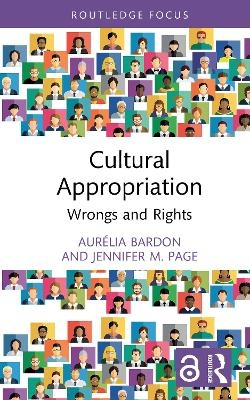
Cultural Appropriation
Wrongs and Rights
Seiten
2025
Routledge (Verlag)
978-0-367-89345-3 (ISBN)
Routledge (Verlag)
978-0-367-89345-3 (ISBN)
Cultural Appropriation: Wrongs and Rights will be of great interest to students and researchers in philosophy, politics and related subjects where cultural appropriation is an important issue, such as race and ethnic studies and anthropology.
From the fashion label Dior being accused of cultural appropriation after using American Indian imagery in an ad campaign for its “Sauvage” fragrance, to the backlash against Kendall Jenner’s afro-esque hairstyle in Vogue, debates about cultural appropriation have reached a fever pitch. In this much-needed analysis of the phenomenon Aurélia Bardon and Jennifer Page step back and ask: when is cultural appropriation wrong and when are we right to criticize it?
Their analysis of wrongful cultural appropriation centers on three questions: whether appropriation involves theft; whether it communicates disrespect; and whether it disregards requests made by marginalized groups about their cultural practices. Sometimes, they argue, it is structural injustice rather than individual wrongdoing that is at stake. They examine cultural appropriation’s political dimensions, asking whether the state should be neutral between appropriative and non-appropriative artistic expression. They contrast bans on wrongful cultural appropriation and the state’s using its expressive power as a speaker, spender, and educator to discourage it. They also consider the ethical questions that arise when cultural appropriation debates spur further debates about online shaming and cancel culture.
Using cases from music, fashion and the arts, Cultural Appropriation: Wrongs and Rights will be of great interest to students and researchers in philosophy, politics and related subjects, such as race and ethnic studies, sociology, and cultural studies.
The Open Access version of this book, available at http://www.taylorfrancis.com, has been made available under a Creative Commons [Attribution-Non Commercial-No Derivatives (CC BY)] 4.0 license. Supported by the Publication Fund of the University of Konstanz, Germany, and the Open-Access Publication Funding Program of the Office for the Advancement of Research at John Jay College, City University of New York, USA.
From the fashion label Dior being accused of cultural appropriation after using American Indian imagery in an ad campaign for its “Sauvage” fragrance, to the backlash against Kendall Jenner’s afro-esque hairstyle in Vogue, debates about cultural appropriation have reached a fever pitch. In this much-needed analysis of the phenomenon Aurélia Bardon and Jennifer Page step back and ask: when is cultural appropriation wrong and when are we right to criticize it?
Their analysis of wrongful cultural appropriation centers on three questions: whether appropriation involves theft; whether it communicates disrespect; and whether it disregards requests made by marginalized groups about their cultural practices. Sometimes, they argue, it is structural injustice rather than individual wrongdoing that is at stake. They examine cultural appropriation’s political dimensions, asking whether the state should be neutral between appropriative and non-appropriative artistic expression. They contrast bans on wrongful cultural appropriation and the state’s using its expressive power as a speaker, spender, and educator to discourage it. They also consider the ethical questions that arise when cultural appropriation debates spur further debates about online shaming and cancel culture.
Using cases from music, fashion and the arts, Cultural Appropriation: Wrongs and Rights will be of great interest to students and researchers in philosophy, politics and related subjects, such as race and ethnic studies, sociology, and cultural studies.
The Open Access version of this book, available at http://www.taylorfrancis.com, has been made available under a Creative Commons [Attribution-Non Commercial-No Derivatives (CC BY)] 4.0 license. Supported by the Publication Fund of the University of Konstanz, Germany, and the Open-Access Publication Funding Program of the Office for the Advancement of Research at John Jay College, City University of New York, USA.
Aurélia Bardon is a Junior Professor in Political Theory at the University of Konstanz, Germany. Jennifer M. Page is an Assistant Professor in Philosophy at the John Jay College of Criminal Justice, City University of New York.
Acknowledgments 1. Introduction: What is Cultural Appropriation, Anyway? 2. The Theft Argument 3. The Disrespect Argument 4. The Request Argument 5. How Should the State Respond to Cultural Appropriation? 6. How Should Individuals Respond to Cultural Appropriation? References Index
| Erscheinungsdatum | 17.04.2025 |
|---|---|
| Reihe/Serie | Routledge Focus on Philosophy |
| Verlagsort | London |
| Sprache | englisch |
| Maße | 138 x 216 mm |
| Gewicht | 380 g |
| Themenwelt | Geisteswissenschaften ► Philosophie ► Ethik |
| Sozialwissenschaften ► Politik / Verwaltung ► Politische Theorie | |
| ISBN-10 | 0-367-89345-2 / 0367893452 |
| ISBN-13 | 978-0-367-89345-3 / 9780367893453 |
| Zustand | Neuware |
| Informationen gemäß Produktsicherheitsverordnung (GPSR) | |
| Haben Sie eine Frage zum Produkt? |
Mehr entdecken
aus dem Bereich



aus dem Bereich
Buch | Hardcover (2025)
Suhrkamp (Verlag)
CHF 32,15
ein Versuch über Kardinaltugenden und Laster
Buch | Hardcover (2025)
De Gruyter (Verlag)
CHF 55,90


