


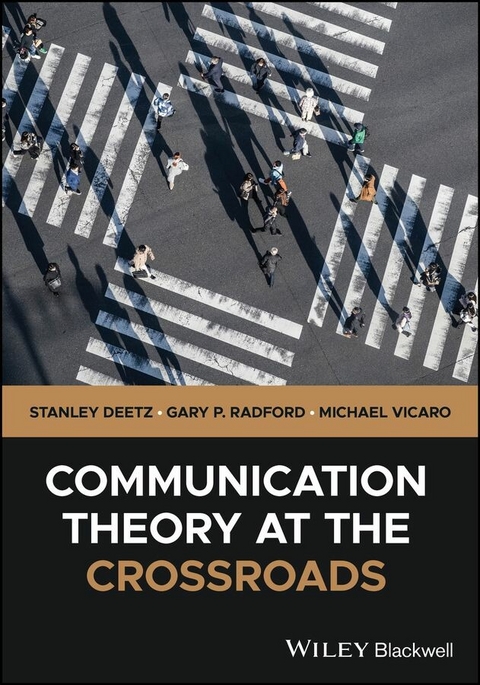
Communication Theory at the Crossroads (eBook)
543 Seiten
Wiley-Blackwell (Verlag)
9781394215706 (ISBN)
A generative conceptual framework for empowering diverse groups and individuals to make productive and creative choices together
Communication Theory at the Crossroads proposes a new way of thinking about communication to generate new insights, promote new interaction practices, and directly address a new set of human problems. Rooted in a systemic constructionist perspective, this groundbreaking volume provides the theoretical foundation for fostering mutually beneficial solutions to contemporary issues of divisiveness, interdependence, rapid social change, technology-mediated human experience, and other contemporary social difficulties.
Rather than merely explicating a novel conceptual framework, Communication Theory at the Crossroads positions students as active and engaged social scientists equipped with a unified, fully integrated theory they can use across traditional divisions of communication to navigate their complex, rapidly changing world.
Throughout the text, the authors identify the limits of the communication theories currently in use, discuss the critical choices facing today's communication students and scholars, explain the theory of relational constructionism, and much more.
Helping students frame their understanding of life difficulties and use theory-based concepts to inform their choices, Communication Theory at the Crossroads is an essential textbook for mid-level undergraduate courses in Communication Theory and Human Communication.
Stanley Deetz, is Professor Emeritus and a President's Teaching Scholar at the University of Colorado, Boulder. He is a National Communication Association Distinguished Scholar and a Past-President and Fellow of the International Communication Association. He has authored or co-authored more than 150 essays and several books, including the award winning Democracy in an Age of Corporate Colonialization.
Gary P. Radford, is Professor of Communication at Fairleigh Dickinson University. He is the author of On the Philosophy of Communication and On Eco and the co-author of Library Conversations: Reclaiming Interpersonal Communication Theory for Understanding Professional Encounters. Radford is the founding editor of The Atlantic Journal of Communication.
Michael Vicaro, is Associate Professor of Communication at Penn State, Greater Allegheny. He is the author of numerous academic articles and book chapters on rhetorical and communication theory. He is currently writing a scholarly book that applies the insights of philosopher Jacques Rancière to present-day political equality movements.
1
Theorizing as an Everyday Activity
Preview
This chapter will show that human interaction is driven by underlying theories. These are people’s theories‐in‐use or implicit theories. Theories‐in‐use, or implicit theories, direct what we pay attention to, how we think about what we see, and routine choices of action. People, organizations, and societies often fail to manage problems and conflicts well when old implicit theories direct their thinking and choices in new circumstances. Even in repeated failure, people often do not make their implicit theories explicit, examine the assumptions on which they are based, and develop better ones. This is especially true of the most common communication theories‐in‐use. Thriving in our increasingly complex personal and social world will require more explicit attention to the theories through which we engage with the world and the people around us. We begin that here.
Implicit Theories and Window Bashing
Before getting into a lot of detail, we wish to build an intuitive understanding of how implicit, theories‐in‐use; work, and can fail. Imagine living in a glass house. Glass houses have an organic relation to the outside. The blurring of the interior and exterior feels like living in the natural world. But glass houses also confuse birds. Birds often think they can fly through them. If you lived in a glass house, you might be sitting there relaxing and suddenly a bird might hit the glass with a bang. This can be startling and sad. But most often the bird will fall to the ground, brush itself off, and then fly away. It is an occasional problem but probably not a big deal.
Imagine however that your bedroom had a glass wall with a tree outside. Every morning when the sun comes up, a cardinal flies to a branch, looks at your glass wall and flies headlong into it. But instead of brushing itself off and flying away, it flies back to the branch, looks out, and flies headlong into the window again and again for 20–30 minutes every single morning. This is a bigger problem and would probably get you thinking.
As you lie there in bed awake way too early, your immediate thoughts might be of the cardinal being “stupid.” After all, can’t this poor creature understand that glass is solid? Isn’t this bird able to learn from experience and realize that the glass will continue to be there, no matter how many times it tries to fly through it? Doesn’t the bird have the sense to know when to stop? While such thinking may provide some temporary satisfaction in terms of expressing frustration and superiority, it does not make any significant progress toward making the cardinal stop crashing into the window, and it does not result in more peaceful mornings. Screaming at it or throwing pillows probably does not help much either, nor would most of the other ways you have routinely used to get annoying things to stop.
But reflective time can lead to reconsideration and very different thoughts. This is the beginning of what we will refer to in this book as explicit theorizing. Imagine for a moment you considered the situation from the cardinal’s perspective. You quickly google, “Why do cardinals attack windows?” After you scroll through a number of advertisements, from a respected ornithologist you learn that cardinals are very territorial birds. The survival of their species is dependent upon their careful protection of territory, and they will attack another cardinal if it enters the territory. For the 20 minutes as the sun rises, the cardinal sees its reflection in the glass and thinks that it is another bird from which it believes it must protect its territory.
Notice that from the cardinal’s perspective, everything looks different. The bird is not stupid; it is doing something smart that has been required for the success of the species. It gets up in the morning, sees another bird in its territory, and attacks. The bird is doing something that makes perfect sense in its situation, and it is also willing to exert an incredible amount of energy to do it. From the cardinal’s perspective, the window bashing is, at least initially, successful. The other bird goes away. Not only was the cardinal doing something that was requisite and difficult but also doing something that was successful. The difficulty from the cardinal’s standpoint was not the shock of bashing into the solid object of the window but rather the tenacity of the other bird, who always came back when the cardinal returned to its branch.
Therefore, the cardinal’s only solution to the tenacity of the other bird is to hit harder and faster. Rather than this behavior being regarded as stupid, it can also be regarded as necessary, smart, difficult, and willful. The cardinal “window bashes” until the rising sun no longer creates the mirror effect, and the problem is resolved. If it were human, it might feel proud and relieved with its success.
We can see in the cardinal’s behavior a typical kind of problem for human beings: employing a script or strategy that may have once been useful in a situation for which it is no longer appropriate or effective. People develop ways of dealing with recurring problems. From the perspective of the participant, these might be considered requisite, smart, desired, and at least temporarily successful. But in the longer term or from an outsider’s perspective, these responses do not truly solve the problem. And often these temporary solutions create new problems that can be even harder to address. And as with the cardinal, when the participant is not successful with this strategy, the natural next move is often to do more of the same but harder. This would be the human equivalent of the cardinal’s window bashing. Individuals, organizations, and entire communities often attempt to solve problems using strategies that might be described as “window bashing.”
For example, the number of people who are unhoused is growing in many cities. Many people put pressure on the city to continue to “sweep” the camps of unhoused people. Often this strategy is very expensive; it disrupts community services for at‐risk individuals; it disperses unhoused individuals to other parts of town where providing social services is more difficult; it disrupts whatever community and support the unhoused have; and it is often only a matter of time before the camps are set up again. These “sweeps” divert resources from programs that actually help get people off the streets. But sweeps are popular and continue; this is in part because they make the unhoused temporarily less visible. The tenacity of unhoused individuals is blamed.
We might consider the human equivalent of “window bashing” as simply a long version of the familiar claim that “insanity is doing the same thing again expecting different results.” We believe that this is too simple an explanation and very misleading. Often when people do things that we don’t understand, a larger unknown background story exists. One of the goals of this text is to show the background mechanism of how the repetition of ultimately failed strategies happens. The cardinal is not crazy when it attacks its reflection. Nor is the city when it tries to remove the unhoused. What is going on with the city and the cardinal is more complicated. Ways of perceiving, common scripts for response, and ways of learning are flawed in some way. As in the Matrix movies, we should probably see déjà vu as evidence of a system glitch, not an individual’s insanity or stupidity.
Window bashing can happen at any level of human interaction. For example, you probably know people who find Tinder dates annoying at best but can’t resist swiping. Or friends who consistently enter the same bad romantic relationships. They break up with their latest partner and say “never again.” But you might well smile. The next time they are out, they start flirting with a person just like the person they just broke up with. They tell themselves things like “this new person is not like the other people” and that this time “things will be different.” They do not see themselves as recreating a problem but rather, like the cardinal, see themselves as engaging in behaviors, which appear to them to have marginal success in the short term (the other bird goes away/the flirting leads to some pleasant initial dates) but which, in the long run, leads to the same repetitive failures.
We can see similar window‐bashing phenomena in businesses as well. For example, a company has an economic downturn owing to increased competition. One way the company’s management can approach this problem is to perceive the downturn as a production cost problem. The recipe for solving the problem when it is viewed in this way calls for cost‐cutting measures, which will improve the bottom line on the next quarterly report. However, the cost‐cutting also reduces innovation and product quality, which causes the economic problem to deepen as they become less competitive; and this can subsequently trigger more cost‐cutting in a vicious cycle that produces a downward spiral. The window bashing remains invisible because the conception of the problem and its solution is widely shared with peers and the measure of success (i.e. the improvement in the next quarterly report) is too narrow to enable the decision makers to see the wider picture. And, of course, dominant key...
| Erscheint lt. Verlag | 3.1.2025 |
|---|---|
| Sprache | englisch |
| Themenwelt | Sozialwissenschaften ► Kommunikation / Medien |
| Sozialwissenschaften ► Politik / Verwaltung | |
| Sozialwissenschaften ► Soziologie | |
| Schlagworte | communication theory comparative analysis • communication theory intro • communication theory scholarship • communication theory textbook • relational constructionism textbook • relational constructionist communication theory • systemic constructionism |
| ISBN-13 | 9781394215706 / 9781394215706 |
| Informationen gemäß Produktsicherheitsverordnung (GPSR) | |
| Haben Sie eine Frage zum Produkt? |
 EPUB (Adobe DRM)
Kopierschutz: Adobe-DRM
Adobe-DRM ist ein Kopierschutz, der das eBook vor Mißbrauch schützen soll. Dabei wird das eBook bereits beim Download auf Ihre persönliche Adobe-ID autorisiert. Lesen können Sie das eBook dann nur auf den Geräten, welche ebenfalls auf Ihre Adobe-ID registriert sind.
Details zum Adobe-DRM
Dateiformat: EPUB (Electronic Publication)
EPUB ist ein offener Standard für eBooks und eignet sich besonders zur Darstellung von Belletristik und Sachbüchern. Der Fließtext wird dynamisch an die Display- und Schriftgröße angepasst. Auch für mobile Lesegeräte ist EPUB daher gut geeignet.
Systemvoraussetzungen:
PC/Mac: Mit einem PC oder Mac können Sie dieses eBook lesen. Sie benötigen eine
eReader: Dieses eBook kann mit (fast) allen eBook-Readern gelesen werden. Mit dem amazon-Kindle ist es aber nicht kompatibel.
Smartphone/Tablet: Egal ob Apple oder Android, dieses eBook können Sie lesen. Sie benötigen eine
Geräteliste und zusätzliche Hinweise
Buying eBooks from abroad
For tax law reasons we can sell eBooks just within Germany and Switzerland. Regrettably we cannot fulfill eBook-orders from other countries.
aus dem Bereich


