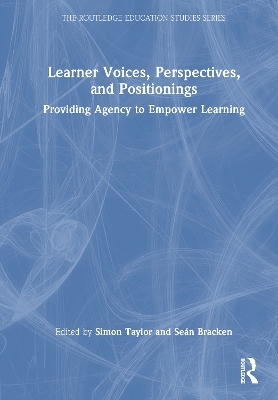
Learner Voices, Perspectives, and Positionings
Routledge (Verlag)
978-1-032-52372-9 (ISBN)
The chapters delve into critical themes such as the influence of teachers' beliefs on student learning, the impact of polarisation in our current educational discourse and the historical voices of children in Victorian schools. Notable case studies include a narrative approach to understanding higher education students' experiences and the examination of learner voice within prison education. The book also addresses pressing issues such as the representation of marginalised voices and the importance of inclusive practices in school leadership and curriculum design. Groundbreaking content includes discussions on "epistemic violence", highlighting the need for a more nuanced, considered and critically aware approach to learner representation.
This important collection will be essential reading for educational studies students and trainee teachers, as well as educators working in further or higher education. It provides practical insights and theoretical frameworks that constitute a roadmap for strengthening diverse learners’ voice and agency, thereby advancing educational equity and inclusion for all.
Simon Taylor is Senior Lecturer and Course Leader at the University of Worcester. He specialises in creativity and cultural education, collaborative research and partnerships. His most recent publication is entitled Creativity in the Early Years: Engaging Children Aged 0–5. Seán Bracken is Doctoral Programme Lead for the College of Education Culture and Society at the University of Worcester and an Adjunct Professor at Curtin University Australia. He is co-founder of the International Collaboratory for Leadership in Universally Designed Education (INCLUDE) and coordinates the Inclusion by Design research group at the University of Worcester (UW).
Preface by Series Editor
Foreword
Chapter 1: Education’s purpose: Conceptions of teaching, conceptions of learning, and learner voice.
Chapter 2: Why don’t they teach education at school? Listening to learners’ voices and resisting polarisation to restore education as common ground throughout our lifetimes
Chapter 3: Finding the voice of children past: how do we do it and what does it tell us?
Chapter 4: Beyond the survey metrics: A narrative approach to higher education student voice.
Chapter 5: Transitions in Education-the importance of learner voice and identity
Chapter 6: Advocating for the learner and their diverse needs
Chapter 7: Examining how academic self-concept and agency shape SEND learner identity across the educational lifespan.
Chapter 8: Epistemic injustice and the silencing of student voices
Chapter 9: From Voice and systemic action: Addressing Race and Racism in a Teacher Education Programme
Chapter 10: Learner voice and the placement experience: Engineering a map of prison-education interactions
Chapter 11: Global voices: Empowering students for world-class education
Chapter 12: Empowering Disabled Learners’ Voices and Agency through Universal Design for Learning.
Chapter 13: The role of learner voice in producing powerful and sustainable educational change
| Erscheinungsdatum | 16.05.2025 |
|---|---|
| Reihe/Serie | The Routledge Education Studies Series |
| Zusatzinfo | 9 Tables, black and white; 10 Line drawings, black and white; 2 Halftones, black and white; 12 Illustrations, black and white |
| Verlagsort | London |
| Sprache | englisch |
| Maße | 174 x 246 mm |
| Gewicht | 500 g |
| Themenwelt | Sozialwissenschaften ► Pädagogik ► Allgemeines / Lexika |
| Sozialwissenschaften ► Pädagogik ► Bildungstheorie | |
| ISBN-10 | 1-032-52372-7 / 1032523727 |
| ISBN-13 | 978-1-032-52372-9 / 9781032523729 |
| Zustand | Neuware |
| Informationen gemäß Produktsicherheitsverordnung (GPSR) | |
| Haben Sie eine Frage zum Produkt? |
aus dem Bereich